



The Use of the Stick in Police Dog Training: Sport Trainers vs. Service Dog Trainers


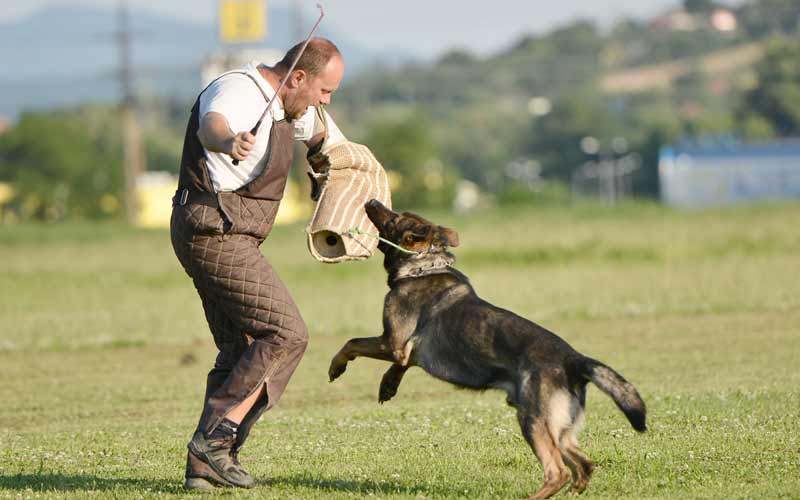
I have recently become involved in an ongoing discussion concerning the use of the stick in police dog training. I was not aware of the fact that there was so much confusion on this subject.
The confusion stems from sport dog trainers applying their use of the stick to police service dog training. Many undereducated sport trainers like to expound on the reasons why "their stick work" is the wrong type of training for police service dogs. In effect they are right, but for the wrong reasons.
To fully understand this issue, a trainer needs to know how and why the stick is used in sport training and then how and why it is used in service dog training.
Sport dog trainers use stick hits during a trial to stress the dog and thereby test his nerves. In sport training, the stick is often used to "clean the dog up" during the bark and hold exercises. The helper simply hits the dog (usually across the front legs or right between the ears) when it takes inappropriate bites on a standing still helper. The purpose for these hits is to teach the dog that he will be hurt if he does not bark at the helper when the helper is standing still. These stick hits are viewed as "helper corrections."
Remember that in sport dog training, the majority of the dogs view the helper as their prey. The dogs approach the bark and hold exercise as a "baiting game." In other words, they look at the bark and hold as a challenge to the helper to move. If they bark hard enough or long enough, the helper is going to be flushed into an escape. When that happens the dog will chase the prey (helper) and bite.
Sport trainers incorrectly feel that there is no place in police dog training where the helper should be correcting the dog. They say that the dog should never feel that he is being corrected by a suspect. Most sport trainers therefore feel that all corrections should come from the handler.
On the surface this would seem to be a logical position to take, but in reality it's very bad advise that is often given to new inexperienced undereducated police canine handlers.
To understand the reasons why this is the case, one must begin by understanding how the dog must view the helper in police work. The helper is not prey, he is a "fighting partner."
There is a clear distinction here. A fighting partner can hurt you and must be taken very seriously. A fighting partner is not going to bolt and run like prey, he is going to stand and fight. So the bark and hold of a service dog is not and should not be approached with a "baiting mentality."
The police dog should approach the helper in defense or fight drive and not prey drive. The dog should not sit directly in front of the helper in a sport style of a bark and hold. He should stand back out of harms way and bark with the intention of notifying his partner (the handler) that he has found the suspect.
So the picture of a service dog approaching a helper (or suspect) is one of forwardness but balanced with caution. The dog will bark with a deep throated challenge but still may have the hair up on his back a little because he knows that he may be going into battle. Even though he has confidence in his ability to beat the suspect in a fight, he has an Adrenaline rush because he knows this is serious work.
This is the difference between the two styles of bark and hold.
Now to the question of a service dog being hit with a stick. I approach this matter by offering a question. What will happen to an improperly trained dog when he is sent after a suspect that is prepared to fight the dog even though he is being bit? I often wonder what these sport dogs (or improperly trained service dog) think when they realize that this guy is not a helper, he is really pissed and he is fighting seriously. I wonder what goes through the dogs mind when they get hurt for the first time in a real fight?
In my opinion, this is not the time or place to find out that a dog does not have the fight drive to carry himself through this kind of situation. It is not fair for the dog or the handler.
Now to the training. If every police dog went through good foundational defense training at a young age (18 to 30 months) there would not have to be a lot of stick work done on these dogs. Unfortunately most dogs that end up on police departments are sport dogs that have some type of training problems. This is based on the price departments are willing to pay. The dogs without training problems are sold for more money to sport people.
Remembering that the goal of this training are to:
- Change the view of the helper to a fighting partner
- Cause the dog to approach a suspect in defense or fight drive and not prey drive.
Attaining these goals can be done with a variety of tools. It can be done with a prong collar and long line, an electric shock collar (topic of a entire article). It can be done by the helper putting the boots to the dog or it can be done with the stick. All of these tools are designed to put stress on the dog in training and none of these tools are recommended for an inexperienced handlers or helpers.
The prong collar and electric collar require handler coordination and a great deal of experience with electricity. By using the stick an experienced helper can eliminate the inexperienced handler and deal with the dog himself. It's also easier to train a new helper to properly use a stick than to properly use an electric shock collar.
When a sport dog is ready for this work he is sent into the helper. The helper is not looking for a typical prey bark and hold. He is looking for a drive change from prey to defense so initially we know this is not going to happen with sport dogs, so the dog is hit with the stick before he even has a chance to bark.
Initially this causes confusion in the dog. Some go right in for a bite, others may back off in confusion. Those that go in for the bite are going to be hit until they release and back off. Here is where sport people get lost. They think the dog is being "cleaned up", when in fact he is learning that the helper can fight and hurt him.
When the dog backs off and barks in a defensive posture he is rewarded with a bite. So the key to this training is to reward a drive change and not a mechanical bark bark bark.
With some dogs, the initial stage of this work results in the complete elimination of prey drive. The dog's drives actually go down and the grip gets weak. This is to be expected. Until the dog learns how to defeat the new stronger tougher helper, many dogs go through this stage of drive loss.
When this happens the training needs to focus on teaching the proper steps of defensive training. We need to develop the dog's fight drive in an appropriate step by step manner. So the point here is that when an experienced trainer applies this initial stick work, he is going to see right away where the holes are in the dogs earlier training. Once those holes are identified, the training program can be developed for those dogs that are genetically capable of accomplishing this work.
Remember, not all dogs have the genetic makeup for fight drive. My definition of fight drive is "A dog that carries the forwardness of prey with the intensity of defense. A dog that is confident of his ability to beat the helper under every circumstance, in every environment with or without training equipment."
Always remember, a police dog must learn how to work with confidence under stress. The police dog that does not view the helper or suspect as a fighting partner (that can hurt him) is going to fail much quicker than one that has had proper training in fight drive. The correct way to look at it is that a dog is not ready to work the street until it can function in "fight drive" (FD) and the stick is just one tool that can effectively add stress to training and help develop fight drive.
In one final closing note, it is important to understand that when comparing dog trainers as a group, sport trainers are much better over all dog trainers (as a group) than police K-9 Handlers (as a group). When a good sport dog trainer makes the effort to get the proper training in police work, he will make the best instructor. I was recently reminded of this by my visit to the Rotterdam Holland police dog school. This is one of the best police k-9 schools in the world. They have 4 civilian trainers as instructors for the school. All are either KNPV competitors or KNPV Judges and competitors. When I questioned Jan de Bruin about this he smiled and asked me who the better dog trainers were. He said his K-9 Officers were the best dog handlers he could find in the department. That did not mean they were the best dog trainers.
If you wish to learn more about this subject, see my video titled Bark and Hold Training for Police Service Dogs. This video details the work to convert sport dogs to service dogs in fight drive. If you are new to bite training or service dog training I recommend you view the first in my series of protection dog training videos, The First Steps of Bite Training.
If you would like to read more about the drives in protection training, refer to some of the articles I have written and posted to my website.


Most Popular Articles
-
01
-
02
-
03
-
04
-
05
Related Products
-
 $2.50
$2.50 -
 $38.25
 -
 $35.00 - $60.00
 -
 $86.75



0 Comments
Ask Cindy
Sorry, adding comments is currently disabled.