


Choose how you want to learn!


*To receive instant streaming access, you must be logged in with your Leerburg account during checkout.


Key Features
- 2 hours, 3 minutes long
- Released 2003
- Instructor: Ed Frawley
Product Description
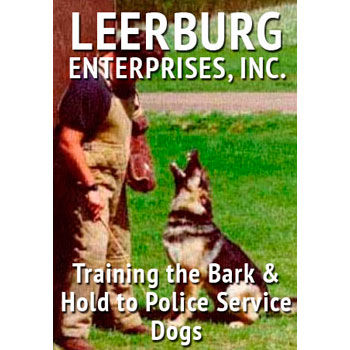
A recent e-mail that I received concerning this video made me realize that I needed to go into more detail on the content of this video. The person that e-mailed me was very concerned that novice sport trainers would watch this video and think that this is how to train a sport dog the bark and hold. That is not the purpose of this video.
So, I need to stress that this video is directed towards police service dogs, not sport dogs. A novice trainer needs to understand that there is a difference between a “police” bark and hold and a “sport” bark and hold.
The difference is that a police dog needs to view the helper as an adversary that can hurt him, for that reason the dog needs to stay 1 or 2 meters back away from the helper (when the helper is not trying to fight or flee). A sport dog is required to perform his bark and hold very close to the helper (not 6 feet back). The intended drive goal for both police and sport is to have a dog working in fight drive, but how these two bark & hold’s are trained is very different.
This tape is directed towards the real world where police departments or professional dog trainers contracted by police departments do not have years to finish the training on a dog before it goes out on the street. It is not uncommon to take a selection tested dog and finish him in 6 to 12 weeks (depending on the dog, the department and what is expected before the dog is allowed to work). For this reason the bark and hold training needs to be done quickly. The training methods in this video have that in mind.
There are a lot of working police dogs in this country that have no business being in the back of a patrol car. By this I mean that these dogs do not have the nerve or fight drive necessary to properly defend their handler when the time comes. The training in this video is designed to measure and test the dogs nerves and then build the fight drive. Some dogs that are exposed to this work will fail, it is my opinion that it is better that they fail during training than on the street.
The work in this video is not bite development, it is not prey work, it is advanced defensive work. If you have a question about what I am talking about here you need to refer to my training article on The Drives of Protection Training.
This video is intended to take the dog through the most critical part of its training. That is to convert it from a sport dog to a service dog. This tape will show how to change the dogs view of bite work from being a game (in the sport work) to becoming very serious business in police work, where it views the helper as a fighting partner.
If a handler needs to learn more about bite development they need to refer to my series on this subject: The First Steps of Bite Training and the other tapes that follow this tape. The fact is every handler needs to understand the steps of bite development so they know how to repair training problems that develop in every dog as it goes through training.
The person that sent the e-mail felt that we were to hard on the dogs and expected too much out of them. He said that too many dogs would not be able to stand the pressure of this training. My response was that "From my experience more than 50% of the patrol dogs I have seen in this country do not belong on the street." So, from that standpoint, he is right. Many of these dogs would fold under this work and most sport dogs would never stand the pressure.
In my opinion, a patrol dog needs to be a special dog. One with excellent drive and sound nerves. His job is to protect the canine officer and apprehend dangerous felony suspects. If a dog can not go through the fight drive training that is shown in this video, he does not belong on the street as a service dog. I feel that a good police K-9 training program should not only build the character and talent of a sound dog, it should also weed out those that are not fit to make the grade. It is far better to learn the weaknesses of a patrol dog in training rather than in a building when the officer is facing a suspect that is 50 lbs bigger than he is and in better shape.
Fight drive is an inherited characteristic. I define fight drive as "a dog that carries the forwardness of prey with the intensity of defense, its a dog that is prepared to fight under every circumstance in every environment with or without training equipment." It is not something that can be put in a dog. Fight drive is not defense. A dog becomes defensive when it is put in a situation where it is concerned for its safety. Dog's are not comfortable when they are working in defense. Fight drive on the other hand is based on self confidence. When a dog is working in fight drive he is confident of his ability to fight and dominate the suspect under every circumstance and in every environment.
In this video there is an extensive section dealing with fight drive training on young mature dogs and on older sport dogs that need to be converted to service work.
The thing that most surprises conventional trainers is the decoy work for this method of bark & hold training. It's easier and it makes a lot more sense than what most people are used to.
Dogs that work in fight drive rather than prey drive are a lot easier for the handlers to control. This video shows how to get a serious find and bark out of a genetically correct dog. The tape is a must for every canine handler. If you are a sport trainer who wants to convert a sport dog to a strong personal protection dog this is the tape to watch. I only caution sport people to make sure your dog has the maturity and the nerves for this work.
If you want to learn more about the drives of protection work, read some of the articles I have written. There are excellent articles on the drives in protection training, drive thresholds vs a dogs nerves, articles on prey, defense, and a lot more.


Have you used this product?
Your review helps others choose the right products for their dogs. Let them know what you think!
Write a Review


New Online Courses