



Aggressive Dogs and New Babies?


I get many emails from people who own dogs and are about to add a baby to their family. These people love their dogs but want to make sure that the dog learns to accept the presence of a new member to the family. They ask what issues need to be considered to keep their new baby safe.
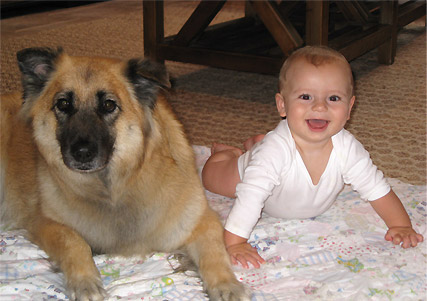
Many dogs learn to live with babies, but some cannot. This article will give you a few ideas to think about with your dog and your new baby.
Before we get into steps to take to be sure your baby remains safe, I need to point out a few facts:
- On average, in America, there are 1,200 to 2,000 children killed by their parents every year. Over the past 16 years, fatal attacks from dogs have averaged between 15 and 18 per year.
- Only about 25 children (between birth and 11 months) were killed by dogs in this country from 1979 to 1988. (Voith, 1984)
- It is felt that most children are killed by dogs because of predatory issues and not rank drive or pack issues. The more dogs in a family, the higher their predatory behavior.
- Most dogs that kill children have not exhibited prior aggression tendencies. (Pinckney and Kennedy, 1982).
- Most attacks on children are against older boys.
- Between 1989 and 1994, there were 109 dog-related fatalities in America, 57% of them were children under 10 years of age. (Sacks and Coworkers 1996b)
So with this said, there is about 100 times more chance of a child being killed by a parent or relative rather than a dog. The unfortunate fact is that the news media sensationalizes the death of a child as a result of a pet attack. These same people call for additional laws on breed bans and additional laws controlling our pets.
If a dog has never been around babies before, they may not look at a baby as a human. To ensure the baby's safety, owners need to step back and take a look at their dog's temperament. They must ask some questions:
- Has the dog ever been aggressive to strangers?
- Has the dog ever been aggressive to strange children?
- Has the dog ever been aggressive to smaller animals?
If the answer to any of these questions is “yes,” then you need to be very careful with this dog around a new baby. If the answer to one of these questions is “yes,” this does not mean that this dog cannot learn to accept a baby. It simply means that you need to be very careful and not make any mistakes.
I like to tell people that dog training is not rocket science. Training a dog is pretty much common sense.
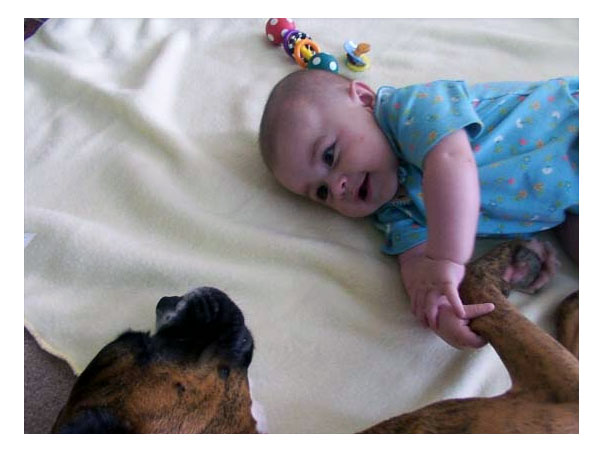
Here are the things to consider when a new baby is going to come into a home:
-
Make sure the dog is fully obedience trained. If you have questions on this, you should refer to my training video titled Basic Dog Obedience. The dog should be trained well enough that you can tell it to go lay down on his rug, or in his crate. This means that the dog will go and stay there.
I believe that this kind of training should be done motivationally. In other words, teach the dog to do it for a food or a toy reward. But once the dog understands the command, it needs to be reinforced with a prong collar correction if the dog does not mind. I call prong collars “power steering on dogs.” They allow small people to control good-sized dogs.
- Get a dog crate and crate train the dog. The crate should NEVER be in the bedroom. If the dog becomes overly excited when the baby cries, it can be put in the crate. Give it a bone or a rubber Kong with a little cream cheese or peanut butter in middle to keep him interested and busy.
- Never allow the dog in the baby's bedroom, not even when you are present. The bedrooms (including your own) should always be off-limits. This is especially true of the baby's room.
- The dog should NEVER be allowed to be near the baby when it is not being supervised, not even for one minute.
- Once the baby is born, they will bring a blanket with the baby scent home (or a dirty baby diaper) to wrap a doll in. When this is laid on the floor the dog is corrected for going near it. It cannot even go and smell it.
-
When you bring the baby home, it is a good idea to have it be a nice quiet introduction. Mom should first meet the dog without the baby.
Homecoming should not be a loud party. When the baby is brought in, the dog should be placed in a “down-stay” position several feet from where mom and baby are sitting.
- The dog IS NOT ALLOWED to smell the baby. Dogs have an excellent sense of smell. There is no reason to allow the dog to come up and smell the baby as soon as it gets home from the hospital. The dog can smell the baby from across the room without any problem.
- If there is any concern about the obedience and control of the dog at any time the baby is present, it should either be on-leash or in a dog crate.
- Get the dog a selection of new dog toys before the baby comes home. Some people will keep the toys available in a basket in the living room. Others prefer to allow the dog to know that there are new toys but they control when the dog gets access to them. They don't get bored with the toys.
People ask, “When can their dog be allowed to come up and smell or lick the baby?” I cannot and would not answer this question.
Allowing a dog to lick a baby is a dangerous thing to do. Although this is usually a sign of acceptance and submission, one never knows exactly what the dog has been licking just before licking the baby.
I also just saw an ad on TV where a dog was drinking from the toilet when the owner came home from work. Then the dog runs down and gives the owner a big lick on the lips. Have you ever watched a dog lick its own butt? Pretty disgusting.
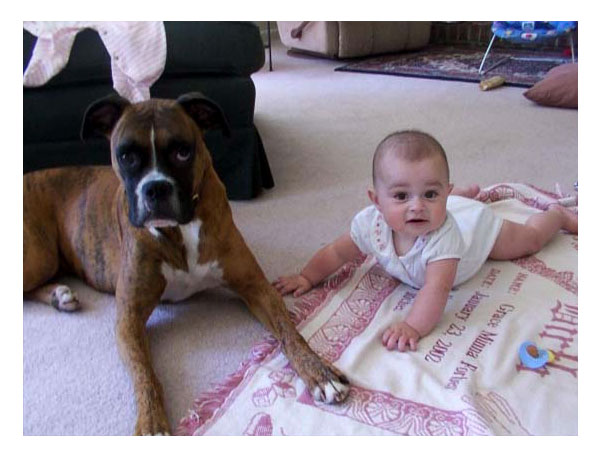
For those pet owners who feel their dog cannot accept a baby or may be too dangerous around the baby, there is always a dog crate and or an outside dog kennel. I have owned a lot of dogs in my life that I would never allow around babies. I recognized the problems with these dogs and just never let them near my boys.
On the other hand, I have had many dogs who indeed were part of my family.
So the bottom line is that introducing a dog to a new baby revolves around common sense and being a responsible pet owner.
When a Dog is Uncomfortable
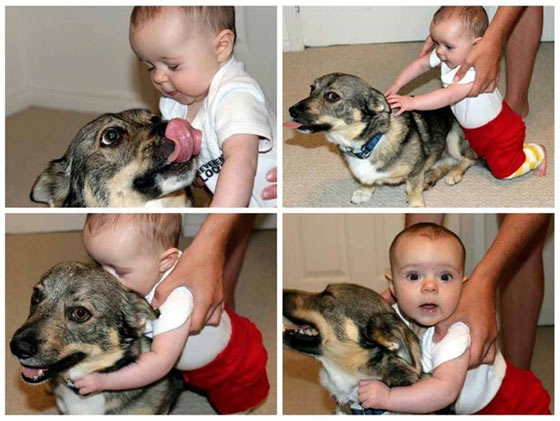
I wanted to share a picture with you showing classic calming signals that a dog gives when he is NOT comfortable. Please note all four signs in these pictures indicating that the dog is NOT enjoying this situation:
- Licking the lips
- Showing the whites of his eyes
- Panting when not overheated
- Turning his head away
Preparing Your Dog for a Baby
Bringing home a new baby doesn’t mean your dog has to take a back seat—it means it’s time to help them become part of the transition. This course is your step-by-step guide to preparing your dog for life with a newborn, created by professionals who understand both canine behavior and the unique demands of new parenthood.
You'll Learn:
- Exactly how to prepare your dog before the baby arrives
- How to safely take your dog on stroller walks
- Managing door greetings and jumping behavior
- How to keep both dog and baby safe during car rides
- The biggest myth about introducing your baby to your dog
Raising a Puppy with Kids in the House
A Real-Life Puppy Training Course for Real-Life Families
Finally—a puppy training course that understands your life isn’t quiet, controlled, or predictable! Created by a professional dog trainer, mother of two, and breeder of Chocolate Labs, this course is designed specifically for families with young children who are adding a puppy to their already energetic household. Forget picture-perfect training setups. This course meets you in the middle of the chaos, with practical lessons you can actually use—starting the moment your puppy comes home.
You'll Learn:
- Safely introducing your new puppy to household dogs and children
- Puppy-proofing your home and setting crate rules
- Socializing your puppy in the city, at parks, and in restaurants
- Navigating dog parks, elevators, stairs, and even biking adventures
- Crate training basics and setting your puppy up for lifelong success
Whether you're navigating your toddler’s toy explosions or trying to walk your puppy through a busy city block, this course offers relatable, real-world solutions. It’s fun, practical, and perfect for getting the whole family involved in raising a well-rounded, confident dog.


Most Popular Articles
-
01
-
02
-
03
-
04
-
05
Related Products
-

$65.00$39.99 -

$45.00$39.99




Ask Leerburg.