



Can I Train My Own Dog in Bite Work?


Understanding the Drives of Protection Training
I have studied the art of protection training dogs since 1974. I have bred over 350 litters of protection dogs and produced over 120 dog training videos, many of them on protection dog training.
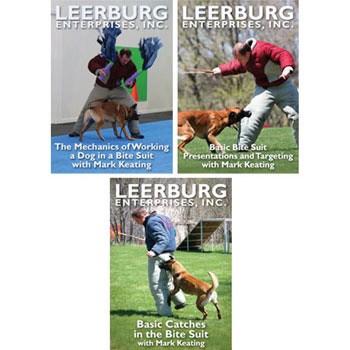
When asked, “Where do I start training a protection dog?”, I recommend these two videos:
Protection training, when it is done properly, is one of the most demanding and difficult dog training tasks out there. Most dogs can learn obedience, scent work, or agility. But few dogs can be trained in handler protection.
I often hear people say “My dog has not been trained in protection but I know that if someone came after me, he would protect me.” In 99% of the cases, this is wishful thinking. In fact, most dogs, when threatened, will show avoidance and run away, leaving their handler to fend for themselves.
The reason for this is based on the temperament of the dog. In its simplest sense, bite training is founded on the ability of a dog to deal with stress. A good protection dog is taught from a young age to act in an appropriate way when threatened. He is taught that to show avoidance and that running away does not solve his problem.
To be successful in this training, handlers need to have a thorough understanding of the drives that govern a dog's temperament in protection work.
The Drives of Protection Training
These drives are:
- Prey drive
- Defensive Drive
- Fight Drive
- Avoidance
If your goal is to learn how to train a dog in protection work, your job begins by understanding these drives and how they relate to each other. If a trainer does not fully understand drive development, he may as well not even start this work because he is never going to accomplish anything in protection training.
If you are new to this sport, you need to listen to what I am about to say about drives and then either watch my video on the subject (The First Steps of Bite Work) or go to an experienced trainer and learn from them. Every time you watch a dog doing bite work, you should be thinking "What drive is this dog in and why?"
If you can watch an experienced helper work with a dog, you need to be thinking "What drive does the helper have the dog in?". When he switches drives, you need to try and recognize when that happens and why.
In my video, I will define and demonstrate drives by showing you dogs that have good drives and dogs that lack drive. I want the viewer to recognize when a dog has the potential for protection work. Probably just as important, I want them to understand when a dog has not inherited the necessary drive and therefore cannot be trained in protection work.
Right from the beginning, everyone needs to understand that dogs must inherit the drives for protection work. It is a genetic factor and neither a factor of training nor a factor of breed. In other words, if a dog does not have the genes for protection work, then you are not going to be able to train the drives into the dog. Just because a dog is a German Shepherd does not mean that it can be trained in bite work. That would be like saying that just because I have a horse, I think it can run in the Kentucky Derby.
The first part of the video deals with defining the drives a dog uses in protection work. We then go into the training steps for the dog, the handler, and the helper. To be effective in protection training, the handler and helper must work as a team.
Prey Drive
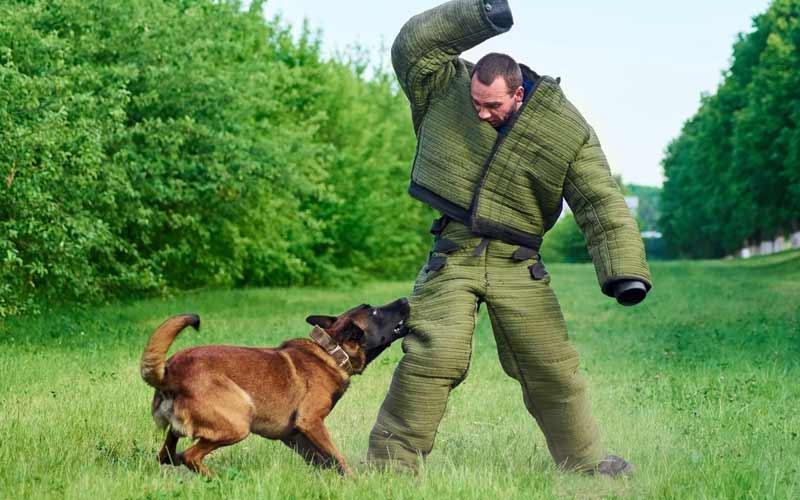
The prey drive is the easiest drive to see and understand in our dogs. It can be recognized in a puppy as early as 6 weeks of age. Prey drive is the desire to chase a moving object, and to grab it and shake it once it's caught. Puppies exhibit prey drive when they chase a ball or play tug of war with your pant leg or sleeve. Hunting dogs that retrieve a dummy are also demonstrating prey drive.
When you see a dog chasing a rabbit, a cat, or a Frisbee, you are watching that dog's prey drive in action. In Schutzhund or protection training, when a dog grabs a sack as the helper runs by, it is working in prey drive. When an older dog chases a helper off-leash in an escape bite or a runaway bite downfield, that dog is also working in prey drive.
When a dog is worked in prey, it does not feel threatened. Prey work is a comfortable drive for a dog to be in. Dogs look at prey work as a game. For them, it's a game of tug of war. They don't feel stressed when they play tug of war.
Think of a Labrador chasing a ball. It doesn't feel threatened as it chases after its ball. When a dog is biting 100% in prey, it too doesn't feel threatened. The dog's body posture during prey drive is alert, with its tail up or wagging, (this is probably the easiest thing for new trainers to spot), there is no hair up on the dog's back while biting in prey, and it is not growling or showing its teeth. The prey bark is a higher-pitched insistent bark. A dog when barking in prey does not sound or look nervous or stressed.
During bite training, we use prey drive in two ways:
- We use the dog's prey drive to teach it the mechanics of biting and fighting. In other words, we use the early prey work to teach it to identify the sack, tube, and sleeve as prey items. The dog is taught that when it sees its owner or a helper with a sack or sleeve, he is about to play tug of war and the item to bite is the sack. During this work, we teach the dog to begin to bark for his bite. We teach it that it must have a firm grip or it will lose its prey item, and we teach it that when the sleeve is slipped or dropped by the helper, the dog must carry and hold the prey item. We will go into the reasons for all this in the training steps of this video.
- More importantly, when a dog matures, we use the comfort level of working prey drive to calm the dog and relieve the stress that builds in defense training. We are going to discuss defense later in this video and will go into more detail on it at that time.
In our training, the prey bite becomes a comfort zone for the dog. It's a place in the work where the dog can calm down without stopping the work. By teaching the dog to move into its prey drive when we want it to, it learns to relax after a particularly stressful training session.
One thing to remember about prey drive is that it is extinguished or is diminished as the dog gets tired. In other words, an exhausted dog does not have much interest in playing tug. This will come into play during our training.
The difficult thing for new trainers to grasp is the fact that as training progresses and a dog gains experience, the picture of a dog working in prey drive will change.
When an uneducated person sees a dog being trained in prey, he would think that this dog is out there actually trying to kill the helper, when in fact, the dog is just playing a rough game of tug with the helper or handler.
Before we move on, let's take one more look at several stages of prey drive. Each dog we see will be doing something different, but all are working in prey. If you are new to bite training, this may seem complicated but hopefully, we will help clear up the confusion as the video progresses.
In the police DPO trials, the helper does an escape and the dog chases him down and apprehends him in prey drive.
Schutzhund is currently going through a series of rule changes concerning the courage test, but the old courage tests started with the helper running away from the dog. When the dog was sent after the helper, the dog was functioning in prey drive.
While all of the dogs we just watched were working in prey, their level of prey, the intensity of the prey work, and the way their prey drive was interacting with the other drives produced different pictures.
Defensive Drive
For a dog to do police service work, serious personal protection work, or good Schutzhund work, it must have a solid defensive drive.
A dog's defensive drive is the drive to protect itself from a perceived threat. When a young dog is working in its defensive drive, it is not in a comfortable situation. The dog thinks that it's in a position where it is being threatened or attacked and as a result, it is stressed. For our training, we want a dog, that even though it is unsure of its position, it will initially react to a limited amount of threat with an aggressive challenge.
This willingness to defend himself is an inherited characteristic. It cannot be trained into the dog no matter how hard you try. If a dog has not inherited the defensive gene, there is no way we are going to make this dog a protection dog. A few good examples of this are most labs, golden retrievers, huskies, or other such breeds. These dogs just don't carry the gene for protection work. The most that can be expected from these dogs is that they will bark at strangers. But when threatened, they will go into avoidance and run.
Even though a dog may inherit the defensive gene, a dog's defensive drive does not start to appear until it reaches puberty. For some dogs, this can be 1 year of age. Defense does not fully develop until a dog reaches mental maturity, this can be as late as 3 years of age, depending on the bloodline.
The picture we see of an untrained dog in defense is a different picture than what we have seen in prey work. Initially, defense is a picture of insecurity. That dog's bark will be deeper and more serious. The hair may be up on his back and he will be showing a lot more teeth in the form of a snarl.
The hair up is a natural reaction to make himself look bigger and more serious. This is a common reaction for animals; we see it with Australian lizards, they have a flap of skin on their neck that flares up to make themselves look more ferocious. Hopefully, this will scare predators away. The defensive bark is a deeper guttural bark. Once you identify it, there is a definite difference in the prey bark and the defensive bark.
In defense, dogs will often carry their tail differently than in prey. The tail will not be wagging as much and will be carried lower than in prey.
A defensive bite is also different than a prey bite. It is done with the front part of the mouth. Often dogs will grip with a full mouth in prey and then only with the front of the mouth in defense. When you hear trainers say that the grip is weakened in defense, they mean the dog is only biting with his front canines and is often chewing on the sleeve.
New trainers should think of the tail and the grip or bite as a temperament barometer. When the dog's tail is up high and wagging, the dog is comfortable with what is going on. As more pressure is added, the tail will wag less, it will come down and the grip will get weaker. If the pressure continues and the dog approaches avoidance, (which is the point where it will run away), the tail will be tucked between his legs.
The safest time to put a dog into defense is after it has reached mental maturity and after it has gone through the foundation work in prey drive.
The defensive drive can begin to show as young as 4 or 5 months of age in the form of barking at strange circumstances. It does not develop to the full extent until the dog is 18 to 24 months old and with some dogs, not until they are 3 years old.
Experienced helpers can begin to introduce a young dog to defense when it reaches puberty. This is usually around 11 to 14 months. New trainers that make the mistake of introducing defense before a dog is mentally mature enough to deal with the pressure are making the biggest mistake of their training career. Pushing a dog into defense before it is mentally mature enough to deal with the stress is the quickest way in the world to end a dog's protection career.
If you have learned anything from this video so far, make sure it's this: BE VERY, VERY, CAREFUL OF DEFENSE ON YOUNG DOGS.
Some dogs have excellent prey drive but lack defense. A common example is the black lab that loves to chase balls but could never be trained in protection because it lacks defense.
Unlike prey drive, the defense does not diminish as the dog gets tired. Another way to look at it is that no matter how tired your dog is, it is still going to react to someone that is threatening him.
American bloodline German Shepherds often have some degree of prey drive, but 99.9% of them have little to no defensive drive. That's why they cannot do Schutzhund work, much less police service work.
Working defensive drive takes a skilled helper that is adept at reading and understanding temperament and knowing exactly how far a dog can be pressured or threatened in defense before it is pushed into avoidance.
Fight Drive
As we progress through training, the dog's view of the helper changes. Initially, in prey work, the helper is a friend that plays tug or a person that is always trying to steal the prey. Then in defensive training, the dog's view of the helper changes to a person that brings stress to his life. The helper now threatens him and is someone to be suspicious of.
As the defensive training progresses, the dog's confidence level increases (if he is genetically capable). He is taught how to defeat the helper in every circumstance. These many experiences slowly change the dog's view of the helper. He begins to see the helper as a fighting partner, as someone to get mad at, and not someone to be nervous about. When this begins to happen, we say that the dog is developing fight drive.
We define fight drive as the interaction of prey and defense where the dog carries the forwardness of prey with the intensity of defense.
The image of a dog working in fight drive is an adult dog with a great deal of self-confidence in all environments and every circumstance. It's a dog that does not look or act insecure during his protection work. The level of intensity during bite work is very high. The dog will display a tenacity towards fighting that is not seen in younger, immature dogs.
The only way that a dog can gain fight drive is through experience and training. They don't just wake up one morning when they are 3 years old and have fight drive. Dogs need to go through a sound foundation of prey drive development and then, at the correct time, they must be introduced to a step-by-step defensive training program. It is important to understand that only dogs with good genetics and proper training will develop fight drive.
An interesting fact is that dogs with strong prey drive develop the best fight drive We also see dogs with dominant temperaments develop fight drive.
When you hear people talk about fight drive being defense, they are not exactly correct. The difference in the two drives is the way in which the dog views the helper and the comfort level of the dog during the work.
Remember this distinction: A dog with fight drive views the helper as a fighting partner. When he sees the helper, he gets mad, he wants to take the fight to the helper. New trainers are going to have a difficult time differentiating between a dog that barks in prey versus a dog that barks with the intensity of defense and a dog that is barking in fight drive. Don't worry, this is only normal. Every new trainer goes through this confusion. It took me a long time to get this clear in my head. As you gain experience, your skill at recognizing these drives will improve.
Avoidance
Avoidance is most commonly used in obedience training. It is a drive we do not want to bring into protection training.
When the stress level becomes too high for the nerves of a particular dog, it will turn and retreat. When that happens, the dog is in avoidance. Some people think of avoidance as a drive. I prefer to think of it as a form of defense. It is defense in the extreme. After all, isn't the safest defense an effective retreat?
Once a dog is put in full avoidance, it instantly learns that this is an easy way to deal with pressure. It can take months to bring a dog back to the point you were at just before he broke and ran.
When we talk about avoidance, we also need to talk about being hesitant. There is a difference. Being hesitant is when a dog takes a step back to evaluate what's going on when he is stressed. This usually happens with young dogs that are raised to a new level of stress. Being hesitant is not bad. In fact, it is actually good. When the dog overcomes his hesitation and learns how to deal with the new situation, it becomes a stronger, more confident dog.
A dog in avoidance will tuck its tail between its legs, lay its ears back, get its hair up on his back and run. A dog that is unsure will not have its tail between its legs. It may come down a little but it will not be tucked. He may look a little confused but he will not look afraid. There is a difference here.
Trainers need to develop the skill to recognize the difference between being hesitant and avoidance. During later stages of training, we will intentionally put a dog in this unsure area and make him learn how to fight his way out of it.
Can I Train My Own Dog In Bite Work?
I am often asked by new trainers if they can protection train their young dogs. I have a little story that I use to answer this question.
If you have a son and want to teach him to fight, you send him to karate classes. These classes are all prey drive work where he learns the technique of fighting. He can compete in a karate competition and get the devil kicked out of him and this is still prey drive work because it's a game. Granted a serious game, but still a game. You can assist your son in his training to this point by helping him learn the basic skills of fighting and coaching him through the work. The same is true with your dog. You can assist him in learning the basic prey skills. You can even let him practice the basic ones on you.
If your son goes downtown on a Friday night and gets into a knife fight where he is fighting for his life, he is then doing defensive work. While a handler can train his own dog in prey work, he can never put his dog in the position where the dog feels like his owner or handler is trying to kill him. Just as you would never put your son in a position where he felt you were trying to hurt or kill him. The same follows with your dog.
The owner can take his dog through the prey drive training to the point where the dog has learned many of the moves (or skills) he needs to do bite work. In fact, if the trainer's neighbor would come over someday and see the dog biting the sleeve on the handler's arm, even though it was in prey, the neighbor would think that the dog was attacking his handler, when in fact the dog is just playing an advanced game of tug of war with his handler.
When the handler needs to be worked in defense, he is going to have to find an experienced helper to work his dog. There is no way around this. We will give you some ideas in our video on how to do a limited amount of defense work without a skilled helper, but the reality is that there is only so much that can be done before you need someone with experience. I will say this: For personal protection work, if all the foundation work is done properly, the amount of additional help that is required is much less.
If you find this information interesting, you need to read my article on Drive Interaction and Drive Thresholds. You should also consider my video titled The First Steps of Bite Training. This video was released in August 1996 but still has several concepts that are useful even today. You will get as much information as I can give in 2 hours. It took me 24 years of experience in training and studying protection dogs to produce this video. The DVD takes you through a step-by-step training program and explains it in a way that someone with no experience with dogs can understand.


Most Popular Articles
-
01
-
02
-
03
-
04
-
05
Related Products
-

$65.00$60.45 -
$195.00$165.00


Ask Leerburg.