



Ed Frawley's Philosophy of Dog Training


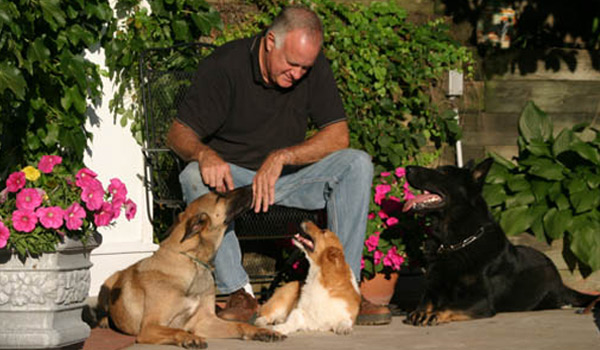
My philosophy of how to train dogs has been a journey that began when I was a boy in the 1950s and continues to this day. I get as excited today as I did 45 or 50 years ago when I learn something new about training my dogs.
For me, this journey began as a hobby and has evolved into a life's passion and work. It will end on the day I die.
There is nothing secretive or magical about training dogs. Good dog training is all common sense combined with a foundation based on experience and a clear understanding of the way dogs think and interact (pack structure). The key is to get the right experience.
One only needs to spend a couple of hours searching the internet to understand that there are a lot of people out there who lack experience or who are basing their training opinions on poorly acquired experience.
Dog training does not necessarily have to begin when you buy an 8-week-old puppy (although it should) or when your 10-year-old dog bites a child. In reality, it begins on the day you make up your mind to learn how dogs think and how they relate to the world they live in. It begins when you decide to relate to your dog in a manner that both you and your dog respect and understand. It begins when you make up your mind to develop a meaningful relationship based on trust, communication, and control.
Although my family had owned dogs my entire life, I made this decision to really try and understand dogs when I was in high school. I was 16 years old and it was the 1960s. I owned a rescue dog named King and thought he was the cat's meow.
We took 2 or 3 walks in the woods every day. He was my best friend. I had him trained to hand signals and verbal commands. One morning, before school, we came out of the woods and King chased a cat into the road. He would not respond to my calls to stop and COME. He ran in front of an Austin Martin sports car and was killed. To this day, I can close my eyes and replay that event in slow motion.
That one incident forever changed the way I looked at dog training. It caused me to step back and make up my mind that the next time, I would learn how to communicate in a way that my dog would listen in every scenario and not just in the ones he felt like.
I wrote this article with that thought in mind. I hope it may help other dog owners develop a new approach to how they train their dogs. I hope in some small way, it makes you change your own philosophy of how to train your dog.
There are 3 basic categories of dog trainers which I place on a sliding scale.
All-Positive Trainers
The first category on the left is the group of people who beg or bribe and lure their dogs to do something by offering a food or toy reward. Don't get me wrong, I use food and toys in training, but I also use distractions and corrections. The people in this first category use neither.
All of the large pet food warehouses (i.e. PetSmart, Petco, etc.) sponsor this category of ineffective training because they feel it's politically correct.
The problem with this group is that the dogs often choose to not do what's asked because they don't think the reward is not high enough in value to them. These dogs end up being pushy, dominant, and often antisocial and aggressive animals. These are the dogs that are turned into animal shelters as being unmanageable when in fact, they act the way they do as a result of ineffective dog training.
Force/Compulsion Trainers
At the other end of the scale, on the right side, is the second category of dog trainers. These are trainers who intimidate or force their dogs to do what they want (the William Koehler trainers). I call them the old school "yank and crank" trainers.
They put a choke collar on a dog and force it to do everything. Most professional dog trainers use these methods because for them, "time is money" and they can get a dog trained much quicker by forcing the dog to perform. The bottom line is with enough force a dog can be trained to do almost anything.
The problem with yank and crank trainers is the dogs seldom like their handlers. In fact, softer dogs are often afraid of their handlers. These are the dogs that tuck their tails or lay on the ground when asked to do something. These are dogs that look nervous when they are near their owners. That's because they never know when the hammer is going to fall.
Balanced Trainers
The problem with both categories above is that their training produces inconsistent results along with dogs that don't like or respect their owners. You will never reach consistency in training if you don't have a good bond with your dog, or if your dog does not respect you as a pack leader.
The third category of dog training is where I strive to be. Category three dog trainers want to be in the middle of the other two categories. They balance in the middle but are always prepared to move one way or the other, depending on what's going on in their dog training at a given moment or point in time.
The third group uses motivational methods (food, toys, or praise) to take a dog through a learning phase. The most effective motivational method is called training with markers. This is where the dog actually learns the meaning of a command. For example, it learns the meaning of the word COME.
Once the dog understands the meaning of the command, the trainer then adds distractions to the program. A good example of this is a dog that has learned the meaning of the word DOWN but now must learn that DOWN means stay down until the handler gives a release command. This means the dog must stay down, even if the owner or someone else tosses a ball in front of the dog's feet or drops a hot dog 4 feet from where he is lying.
If a dog is disobedient under distraction or does not follow directions, this third category of dog trainers teaches a dog that there will be a correction for being disobedient. The key here is that corrections are never given unless the owner 100% knows the dog understands what is being asked of him but refuses to follow the command.
Dogs Are Pack Animals: They Can Love You But Not Respect You
New pet owners also fail to understand that dogs are pack animals. They have the same genetic driving force that wolves have to form and live in a "pack environment". Members of a pack seek a hierarchy within their family pack. Then genetically seek a ranking order.
Domestic dogs look at the family they live with as their family pack. If the humans don't become pack leaders, their dogs will step up and assume the role. That's how dogs become dominant.
The majority of behavioral problems develop as a result of poor pack structure in the dog's living environment. This is why I tell people that obedience training is only 25% of the solution to correct behavioral problems and 75% of the solution deals with establishing a sound family pack structure.
Your dog can love you and not respect you. You can NEVER love your dog into respecting you. People who anthropomorphize their dogs (treat them as human children) will find this out very quickly.
When referring to a canine relationship, love and respect are two unrelated emotions.
Respect is gained through hard work, education, and experience.
When my dog shows disrespect, I increase the pressure I put on the dog. This means I work the dog harder and control his free time until he shows me the respect that a pack leader must have. Pack leaders control the lives of pack members in fair, firm, and consistent ways.
How to Build Respect and Leadership
When asked how to build a bond, gain respect, and still maintain a leadership role with our dogs, the answer is that we must make sure the dog understands that we will always be fair with him. With that said, he has a responsibility to follow known directions and that if he refuses, there will be consequences.
Dogs see life in black and white terms. This means they see life in terms of "things that are good for them" and "things that are not good for them." They don't understand English and for the most part, they don't reason; they just react to the black parts of life and the white parts of life.
The vast majority of pet owners, I would say 99% of them, fail to understand that the driving force in a dog's life is its desire to do things that make them feel good. Dogs never do things to make "YOU" feel good, they do things that make them feel good. Once people truly understand and accept that principle, they are on their way to becoming a better leader and dog trainer.
Through the experience gained in training, we show the dog that we are only going to ask him to do things he knows how to do. When he does something correctly, we always do something good for him. Likewise, when he does something wrong, we will ALWAYS let him know he has made a mistake.
We never correct our dog in obedience training for things he doesn't understand or that he has not been trained to do. This supports the black and white rule. We don't correct him because "We think he knows better." We only correct him because we know, through experience gained in training, that he understands a command or rule and is refusing to do it.
The dog must learn that we are 100% consistent in how and when we administer corrections. Being consistent at all times is one of the most important parts of being a pack leader. For example, we can't ignore aggressive behavior towards guests in our home and then go for a walk and correct the dog when he wants to be aggressive.
I have trained protection dogs and police service dogs almost all my adult life. I started studying protection work in 1974. My dogs learn that the only time they are allowed to be aggressive is when I tell them it's OK or when I am attacked. Through my training, this becomes very clear to the dog. It is black and white for the dog.
If you study pack behavior or even herd behavior, you will see that rank issues in the pack are often dealt with very subtly. However, disrespect is dealt with very quickly and aggressively. The same thing needs to happen in a relationship with a dog.
For a correction to be effective, it must be administered within 1 ½ seconds of an infraction—not 5 minutes later or an hour after the dog peed on the floor. When I hear people say, "He knows he did something wrong while I was gone," I shake my head and feel sorry for that poor dog because that dog owner is clueless.
One of the most important parts of training is for the handler to learn to administer corrections at a level that produces harmony in the family pack. This means that the handler must learn when simply saying NO is enough of a correction to let the dog know that he is doing something wrong vs. learning when to administer a level 10 leash correction (e.g. when showing aggression to a child).
One of the most difficult things for new trainers to learn is when to administer a correction, what type of correction to administer, and how hard that correction should be.
New dog trainers need to remember that a dog learns through repetition. It often takes 30 repetitions for a dog to learn a new command. Trainers are often guilty of thinking their dog understands a command when in fact they have not repeated an exercise often enough for a dog to completely understand the true meaning of what you expect. This results in dog owners unjustly correcting for something the dog does not fully comprehend. When this happens, it breaks the "black and white rule" and destroys the relationship between the handler and dog.
Most Trainers Are Too Passive
Most new trainers are too passive. This is either a result of them having a soft personality or temperament or it's the result of the handler being exposed to ineffective and poor dog training techniques. We see this frequently in training classes that only focus on positive training methods while ignoring distractions and corrections. The dog training classes at PetSmart or Petco are the perfect example. What these companies call dog training classes are a sham.
People who train with clickers or markers and never correct a dog also fall into this category. Don't get me wrong, I love training with clickers and markers. I wrote an extensive article on training with markers and have produced several DVDs and courses that use the same methodology.
So-called instructors who claim that clicker training without corrections can solve all behavior problems are drop-dead wrong. They do the concept of marker training a disservice because when markers are combined with corrections, we have the most powerful tool available to train a dog.
The difference between what I do and what these ineffective obedience classes do is that once the dog has learned an exercise with markers, I add distractions. When the distraction becomes so high that it promotes disobedience, I introduce corrections into the training. This is the cornerstone of my philosophy on dog training. This is the only way to get consistency in training and anyone who tells you differently lacks the experience.
Professional Trainers - Should You Use Them?
On the other end of the scale, we find professional dog trainers who take a customer's dogs into their kennel for training. The vast majority of these trainers use far too much force. I have already said to a pro "time is money". These pros can force a dog into submission a lot quicker than they can take it through marker training.
Forty years ago, people trained dogs almost exclusively with force. Read the old William Kohler books. William Koehler is the model-T of the dog training world. I read them when I was 16 and thought they were the cat's ass. Since then, I have come to realize that Koehler was the master of yank and crank training.
In recent years, the pendulum has swung to the other end of the spectrum. Today, clickers and head halters with no corrections are the fad. Trainers try and REDIRECT a dog from aggressive behavioral problems. This approach only works in a very small percentage of dogs with extremely soft temperaments.
The result is an explosion of family pets with dominant and aggressive dog problems. Take a look at the emails I get from people who have been bitten by their dog. The vast majority of these bites happen because of a lack of pack structure and a lack of sound dog training.
Once again, the correct position is in the middle. The difference between a good trainer and a great trainer is that the great trainer will always maintain a balance point between motivation and correction.
Respect - Cooperate - Try
I tell people my dog should respect me, cooperate with me, and try to do what I ask. If I have that, then I can train the dog to do almost anything. For me this is not just "good behavior", it is "expected behavior." There is a huge difference between a dog that fails to follow directions despite trying and a dog that refuses to follow a command. That's a very important concept that a new trainer must work out in their head.
Many people own dogs that are disrespectful and behave badly. When these owners start to train their dogs and the dogs start to mind, the owners mistakenly think their dogs now respect them. These owners are often wrong.
Respect is earned. It develops over time and is the result of good leadership techniques. It's not uncommon for a dog to mind 80% of the time and still not respect its owner. When dogs like this are asked to do something they don't want to do, and the handler pushes the point to try and force the dog to mind, these dogs often become handler aggressive. Their owners find themselves scratching their heads wondering why and what went wrong. What went wrong was a lack of pack structure. A dog with solid pack structure is not going to be aggressive in the presence of its pack leader.
The opposite of this problem are people who ask rather than tell their dogs to do something. They act like they are begging their dog to mind. If you go to any beginner obedience training class, you will see this happen again and again. The sad thing is that this attitude in dog training not only produces inconsistent behavior, it can also produce a dangerous, aggressive dog.
When owners learn to apply responsible pack structure techniques and they master the concepts of a learning phase, a distraction phase, a correction phase along with a maintenance phase, they are on the road to being a pack leader.
Getting out and actually working with the dog will give people the experience needed to learn the levels of praise and correction that are required to get a dog to do what is wanted. Applying sound pack structure principles in your day to day lives will establish you and your family as higher-ranking members in your family pack.
Never forget that "most dogs prefer being followers." Most dogs don't want to be pack leaders. When a dog owner learns to control the lives of a pet, he will become the pack leader his dogs want him to be.
My Dog Training DVDs
I started producing dog training videos back around 1982 (I can't remember exactly when. It seems like I have done them forever).
When I initially got a video camera (1978), it was to film dog training seminars that I attended for myself so I could review the seminar. After a short while, people asked to buy copies of those seminars so I sold them. It did not take long to determine that most clinicians don't give well-organized seminars. They train the next dog to walk on the field and then talk about the training for that dog. They then go on to the next dog. There was little to no organization.
After a few years, I realized that I was a sponge for training ideas. So I started to take ideas I had collected and organized them into a training video on a specific subject. I get a lot of satisfaction in helping people learn how to train their dogs.
I am the first to admit that my early videos left a lot to be desired. I tried to put too much into a 2-hour video. I thought I was doing customers a favor when in fact, I was short-changing them because there was not enough time in a 2 hour VHS video to put a lot of details.
My first production was "Training a Competition Obedience Dog." I quickly learned that this was foolish. How can one put everything one needs to know about competition obedience into two hours? It's impossible. So I learned to break training exercises down into small parts that everyone can understand and then produce very specific training videos on very specific exercises. I hold nothing back and I believe that philosophy has been the backbone of my success in business. I laugh at so-called dog trainers who claim to sell the secrets of dog training. In my opinion, these are just scammers. There are no secrets to dog training.
New dog trainers have such an advantage over when I started. They have these DVDs and the internet to learn from. My website alone has over hundreds of articles. The DVDs and courses I have produced offer a wealth of information. I would have died to have had access to this 45 years ago.
When I decided to expand Leerburg into providing dog training equipment, I made the decision to approach equipment sales exactly like I approached training DVDs. That is to find the best products I could find in the world and only offer those quality products. I would never try and compete with Walmart or the massive pet store warehouses where quality takes a backseat to price points. The success of Leerburg has proven that there are people out there who value quality information and products and they are willing to pay for it.
About Me
If you want to learn details about my journey as a dog trainer, you can read my bio.


Most Popular Articles
-
01
-
02
-
03
-
04
-
05
Related Products
-

$65.00$29.99 -
 $15.40
 -
 $14.60 - $15.85



Ask Leerburg.