



Myths about on Becoming Your Puppy's Pack Leader


A guide to becoming your pup's leader and how we train our puppies
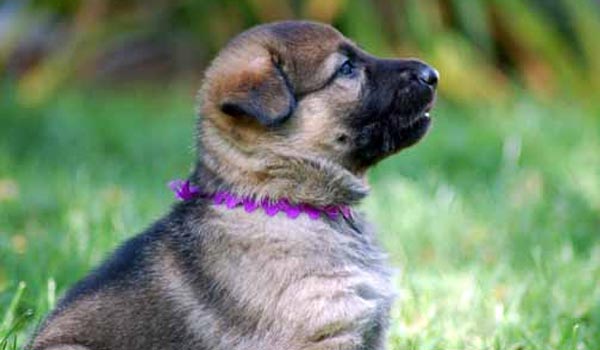
A year or two ago I wrote an article titled The Groundwork to Becoming a Pack Leader. This article has been well read but over time it has become obvious that I should have written two articles; one for adult dogs and one for puppies. This article will address the groundwork that should be done with puppies.
When people bring an 8-week-old puppy home their first concerns are "what should I feed my puppy?" and "how do I stop it from peeing on the floor?" These are important and credible concerns, but equally important and often ignored, is the concept of how to establish yourself as your new pup's pack leader.
The average dog owner does not have a clue about how strong the genes are that control their puppy's temperament, personality, and drives. Puppies that don't have a sold pack structure grow up to become dominant and obnoxious adult dogs.
This article will explain how we raise a new puppy in our home.
I have owned and trained dogs for 45 years, and bred over 350 litters of German Shepherds since 1978. Cindy has owned dogs her entire life and has done serious competition training since 1984. I only tell you these things so you can see that we have a lot of experience and expertise in this area. God knows there are enough people out there with little to no experience who will also offer you advice on this subject.
Pack Structure
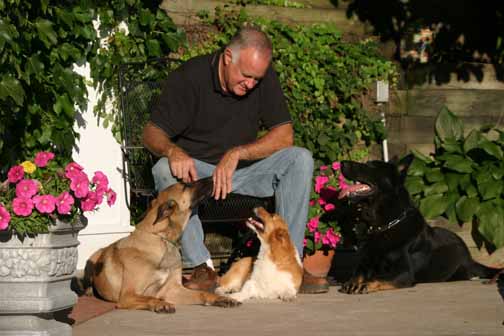
Dogs are pack animals, just like wolves are pack animals. They are predators. Horses and cows on the other hand, are herd animals. Being herd animals also makes them prey (food) for predators.
Predators live by one set of genetic rules, prey animals live by a different set of genetic rules.
Pack animals live in family packs which have a pack leader and lower ranking pack members. Dog packs, like wolf packs, are not a democracy.
A pack is organized in a hierarchy of rank. Simply put, this means that every member of the pack knows exactly what its rank is within the family pack.
Pack animals genetically understand this concept. This concept is the reason people have dog fights when they add a new dog to a home that already has dogs. Everyone has to re-establish the new pecking order when a new pack member comes on board.
The Beginning of Pack Structure
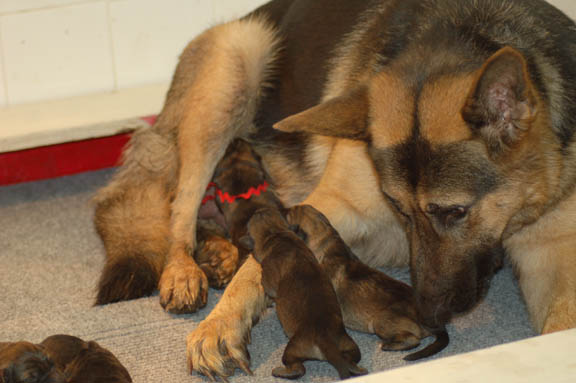
When a puppy is raised with littermates they begin to establish their family pack at about 4 ½ weeks of age. They start by playing with one another.
They bite and push each other around. Those pups that bite the hardest and push the most become the higher ranking pack members of the litter.
With that said, there is no question that the mother is the pack leader. A good mother will exert her leadership by warning puppies to stay away from her food bowl when she is eating. She protects her litter which demonstrates leadership and she also controls the litter in subtle ways that establish her as the pack leader.
What is a pack leader?
When people get puppies they need to establish themselves as the new pack leader. To do this correctly they should first understand exactly what a pack leader is.
Pack leaders are aloof, they are calm, and they are self confident. A pack leader is fair in how he lives with pack members. While the pack leader is a dictator, he is a fair dictator who enforces a well defined set of rules that members know, understand and are expected to live by.
What a pack leader is not, is a dictator who loses his temper, bullies pack members into compliance, and does not act in a fair manner in regard to the lives of pack members.
For example, the leader always eats first. Lower ranking members don't get the choice food. But when the leader is finished and he turns the food over to other pack members, he does not come back and drive them away from the food.
People who put food down and then take it away or push the dogs away from the food bowl are bullies. This is how their dogs view them. This is not practicing fair leadership principles.
The correct way is to make the dog do something (i.e. sit) before the food is put down. But once it's down they leave it alone until it's time to pick it up. We leave food down for 15 minutes and then pick it up, even if the dog has not eaten it all.
It's easy to bully your way into a leadership position. People (mostly men) do this all the time. The problem is that the bullying destroys their relationship with their dogs.
I want my pack members to trust me, feel relaxed around me, and be comfortable in my presence. The only way this can happen is if they know the rules and anticipate our expectations. When that happens they know they will be treated fairly. They also know that if they ignore the rules they will suffer the consequences.
This leadership relationship is a learned endeavor. It's learned through the day to day experiences of living with an owner who establishes and enforces rules. It's also learned through formal obedience training.
But with this said, I tell people that hundreds of thousands of dogs go through obedience classes in this country every year. The vast majority of dominant dogs come out of these classes just as dominant as when they went in. That's because the owners were not trained in pack structure.
Puppies who grew up and became dominant and aggressive dogs were always raised by people who did not establish the correct family pack structure.
Where does it start?
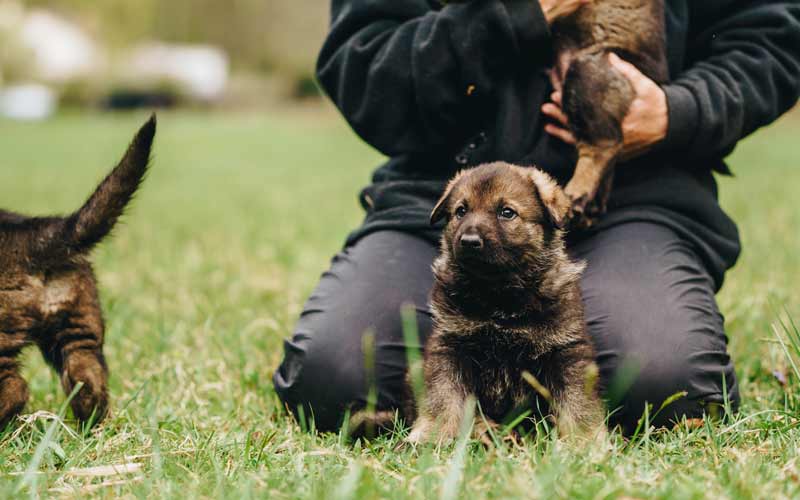
When a puppy comes to your home its only experience in life has been with its mother and littermates. It sees that things have changed, but it has no reason to believe that how it interacts with a family pack has changed.
It has played with littermates by biting and chasing, so that's how it thinks it should continue to interact within a family pack.
It takes a few days but once it accepts you and your family as its new pack, it will try to interact with you the same way it did with littermates...by biting and chasing.
The fact is, in its own small way it's trying to find its rank within the new pecking order of your family.
It's your job to teach your puppy (without scaring it) that you are the new pack leader. It's your job to teach it that biting and chasing high ranking human pack members is unacceptable. Therein lies the rub. Many people ignore these small challenges and others overreact to them. You have to find the middle road.
Those who ignore this behavior often end up with dominant dogs. Those who overreact and use too much force in correcting the biting end up with shy dogs that never reach their potential.
Establishing the Tether
When we bring a pup home we always use a dog crate. Those who don't use a crate are making a mistake. Those who won't use a crate should just quit reading because they are wasting their time to read further.
Our first goal is to reduce the possibility of house training mistakes and to teach the pup that being wild in the house is not going to happen.
So in the beginning most of our interaction with a new pup is done outside. We use a flat collar with a snap and one of the 20 foot cotton lines we have. When the pup runs around we let it drag the line.
While this is not a house training article, I want to make the point that teaching a dog to pee or poop when it's on a line is a very smart thing to do. You will find out how smart if you ever have to travel with your dog.
When we bring a pup in the house we never allow it to run around the house. We always have a line on it. What better way to establish our leadership than to control every aspect of the pup's life? Trust me this does not fall on deaf ears.
Those who allow puppies to run around un-tethered are only asking for the problems that will eventually come up. These pups are going to get into things, they are going to pee on the floor, or they are going to jump up and play bite.
When we are tired of dealing with the pup it goes into its crate. In the beginning, it's going to scream like a banshee for a few days, but such is life. We will put the pup in a crate in the garage and let it scream its head off.
For those who don't have a garage you can leave a radio or TV on, or cover the crate with a sheet, or leave one of the toys with treats in the crate, or leave a cow knuckle bone to chew on (although you need to be a little careful about loose stools here).
As time passes and the pup calms down and learns manners in the house, I may let it lie at my feet when I work on my computer. If it doesn't calm down it stays in the crate when I don't have time for it.
In the article I wrote "Who Pets My Puppy?" I explain why I don't allow other people to pet or play with my puppy. The short version is that I want to become the center of the universe for my dog. I don't want my dog to be looking to other people as a source of praise and fun. I recommend that you take a minute and read or listen to that article.
Controlling the Wild Puppy
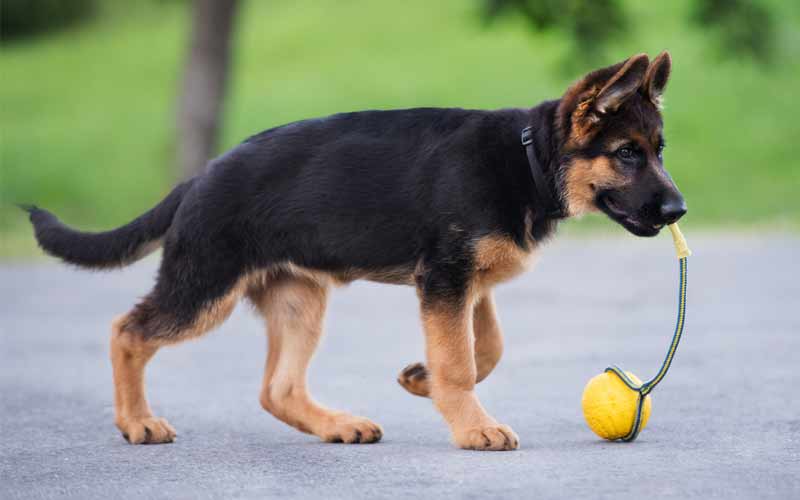
When people get puppies with a lot of prey drive, they are often at a loss as to what to do to control the little alligator they now live with.
The simple answer is to redirect the puppy into a toy.
As I explained earlier, puppies play by using their mouth. They see littermates as prey objects. When they come into your home and start chewing on you, they see you as a prey item. Your job is to teach them that toys are now prey items and not your hands,arms and legs.
Some puppies will pick up on this concept pretty quickly, some will not. Those that are little biting machines need additional work. In the DVD I recently finished titled "Dealing with Dominant and Aggressive Dogs" I demonstrate exactly how to handle this kind of puppy without hurting its drive or temperament. I show how to teach a wild puppy to calm down and knock it off without shaking it or hitting it or raising your voice. If you have this problem I recommend that you get this DVD.
Doors and Gates
Going through doors, going through gates, and coming down stairs first are a huge things in terms of rank for a dog. All dogs, puppies or adults, get excited when it's time to be let out or time to come back in the house. Without training they will all bolt out the door. This is not only annoying, it can be dangerous.
From day one we control the pups at the door. They are always on a line and we always make the pup sit for food when we go outside or come back inside. In fact, we even make the dog sit when we step outside before we close the door.
Establishing a routine at the door again enforces your rank and control over the dog. Don't underestimate the importance of this.
Toys
There is no question that people quickly fall in love with their puppies. Many buy their pets toys. I recently saw a reality TV show in which a women spent over $100 a week buying her dog new toys. Boy, do I wish I could send her a catalog...
With this said, we don't leave toys lying around our home. We take the approach that the dog does not own any toys. The toys are our toys and we allow the pup to play with "OUR TOYS." But we always take the toys away when the play time is finished.
Once again this demonstrates leadership without pressure. It's not domineering but it makes it clear that you are the leader.
With little pups we experiment to find toys that interest them. Sometimes it's a puppy tug, sometimes is an orbee ball, sometimes it's one of the other various dog toys we sell.
When we play with pups we always have it wear a line. This does two things. It stops them from playing keep away, and it conditions them to forget that they have a line on.
I explain exactly how to play with pups in my DVD "Building Drive and Focus." I will not go into that here, only to say that through our play we teach our pup that we are fair. We don't bully him and we teach him that if he gives us the toy when told the game will sometimes go on and not end.
This is accomplished by immediately tossing the toy and starting the game all over again after we ask him to release the toy.
Taking the Toy Away From the Puppy
After play, when it comes time to take the toy away we say "OUT" (any word will do as long as we are consistent and stick with the same word) and offer to trade the pup a really good treat for the toy.
We simply let them smell the treat and when they spit out the toy they get the food. If we want the game to end we do a slight of hand to get the toy out of the picture and make it disappear. We don't tease them with the toy once we take it away. That's poor leadership and is counter productive to a good bond.
Trading food for toys is only going to last so long. Many dogs will start to look at you like "OH NO - I KNOW THAT TRICK - I STILL WANT TO PLAY."
When that happens we change our approach and move on to the second stage of teaching the dog to release when told. That training is beyond the scope of this article but it's covered in "Building Drive and Focus."
Other Dogs and Puppies
I have written extensively about the fact that we never allow our puppies to be around other dogs or puppies. If we are raising two pups at the same time we never allow them to play together. We want our pups to look at us as their source of fun and excitement and not another dog.
I get emails all the time from people who have serious behavioral problems because they mistakenly bought two pups which are now 12 to 24 months old. These dogs are now anti-social and are more difficult to train. Many have aggression problems.
A word of caution to those who live in urban areas which have dog parks. Don't take your new puppy to a dog park. You are only asking for problems if you do. Read the article I wrote on dog parks to learn more about this.
If we are out for a walk and are approached by another person walking their dog we NEVER allow the other dog to come up and smell or greet our puppy. I cannot stress this enough.
We don't know how territorial or dog aggressive this other dog is. It only takes a blink of an eye for another dog to strike our puppy. Once a puppy has been attacked, it will be dog aggressive for the rest of its life. Dogs don't forget traumatic events like this.
As the pack leader our puppy EXPECTS us to protect it from non-pack members. If we are out for a walk and a stray dog tries to approach our puppy we put ourselves between the pup and the off leash dog. We drive the stray away. If we walk in an area that we know there are stray dogs we will carry pepper gas or a stout walking stick and we don't hesitate to use them if the stray does not heed our verbal warnings.
Vets, Vaccinations, and Neutering
I have written an article that details our position on vaccinations which basically says "less is better."
It is our opinion that dogs do not need yearly vaccinations. This opinion is shared by a growing number of Veterinary Universities. There is an article on my website about which Universities these are.
In our opinion vaccinations often cause more problems than they prevent. We feel they are a major cause of allergies in dogs. We feel that vaccinations, along with commercial dog foods, are a leading cause of cancer in dogs. Vaccinations are also the reason that many dogs develop thyroid problems which can lead to aggression problems in dogs. Many times these changes don't appear until months after a vaccination.
Many old school vets don't like to talk about these things because a major part of their income comes from yearly vaccinations. Our recommendation is to walk away from a vet who pushes yearly vaccinations.
Rabies vaccinations are required by law, but it is not without risk.
Bottom line is you need to do your own research and make your own decisions on what to do for your own dogs.


Most Popular Articles
-
01
-
02
-
03
-
04
-
05
Related Products
-
 $40.00
 -
 $12.99
 -
 $90.00


Ask Leerburg.