



How to Choose the Right E-Collar


Introduction
Cutting Through the Noise: How to Actually Compare E-Collars
Walk through any e-collar lineup from Dogtra, Garmin, or E-Collar Technologies and you'll find dozens of models that look similar at a glance but differ in meaningful ways — range, number of stimulation levels, whether intensity is set with a dial or a screen, how many dogs one transmitter can run, and what extra cues like tone, vibration, or a beacon light bring to the table.
This guide walks through what each of those features actually means for you and your dog, then lays out a full side-by-side comparison chart so you can match a collar to your specific training needs rather than guessing from a spec sheet.
A quick framing note: there is no single "best" e-collar. The right choice depends on what you're training for — yard manners, off-leash reliability at distance, hunting, multi-dog households, or pure bark correction. Use the sections below to figure out which features actually matter for your situation before you look at price or brand.
How to Choose the Right E-Collar
Five Questions to Answer Before You Buy
Before comparing model numbers, narrow the field by answering a few practical questions about how the collar will actually be used.
- 1What are you training for? A collar built primarily for bark correction (like the Dogtra No Bark Collar line) is a very different tool than a full remote trainer with adjustable stim, tone, and vibration. Don't pay for range and multi-dog capability you'll never use if all you need is bark control.
- 2How much real-world range do you need? Yard and obedience work rarely require more than a half mile. Hunting, tracking, and working dogs in open terrain may justify the 1-mile-plus or multi-mile GPS-capable units.
- 3Do you have — or plan to have — more than one dog? If so, look closely at the "Expand" column and the footnotes. Some systems are technically expandable but the manufacturer doesn't sell extra collars separately, and some multi-dog kits only come bundled as a fixed set.
- 4How precisely do you want to control intensity? A continuously variable rheostat dial gives finer, more immediate control than stepping through fixed numbered levels — worth considering if you do sensitive, low-level conditioning work.
- 5What's your dog's size? Minimum weight ratings exist for a reason. A collar rated for 35lbs+ isn't appropriate for a 10lb dog, regardless of how low you set the intensity.
Watch: 10 Rules for Using a Remote Collar
Ed Frawley on the Mindset Behind the Tool
Before picking a model off the chart below, it's worth understanding how a remote collar is meant to be used in the first place. Ed Frawley breaks down the most common mistake new owners make — strapping the collar on and diving straight into use — and the principles that turn it into a genuine communication tool with your dog rather than a punishment device.
This video lays out the ten rules Ed considers essential before and during remote collar use — covering the groundwork that needs to happen before the collar ever goes on the dog, and the habits that keep it an effective, fair tool over the long run.
Watch: 10 Rules for Using A Remote Collar »Range
Match the Range to Where You Actually Train
Range in this chart spans an enormous spectrum — from 30 yards on a basic no-bark unit up to 9 miles on GPS-capable tracking and training combo units. More range isn't automatically better; it's a feature you pay for in price and bulk, and most obedience and yard work never approaches even a half mile.
Short range (30 yards–1/2 mile)
Suited to yard work, basic obedience, and bark correction where you and the dog are rarely far apart.
Mid range (3/4 mile–1 mile)
Covers most off-leash training, sport work, and general field use where the dog may range out further.
Long range (9 miles)
Built for hunting and working dogs that need to be tracked and corrected across large, open, or wooded terrain.
Stimulation Levels & Rheostat / Intensity Dial
Two Different Ways to Control Intensity
The "Stim Levels" column tells you how granular a collar's correction settings are — anywhere from a handful of fixed levels (like 6 or 8) up to a fully adjustable 1–100 range. More levels generally means finer control, which matters most when you're working at the low intensities used in conditioning and desensitization.
The "Rheostat / Intensity Dial" column is a separate feature: a physical dial that lets you adjust intensity continuously and instantly, rather than stepping through buttons or a screen. This is particularly useful when you need to react and adjust intensity in real time during a session.
Multi-Dog Expandability
Running More Than One Dog From a Single Transmitter
The "Expand" column shows the maximum number of dogs a system supports from one handheld transmitter — anywhere from a single dog up to 250 on the high-end Garmin Alpha 200 Plus. This matters for multi-dog households, kennels, and working teams, but read the footnotes carefully:
- * The product is expandable, but extra collars or multi-dog units are not currently sold separately for this product.
- ** The multi-dog option is only sold as a complete set with one transmitter and two receiver collars — you can't add a second collar to an existing single-dog unit.
If multi-dog capability is a priority, confirm with the manufacturer that you can actually purchase additional collars for the specific model you're considering — "expandable" on paper doesn't always mean expandable in practice.
Display
Seeing Your Settings at a Glance
Some transmitters include a screen — ranging from a basic backlit LCD up to a large color touchscreen on the Garmin Alpha 200. A display lets you confirm intensity level, dog selection, and (on GPS units) location at a glance, which is especially useful in low light or when managing multiple dogs at once. Units without a listed display typically rely on button presses, audible tones, or a simple dial instead.
Tone & Vibration
Non-Shock Cues for Communication
Tone and vibration are stimulation-free ways to get a dog's attention or deliver a cue. Tone is an audible beep from the collar — useful as a marker or recall cue once conditioned. Vibration is a physical buzz, which is especially valuable for dogs with hearing loss or in situations where an audible tone isn't practical. Many collars in this chart include one or both alongside standard stimulation, giving you a lower-intensity option to start with before reaching for electrical correction at all.
Bark Correction
Built-In Automatic Bark Deterrence
A small number of units in this chart are built specifically — or include a dedicated mode — for automatic bark correction, detecting a dog's bark and delivering a correction without the handler holding a transmitter. The Dogtra No Bark Collar (Small and Medium) and Smart Nobark are purpose-built for this; a few full remote trainers, like the Garmin Sport Pro and Pro 550, layer bark correction in as an additional mode alongside manual remote training.
Beacon Light
Visibility for Night Work and Tracking
A beacon light is a small light built into the receiver collar, used for visually locating a dog at night or in heavy cover — common on tracking-oriented and higher-end multi-dog units. It's a convenience and safety feature rather than a training feature, but it's a meaningful consideration for anyone working dogs after dark or in the field.
Dog Weight & Collar Sizing
Minimum Weight Ratings Exist for a Reason
The "Dog Weight" column lists the manufacturer's minimum recommended weight for safe, effective use — ranging from 5lbs up to collars rated for 10–100+lb dogs. These ratings account for how the stimulation is calibrated and how the collar fits and sits against the dog's skin. Going below a stated minimum can mean either an uncomfortably strong correction for a small dog or unreliable contact and inconsistent feedback.
E-Collar Comparison Chart
Full Side-by-Side Specifications
Scroll horizontally on smaller screens to see every column.
| Brand | Model | Range | Stim Levels | Rheostat / Dial | Expand | Display | Tone | Vibration | Bark Correction | Beacon Light | Dog Weight |
|---|---|---|---|---|---|---|---|---|---|---|---|
| Dogtra | No Bark Collar - Sm | — | 1-6 | — | — | — | — | ? | ? | — | 10lbs |
| Dogtra | No Bark Collar - Md | — | 1-10 | — | — | — | — | ? | ? | — | 35lbs |
| Dogtra | Smart Nobark | 30 yards | — | — | — | — | — | ? | ? | — | 10lbs |
| Dogtra | iQ Plus | 400 Yards | 100/100 | — | 2 Dogs* | — | — | ? | — | — | 10lbs |
| Dogtra | 200C | 1/2 Mile | 100/100 | ? | 2 Dogs** | — | — | ? | — | — | 10lbs |
| Dogtra | 280C | 1/2 Mile | 127/127 | ? | 2 Dogs** | LCD Backlit | — | ? | — | — | 10lbs |
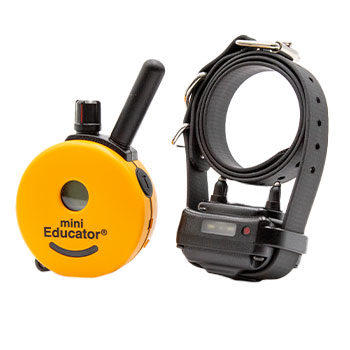
| E-Collar Technologies | ET-300 Mini Educator | 1/2 Mile | 1-100 | — | 2 Dogs | — | ? | ? | — | — | — |
| Dogtra | 280X | 1/2 Mile | 1-100 | — | 3 Dogs | — | ? | ? | — | ? | 10-100+lbs |
| Garmin | Delta SE | 1/2 Mile | 1-10 | ? | 2 Dogs | — | ? | ? | — | — | — |
| E-Collar Technologies | PE-900 Pro Educator | 1/2 Mile | 1-100 | — | 3 Dogs | — | ? | ? | — | ? | 5+lbs |
| E-Collar Technologies | ET-400 Educator | 3/4 Mile | 1-100 | — | 2 Dogs | — | ? | ? | — | ? | — |
| E-Collar Technologies | K9-400 Trainer | 3/4 Mile | 1-100 | — | 2 Dogs | — | ? | ? | — | ? | 5-100lbs |
| E-Collar Technologies | K9-400 Plus | 3/4 Mile | 1-100 | — | 2 Dogs | — | ? | ? | — | ? | — |
| Dogtra | 1900X | 3/4 Mile | 1-100 | — | 3 Dogs | — | ? | ? | — | ? | 35lbs |
| Dogtra | 1900X Handsfree | 3/4 Mile | 1-100 | — | 3 Dogs | — | ? | ? | — | ? | 35lbs |
| Dogtra | ARC-X | 3/4 Mile | 1-100 | — | 3 Dogs | — | ? | ? | — | ? | 15lbs |
| Dogtra | 2300NCP Advance | 3/4 Mile | 127/127 | ? | 2 Dogs | LCD Backlit | — | ? | — | — | 35lbs |
| Dogtra | ARC Handsfree Plus | 3/4 Mile | 127/127 | ? | 2 Dogs | LCD Backlit | — | ? | — | — | 15lbs |
| Garmin | Sport Pro | 3/4 Mile | 10/10 | — | 3 Dogs | — | ? | ? | ? | ? | — |
| Dogtra | 1900S - Black Edition | 1 Mile | 127 | ? | — | LCD Backlit | — | ? | — | — | 35lbs |
| Garmin | Pro 70 | 1 Mile | 6/No Nick | — | 6 Dogs | — | ? | — | ? | ? | — |
| Dogtra | Edge RT | 1 Mile | 8/8 | — | 3 Dogs* | — | — | ? | — | — | 35lbs |
| Dogtra | Pathfinder2 | 9 Miles | 100/100 | — | 21 Dogs | — | ? | — | — | — | 35lbs |
| Dogtra | Pathfinder2 TRX GPS† | 9 Miles | — | — | 21 Dogs | — | — | — | — | ? | — |
| Dogtra | Edge | 1 Mile | 8/8 | ? | 4 Dogs* | LCD Backlit | — | ? | — | ? | 35lbs |
| Garmin | PT 10 | 1 Mile | — | — | — | — | — | — | ? | ? | — |
| E-Collar Technologies | K9-800 | 1 Mile | 1-100 | — | 2 Dogs | — | ? | ? | — | ? | 25+lbs |
| E-Collar Technologies | K9-800 Plus | 1 Mile | 1-100 | — | 2 Dogs | — | ? | ? | — | ? | — |
| Garmin | Pro 550 | 1 Mile | 21/21 | ? | 3 Dogs | — | ? | ? | ? | ? | — |
| Garmin | Pro 550 Plus Handheld | 9 Miles | 18/18 | ? | 3 Dogs | LCD | ? | ? | — | ? | — |
| Garmin | Alpha 10 Handheld | 9 Miles | 18/18 | — | 20 Dogs | LCD | ? | ? | — | ? | — |
| Garmin | Alpha T 20 Track† | 9 Miles | — | — | — | — | — | — | — | ? | — |
| Garmin | Alpha TT 25 Track & Train | 9 Miles | 1-18 | — | — | — | ? | ? | — | ? | — |
| Garmin | Alpha 200 | 9 Miles | 18/18 | — | 20 Dogs | Large Color Touchscreen | ? | ? | — | ? | — |
| Garmin | Alpha 200 Plus Handheld | 9 Miles | 1-18 | — | 250 Dogs | — | ? | ? | — | — | — |
| Garmin | Alpha 300 Handheld | 9 Miles | — | — | 20 Dogs | — | ? | ? | — | — | — |
* Product is expandable, but extra collars or multi-dog units are not currently sold separately for this product.
** Multi-dog option only sold as a set with 1 transmitter and 2 receiver units.
† Tracking device only — no stimulation levels.
Recommendations by Use Case
Matching the Chart to Your Situation
Bark correction only
Dogtra No Bark Collar (Small or Medium, depending on dog weight) or Smart Nobark — purpose-built, no remote transmitter needed.
Entry-level remote training, small/single dog
Dogtra iQ Plus or Garmin Delta SE — solid half-mile range with adjustable levels for a first remote trainer.
Two- or three-dog households
E-Collar Technologies ET-400/K9-400 line or Dogtra 1900X — 3/4-mile range with confirmed multi-dog expansion, tone, vibration, and beacon light.
Fully adjustable, feature-complete remote trainer
Garmin Pro 550 — rheostat dial, tone, vibration, bark correction, and beacon light all in one unit at 1-mile range.
Hunting, working dogs, or large groups at long range
Dogtra Pathfinder2 (21 dogs) or Garmin Alpha 200 / Alpha 200 Plus (up to 250 dogs) — 9-mile range built for open terrain.
GPS tracking without stimulation
Pathfinder2 TRX GPS† or Alpha T 20 Track† — pure location tracking with a beacon light, no e-collar function.
Further Reading
For a deeper walkthrough of how e-collars work, training philosophy, and proper introduction techniques, see our Ultimate Guide to Dog E-Collars.


Most Popular Articles
-
01
-
02
-
03
-
04
-
05
Related Products
-
 $65.00
-
$16.99 - $18.99
$6.99 - $18.99 -
$219.99 - $349.99
$199.99 - $309.99 -

$65.00$19.99




Ask Leerburg.