



Every Team Is Unique: Why Training Must Adapt to the Dog and Its Handler


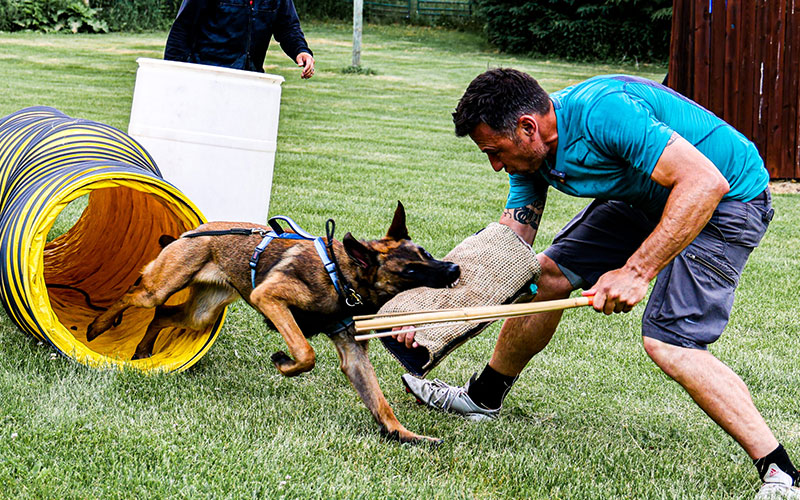
After twenty-seven years in the world of working dogs, one conviction now guides my entire approach: there is no universal method capable of suiting every dog and every handler.
A program can be defined in advance, and an exercise can have a precise goal. However, the path to reaching that goal almost always has to be adapted. Every dog has its own genetics, history, temperament, motivations, and experiences. Every handler also has their own personality, abilities, sensitivity, and way of communicating.
Training is therefore never about the dog alone. It's about a team. To achieve solid, harmonious work, you need to understand both individuals that make up that team, as well as the particular relationship between them.
A Vision Built Across Several Disciplines
I'm a carpenter by trade, and I started practicing mondioring in 1999. I first worked in the bite suit as a decoy. I was immediately drawn to the physical side of that role, but even more so to the chance to observe training from a different angle.
When you're facing the dog in the suit, you feel directly its engagement, its hesitations, its determination, and how it handles pressure. You learn to perceive details that are sometimes less visible from the outside: the quality of its entry, the stability of its grip, its intensity, or, conversely, the signs that confidence is slipping.
Working as a decoy isn't simply about receiving the dog. You have to know how to observe it and present it with a situation matching its level. An action that's too strong, too fast, or poorly placed can put the dog in difficulty. Conversely, work that's too predictable doesn't let it progress. So you have to find the right level of difficulty and move it forward at the right moment.
Mondioring taught me the diversity of exercises and the need to generalize them. The dog must be able to respond in different situations and on different terrain. It shouldn't just reproduce a scene learned by rote, but understand what's expected of it despite changes in context.
My path led me to become an expert instructor with the CTUS, the Swiss mondioring organization. I've also taken part in six world championships and eighty-four competitions. These experiences taught me to prepare dogs and their handlers for the demands of competition, while analyzing each difficulty without automatically applying the same solution.
I've also practiced RCI at a high level with Tanja Lutz. This discipline gave me a great deal in terms of pursuing precision, building repetitions, and mastering the transitions between the dog's different states. I deepened my work on instinct, motivation, prey drive, and the dog's ability to shift quickly from a phase of intensity to a phase of control.
French ring let me develop bite-work techniques, particularly pivots, esquives (evasions), and sleeve work. Belgian ring, a discipline I've always appreciated, passed on to me its culture of the full grip, engagement, and stability in the dog. My experience with the KNPV program, for its part, introduced me to another way of building engagement.
These disciplines aren't in opposition to one another. Each has its own culture, demands, and techniques. Each has let me add new tools to my way of working. But having many tools doesn't mean you have to use them all with every dog. Experience is knowing which one to choose, at what moment, and for what purpose.
What the Swiss Army Taught Me
I worked for thirteen years within the Swiss Army. At the center where I served, we bought dogs roughly one to four years old. Some came from French ring or RCI. Others were still "green," meaning inexperienced or without complete training.
We had to prepare them for the military program, which included obedience, bite work, and searching.
This experience deeply shaped my view of training. When you receive an adult dog, or one that's already partly trained, you never start from a blank page. The dog arrives with its genetics, its learning history, its habits, its strengths, its misunderstandings, and sometimes its conflicts.
Before teaching it a new program, you have to understand what it has already learned. You have to look into how its behaviors were built and what emotions are attached to them. Two dogs can outwardly perform the same behavior while experiencing it in completely different ways.
One dog might obey because it clearly understands the exercise and enjoys doing it. Another might produce nearly the same result out of anticipation, avoidance, or because it has become dependent on a particular cue. Visually, their responses can look similar. Yet their soundness and their ability to hold up under pressure will not be the same.
That period taught me not to look only at the final result. I also want to understand the process that gets the dog there.
It's essential to take into account the dog's genetics and the foundations laid during its early months. Some qualities are natural. Others were reinforced by the environment or early training. Some weaknesses can be improved, while others will need to be managed throughout the dog's whole career.
Adapting the training doesn't mean looking for an excuse for every difficulty. It means honestly recognizing the dog in front of us, in order to build the best possible progression from its actual qualities.
From Training the Dog to Training the Team
Later, in the army's recruit schools, I had to support not only the dogs but also the teams formed by the dogs and their new handlers.
A dog can know its program and perform well with an experienced handler, then run into difficulties when handed over to someone else. That doesn't necessarily mean it has forgotten what it knew. More often than not, the relationship, the communication, and the reference points have changed.
Every handler has their own rhythm. Their body position, their gaze, the tone of their voice, the timing of a command, and the way they use the leash are constantly conveying information. One person might be very dynamic and naturally encourage engagement. Another will be calmer, more precise, or more reserved.
The dog has to learn to understand this new language. The handler, for their part, has to learn to read their dog's reactions.
Even when a dog has mastered its program, the connection with its handler remains unique. That connection can't be handed over like ready-made equipment — it has to be built.
Some handlers need to learn to become clearer and more consistent. Others need to trust their dog more, intervene less often, and give it more initiative. It may also be necessary to build up motivation, or to temporarily return to simple exercises in order to establish shared communication.
The trainer therefore has to observe the dog, but also the person handling it. It's not enough to say, "Here's how it's done." You have to offer a way of working that the handler is actually able to understand, apply, and reproduce correctly.
An excellent technique that's poorly understood loses much of its value. Conversely, a simple, consistent solution used well can transform a team's progress.
Why a Single Method Can't Work
In dog training, it's tempting to look for a complete system capable of solving every problem. A structured method is useful: it provides reference points, avoids constant improvisation, and allows for a clear progression. The danger appears when that structure becomes rigid and you try to force every dog into it the same way.
Take two dogs that are both highly motivated by reward. The first might become more focused as its motivation increases. The second might lose precision because its excitement takes over completely. Using more rewards may help the first dog, but make the second one faster, noisier, and less attentive.
Two dogs may also hesitate in front of an exercise for different reasons. One may lack understanding. The other understands, but doesn't yet have enough confidence to commit. More repetition may help the first. For the second, poorly structured repetitions risk installing even more hesitation.
Visible behavior, then, doesn't always reveal the real cause of a problem. That's why observation matters more than the automatic application of a technique.
Before changing an exercise, I try to work out what's blocking the team. Does the dog understand the goal? Does the motivation being used have enough value? Is the level of difficulty appropriate? Is the environment too stimulating? Is the handler giving contradictory information? Are we trying to get too many things at once?
The solution depends on the diagnosis.
If a dog lacks understanding, I'll look for more simplicity and clarity. If it lacks confidence, I'll build up successes and carefully manage the difficulty. If it has a lot of energy but little control, I'll work on the transitions between activation and control. If it relies too heavily on the handler's help, I'll gradually reduce that help to build its independence.
This isn't about lowering the final standards, but about building a path that the dog and handler can actually walk.
Adapting Doesn't Mean Accepting Everything
Adaptation is sometimes mistaken for an absence of rules. But personalizing training doesn't mean letting the dog decide everything, or constantly changing the criteria.
The goals must remain clear. In obedience, we may be looking for a precise position, a fast response, or lasting stability. In bite work, we may want a full grip, genuine commitment, and reliable control. In searching, the dog must work with persistence while staying available to its handler's guidance.
It's the means of reaching these goals that must be adapted.
You also have to avoid switching technique at every difficulty. The dog needs consistency. If the handler adopts a new solution at every session, it becomes impossible to know what's actually working, and the dog receives inconsistent information.
Adaptation, then, has to be thought through and structured. You observe, you form a hypothesis, you choose a change, and you give it enough time to have an effect. Then you evaluate the result. Good adaptation doesn't make the work confusing. It makes it more understandable.
Respecting the Handler's Abilities
We often talk about adapting to the dog, but less about adapting to the handler. Yet it matters just as much.
Not every handler has the same reflexes, coordination, or experience. Some people grasp a technical explanation immediately. Others need to see the exercise, break it down, or repeat it slowly. Some sense very clearly the moment the dog's attitude changes, while others have to learn to watch for specific signs.
Asking a beginner handler to manage their posture, their leash, their reward, their command, and the dog's reaction all at once can create overload. They end up focused on the technique and lose contact with their dog.
In that case, I prefer to simplify. We can work on a single element at a time, repeat certain movements without the dog, or organize the exercise in a way that gives the handler more time. The trainer's goal isn't to demonstrate what they themselves are capable of doing with the dog. Their role is to make the handler capable of progressing with their own dog.
That means accepting that a method perfectly suited to a professional isn't necessarily the best one for an amateur. If the handler can't correctly reproduce a technique once on their own, it isn't a lasting solution for the team.
Progress Belongs to the Team
Sometimes a dog progresses quickly when taken over by an experienced person, then falls back into its old difficulties with its usual handler. That shows the dog is capable of succeeding, but also that the team's learning isn't finished yet.
Real progress appears when the handler understands why the exercise works, knows how to recognize mistakes, and can adjust their own actions without constantly relying on the trainer.
To get there, they need to be taught how to observe. What are the first signs of a loss of focus? At what point does motivation start to drop? When does the dog start to anticipate? Which reaction from the handler improves the situation, and which one increases conflict?
I try to pass on a working logic, not just a series of movements. When the handler understands that logic, they become able to make better decisions.
This independence is essential, because the trainer won't be there for every session. Most of the work happens in the team's everyday life, far from seminars and training grounds.
Progress Belongs to the Team
My various experiences have broadened my view of the dog. Mondioring taught me variety and generalization. RCI strengthened my taste for precision and transitions. French and Belgian ring gave me different bite-work techniques and a way of thinking about the quality of engagement. KNPV showed me another conception of the work. The army taught me to evaluate dogs from very different backgrounds and to build operational teams.
I don't see this experience as a closed method, but as a range of possibilities.
Faced with a dog and its handler, I have to select the exercises that suit them, modify them when necessary, and clearly explain the goal being pursued. I also have to be able to let go of an idea when it isn't producing the expected result.
Experience doesn't mean repeating for twenty-seven years what you learned in the first one. It means continuing to observe, compare, question yourself, and enrich your approach.
Dogs force us to stay humble. A technique that produced excellent results with several dogs can fail with the next one. That new failure doesn't necessarily mean the technique is bad. It simply reminds us that we're working with an individual.
Finding the Balance Between Motivation, Control, and Confidence
For me, successful training has to seek a balance. The dog must want to work, understand what's expected of it, and stay stable as difficulty increases.
Motivation without control can produce a lot of intensity but little precision. Control without motivation can give an apparently correct result, but one that's fragile and without real commitment. Confidence without clear criteria can create confusion. High standards without confidence can shut the dog down.
This balance isn't the same for every team.
Some dogs need to learn to raise their intensity further. Others need to learn to come back down and think despite their excitement. Some handlers need to become more active to support their dog. Others need to intervene less and give the dog the space it needs to act.
The trainer has to look for the zone where the exercise represents a genuine challenge without becoming incomprehensible or impossible.
If everything is always easy, the dog doesn't develop the abilities it needs to face new situations. If everything is constantly too hard, it can't build solid understanding and confidence.
A Philosophy Focused on Passing It On
Today, I enjoy passing on the experience gained over the course of my career, in bite-suit work as much as in obedience and in coaching handlers.
I don't just want to show one way of doing things. I want to help people observe their dog better, understand the reasons behind a behavior, and choose a suitable response.
When an exercise fails, the first question shouldn't be: "How can I force the dog to succeed?" We should first ask ourselves: "Why is it failing, and what, in our training, needs to become clearer?" That question pushes us to examine the foundations, the motivation, the criteria, the environment, and the handler's role.
Adapting the training to the team sometimes takes more time at the outset. You have to observe, try things, compare, and be willing to go back over certain steps. But that work then makes it possible to build more solid behaviors and a more consistent relationship.
After twenty-seven years of training, competing, and working with dogs from many different backgrounds, I remain convinced of one thing: the best system isn't the one that claims to work identically with every dog.
The best system is the one that lets the trainer understand the dog in front of them, respect their handler's abilities, and build a shared language between them.
The dog is unique. The handler is unique. So is their relationship.
It's by recognizing this reality that we can help the team move forward, develop its strengths, and let it express its full potential
Joaquim Is Coming Back This October
We're so excited to have world-class decoy Joaquim Dovat leading another seminar at Leerburg! Join us as Joaquim instructs trainers of all levels — from brand-new handlers to experienced competitors — with bite work in action that'll prep you for protection training.
This seminar is great for anyone interested in protection sports like Mondioring and IPO/Schutzhund, with both working spots and decoy spots available. If you're registering for a decoy spot, we recommend bringing your own suit if you have one.
Joaquim has a clear goal in mind for every student. He'll break exercises down into smaller pieces to build clear understanding between you and your dog, and he'll demonstrate exercises you can practice at home without needing a decoy. You'll learn how to read your dog clearly and develop a structured training routine based on your dog's genetics, personality, and training level.
Good bite work is a team effort — it takes more than a great dog. It takes a handler who can read their dog clearly and structure training around that dog's genetics, personality, and training level. This seminar is built to develop exactly that skill, giving you practical tools to train with more clarity, less conflict, and better long-term results.
Seminar Details
Dates: Saturday, October 10 – Sunday, October 11, 2026
Location: Menomonie, WI
Open to: Handlers and decoys of all levels
What a Seminar Day at Leerburg Looks Like
On Saturday and Sunday, Joaquim will lead instruction and demos with attendees registered for working spots. A typical day runs roughly from 8:00 am to 4:00 pm (times may vary — we'll email attendees with more details), with a break in between to grab your own lunch.
Leerburg is located in an area with a great walkway, and our facility has ample parking so you can keep your dog at your car whenever they're not working.
Learn more about Joaquim's seminar: Bitework Development for All Levels »
About Joaquim Dovat
Joaquim Dovat's journey as a world-class decoy began in 1999 at a dog club near his hometown in Switzerland. In 2005, he was recruited by the Swiss Army, where he spent 14 years training and selecting some of the country's finest military defense dogs. Always eager to expand his skillset, he also became an expert in training narcotic and detection dogs for annual deployments and defense missions.
Today, almost 25 years later, Joaquim has been selected to decoy for more than 80 Mondioring, French Ring, and IPO competitions around the world, including 6 World Championships. He has shared his passion and knowledge with hundreds of competitive sport dog teams during seminars and workshops across the US, Europe, China, and Russia.
Learn more about Joaquim's seminar: Bitework Development for All Levels »

Most Popular Articles
-
01
-
02
-
03
-
04
-
05
Related Products
-
 $65.00
 -
$16.99
$6.99 - $16.99 -
$219.99 - $349.99
$199.99 - $309.99 -

$65.00$19.99

Ask Leerburg.