



St. Patrick's Day & The Dog That Outlasted Empires


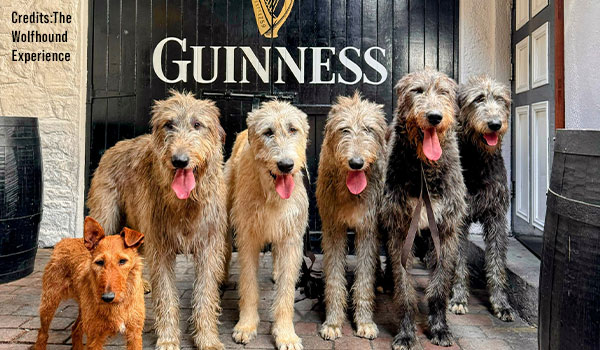
Most St. Patrick's Day posts will show you green beer and leprechauns. Today, we honor the Irish Wolfhound — known in ancient Gaelic as the Cú Faoil — which was owned by kings, gifted to emperors, used as a weapon of war, and nearly wiped from the earth twice. This is the story of a breed that outlasted empires, and what it tells us about the ancient bond between serious people and serious dogs.
St. Patrick's Day & The Dog That Outlasted Empires
Most people will spend today raising a glass to Ireland. We want to raise one to the dog that helped build it.
Before the shamrock. Before the parades. Before Patrick ever set foot on Irish soil — there was the Cú Faoil. The Irish Wolfhound.
These were not pets. Under ancient Brehon law, only kings, chieftains, nobles, and poets were permitted to own them. Their theft could spark wars. They wore collars of gold and silver. Julius Caesar wrote of them. A Roman consul received seven as a gift and recorded that "all Rome viewed them with wonder." Celtic warriors grafted the word cú — hound — onto their own names as a mark of honor, because in ancient Ireland, to be compared to your dog was the highest compliment a man could receive.
The greatest hero of Irish mythology, Cú Chulainn, earned his name as a boy when he killed a chieftain's guard dog and offered to take the animal's place. His name, for the rest of his life, meant Hound of Culann. The Irish didn't separate the warrior from his dog. They were the same thing.
The Irish Wolfhound
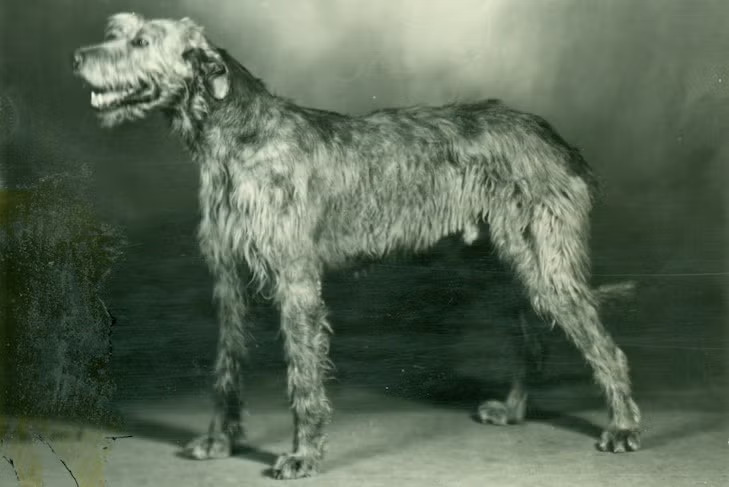
To understand why this dog held such a place in Celtic culture, you have to understand what it actually was.
The Irish Wolfhound is the tallest breed of dog in the world. Standing on its hind legs it can reach over seven feet. The breed standard sets the floor at 32 inches at the shoulder and 120 pounds — and many exceed it considerably. But here's what surprises people: this is not a lumbering giant. The Wolfhound is a sighthound, built on the same architecture as a Greyhound — long legs, deep chest, explosive acceleration. It was the only dog in history considered both fast enough to run down a wolf and powerful enough to kill it alone. In battle, packs of them were used to pull armed warriors from horseback — a living counter to cavalry. The legendary Irish war chief Fionn Mac Cumhaill kept over five hundred of them. Three hundred adults who fought alongside his men, and two hundred pups in training.
And then you meet one, and it leans its great head against your leg like it has nowhere else to be.
There's an old Irish saying about them: "Gentle when stroked, fierce when provoked." The modern Wolfhound is famously serene — calm, affectionate, almost meditative in the home. That paradox isn't a contradiction. It's the mark of a dog that has been shaped over millennia to know exactly when force is necessary and when it isn't. Any serious working dog person will recognize that quality immediately.
There is one bittersweet dimension to this breed that every Wolfhound owner carries quietly. Despite everything — the size, the history, the presence — they live only six to eight years on average. One of the shortest lifespans of any breed. There's an old Irish proverb that captures it: "Big of heart, short of years." For those of us who understand working dogs, that particular ache is familiar. It doesn't diminish the bond. If anything, it sharpens it.
Who Was St. Patrick?
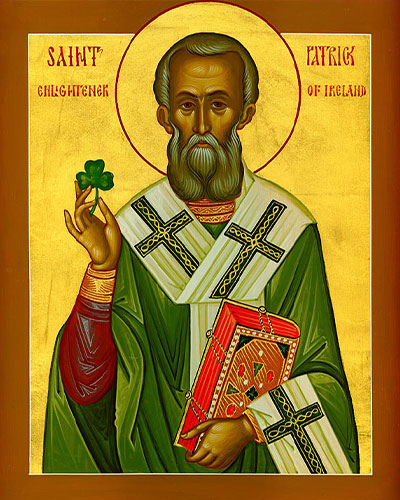
Then came the conversion.
Patrick was not Irish. He was born in Roman Britain around 385 AD, the son of a Christian deacon, raised in relative comfort. At sixteen, Irish raiders crossed the sea and took him — selling him into slavery in the country that would eventually define his legacy. For six years he worked as a shepherd in Ireland, isolated, captive, and by his own account, deepening a faith that would eventually send him back. He escaped. He trained as a priest. And then, in one of history's more extraordinary decisions, he returned voluntarily to the island that had enslaved him — not in vengeance, but in service.
When Patrick arrived in the 5th century to bring Christianity to the Celtic people, he encountered a culture that had built its entire spiritual world around nature — the seasons, the land, the animals. The spring equinox was sacred. The shamrock was already a holy plant long before anyone used it to explain the Trinity. The Celtic cross didn't start as a Christian symbol — the circle representing the sun was added deliberately, to meet a pagan people on ground they already understood.
Over the following decades, he established monasteries, churches, and schools across Ireland, converting a deeply rooted Celtic pagan culture through education and a deliberate effort to meet that culture on its own terms. He didn't erase what he found — he translated it. Patrick died on March 17th, 461 AD, and that date became his feast day. Notably, despite being one of the most venerated saints in the world, Patrick was never formally canonized by the Catholic Church — the process didn't exist until centuries after his death. Ireland claimed him anyway. That, too, feels like something worth honoring.
St. Patrick did not arrive in Celtic Ireland with a list of prohibitions. He did not declare the culture wrong, strip it of its symbols, or demand conversion through force. He studied what the Irish already knew and held sacred — their plants, their sun cycles, their mythological framework — and he built his teaching on top of it.
It is one of history's more quietly radical ideas: that you reach people not by banning what they know, but by deepening their understanding of it. Anyone who has spent serious time in the world of dog training will recognize that philosophy immediately. The handlers and trainers who have genuinely advanced the craft are not the ones who arrived with prohibition lists — declaring tools controversial, avoiding uncomfortable topics, or demanding that everyone begin from zero. They are the ones who met their students, and their dogs, where they actually were.
Devastation of the Wolfhound
By the 17th century, the Irish Wolfhound faced a different kind of threat — not spiritual, but political. As Ireland was conquered and its chieftains scattered in what history calls the Flight of the Earls, the great hounds went with them into exile or were left behind to decline. They were exported so relentlessly as gifts to European royalty that Oliver Cromwell issued a formal decree in 1652 prohibiting their export — not out of affection, but because without them, Ireland's wolf population had grown uncontrollable. The dog was literally infrastructure.
By 1836, the Irish Wolfhound appeared on an official list of animals that had disappeared from Ireland.
Resuscitation of the Wolfhound
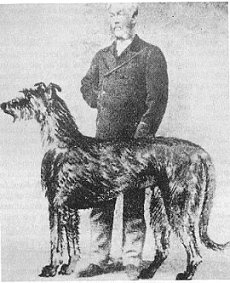
In the mid-19th century, a British Army captain named George Graham made it his life's mission to bring the breed back. Working from whatever surviving bloodlines he could find — crossing with Scottish Deerhounds, Great Danes, even a Tibetan dog — he rebuilt the Irish Wolfhound from near-nothing. It was painstaking, imperfect, and extraordinary. In 1885 he founded the Irish Wolfhound Club. In 1902, the breed was named the regimental mascot of the Irish Guards — a tradition that continues to this day, with a Wolfhound still parading in full ceremonial dress alongside the regiment.
The dog that had hunted alongside Celtic warriors, been gifted to emperors, and twice nearly vanished from the earth — was standing again.
That's the story underneath St. Patrick's Day that nobody tells.
The real spirit of this holiday, if you trace it all the way back, is about a people who survived slavery, famine, colonization, and cultural erasure — and kept their identity alive anyway. Their dogs were part of that identity. Not accessories. Not symbols. Working partners, war companions, and living proof of what a culture values.
The Cú Faoil is still here. Still carrying something ancient in its bones.
That's what the working dog world has always understood: the bond between a serious person and a serious dog is one of the oldest things in human civilization. Older than nations. Older than saints. Older than the holidays we use to remember where we came from.
Happy St. Patrick's Day from all of us at Leerburg.
To the dogs that outlasted empires — we see you.
Sláinte to the Cú Faoil.


Most Popular Articles
-
01
-
02
-
03
-
04
-
05
Related Products
-
 $65.00
 -
$16.99
$6.99 - $16.99 -

$219.99 - $349.99
$199.99 - $309.99 -

$65.00$19.99





Ask Leerburg.