



Heatstroke in Dogs: Recognizing the Danger and Applying the Rapid Cooling Protocol


Introduction
What Every Owner and Handler Needs to Know About Canine Heatstroke
Heatstroke is one of the most preventable causes of death in dogs — and one of the fastest-moving. A dog can go from looking fine to collapsing in a matter of minutes, and once full heat stroke sets in, survival rates hover around 50%, even with treatment. The single biggest factor in whether a dog survives a heat injury is how quickly cooling begins.
This article covers three things every dog owner, handler, and trainer should know: how to recognize the stages of heat injury before they become an emergency, how to apply a rapid cooling protocol on the spot, and why veterinary follow-up still matters even after your dog seems to recover. We'll also look at new research on a surprisingly simple field cooling method — the voluntary head dunk — that may belong in every handler's toolkit.
Why Dogs Overheat So Easily
Panting Has Real Limits
Unlike people, dogs don't have sweat glands across their body. Panting is essentially their only significant cooling mechanism, and it has real limits. Once a dog crosses a certain threshold of heat buildup, panting alone can't keep up, and core temperature can climb rapidly.
A few baseline facts help put this in context:
- Normal resting body temperature in dogs is roughly 99–102.5°F.
- It's common — and not necessarily dangerous — for a working or exercising dog's temperature to climb above 106°F during activity. Temperature can keep rising for up to 15 minutes after activity stops, even with no ill effects.
- Dogs without heat injury typically return to normal temperature within 15–20 minutes of rest.
- Every dog's individual heat tolerance is different. Fatal heat stroke has been documented in dogs with temperatures as "low" as 105.8°F. There is no single magic number that predicts which dogs are at risk.
- Humidity matters as much as temperature. Once humidity climbs above roughly 35%, a dog's ability to cool itself through panting drops significantly.
Heat injury occurs when a dog's internal temperature exceeds the body's ability to dissipate that heat — and when it does, organs including the brain, heart, gastrointestinal tract, and kidneys are all at risk of severe damage. There are two main scenarios that cause this:
- Confinement: A dog in a closed space — a kennel, crate, or vehicle — without proper cooling or ventilation. Most confinement heat injuries involving vehicles happen because of cooling system or alarm malfunctions, so a vehicle that feels fine at the start of a shift is not a guarantee of safety throughout it.
- Exertional overheating: Most often seen in dogs that are not properly conditioned or acclimatized to the outdoor environment during training or operational work. High drive can override a dog's instinct to slow down — making handler vigilance critical.
Risk factors to watch for:
- Poor acclimatization to heat or to high-intensity activity
- Inadequate hydration
- A prior history of heat injury
- Obesity or excess body condition
- Short-nosed (brachycephalic) breeds — which have a harder time dissipating heat through panting and can reach a dangerous breaking point with comparatively little exertion
Important note: If an older dog suddenly develops heat sensitivity with no prior history, a veterinary check is warranted. Underlying pain, neurological, or endocrine conditions can sometimes be a contributing factor.
Recognizing the Three Stages of Heat Injury
Knowing the Difference Can Decide How Fast You Act
Heat injury in dogs is generally described in three escalating stages. It is of the utmost importance that handlers recognize early signs to prevent life-threatening events — don't wait for the dog to deteriorate before taking action.
| Stage | Signs | Immediate Action |
|---|---|---|
| Mild — Heat Stress | Excessive thirst, shade-seeking, reluctance to move, flat or extended tongue, retracted lips, atypical disregard to commands, panting the dog can still pause or reduce if distracted. | Rest, water, shade, and ventilation — now. |
| Moderate — Heat Exhaustion | All of the above, plus weakness, distress, and panting the dog cannot stop or slow even when distracted. May include petechiae (small red/purple spots) or bruising. | Active cooling with cool water immediately. Begin the full 5-step protocol. |
| Severe — Heat Stroke | All of the above, plus neurological symptoms: disorientation, vomiting or diarrhea, stupor, seizures, collapse, or a dull to minimally responsive state. Life-threatening; risk of multi-organ failure. | Immediate, aggressive cooling. Immerse in cool water or apply cool water to entire body. Transport urgently. |
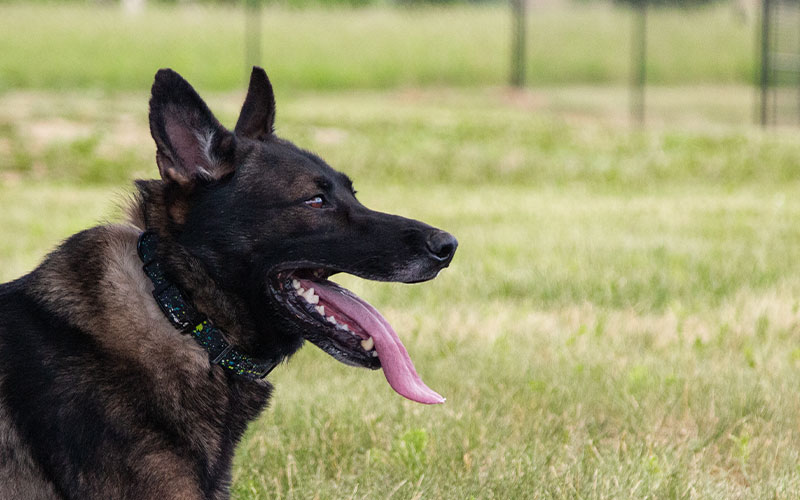
A few important nuances every handler should understand:
- There's no single temperature that defines heat stroke. While it's most commonly seen above 107°F, documented cases have occurred as low as 105.8°F.
- A dog in heat stroke can still be alert and responsive. Don't wait for collapse before treating this as an emergency.
- Common visible signs to watch for in the field: an elongated, flattened tongue; retracted lips; retracted ears; narrowed eyes; shade-seeking behavior; and a noticeably slower pace. For working dogs, an atypical disregard to commands is an important early warning sign that should not be dismissed.
A note on rectal temperature for working dog handlers: Many well-conditioned, acclimatized working dogs operate comfortably with rectal temperatures in the 104–107°F range. Rectal temperature readings can also lag behind true core temperature by up to 15 minutes. For these reasons, rectal temperature alone is not a reliable trigger for action — handlers must recognize the clinical signs listed above and respond to those, not wait for a thermometer reading to confirm what the dog's behavior is already telling them.
The Research Problem: Most Dogs Aren't Cooled Correctly
"Cool First, Transport Second"
A 2023 UK-based study (Hall et al., published in Veterinary Sciences) reviewed the records of 856 dogs presented to veterinary practices for heat-related illness. The findings were sobering:
- Only about 55% of those records even mentioned any active cooling at all.
- Of the dogs that were cooled, only around 22% were cooled before they ever reached the veterinary practice.
- The single most common cooling method used — by a wide margin — was simply wrapping the dog in wet towels (used in just over half of cases).
- Only about 24% of dogs were cooled using a method actually recommended by veterinary emergency guidelines (cold-water immersion or evaporative cooling with airflow).
This matters because wet towels, used alone, are one of the least effective cooling methods available — they can actually trap heat against the body if not paired with airflow, working against the evaporative cooling a dog needs.
The takeaway from the veterinary emergency community is a simple, memorable phrase: "Cool first, transport second." Don't just rush a hyperthermic dog to the car — begin cooling immediately, then transport.
The Rapid Cooling Protocol — 5 Steps
What to Do the Moment You Suspect Heat Injury
-
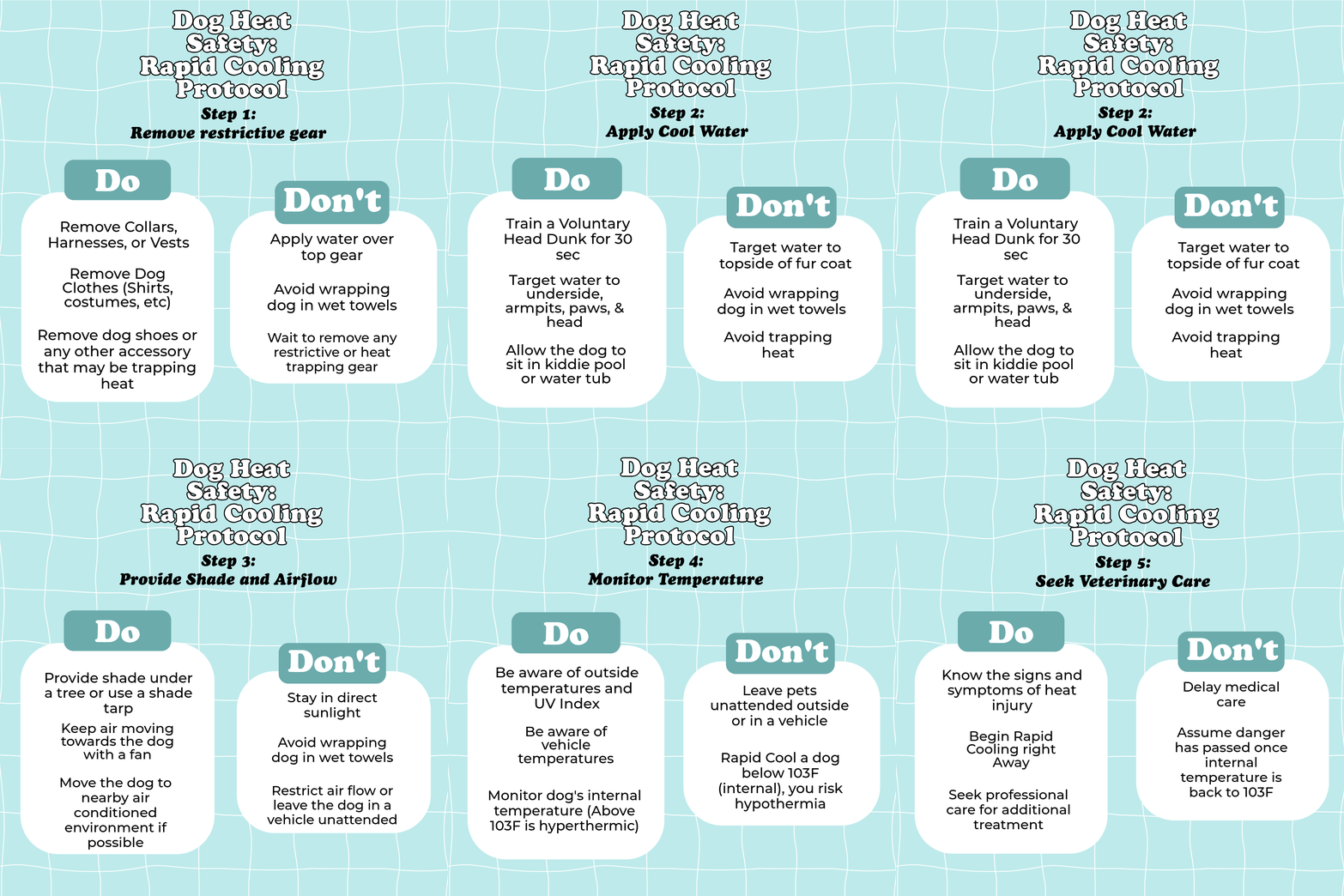
Remove Restrictive Gear Remove all collars, harnesses, vests, dog clothing, shoes, or any accessory that could be trapping heat. Do this immediately, before anything else. Don't apply water over the top of gear, and don't wait — every second counts.
-
Apply Cool Water — Correctly Target water to the underside of the body, the armpits, the paws, and the head. Allow the dog to stand or sit in a kiddie pool or water tub if available. If your dog is trained for it, a voluntary head dunk for 30 seconds is one of the most effective things you can do (more on this below). Don't target water only to the topside of the fur coat, and don't wrap the dog in wet towels — that traps heat rather than releasing it.
-
Provide Shade and Airflow Move to shade under a tree or a shade tarp, point a fan at the dog to keep air moving, and get to an air-conditioned space if one is nearby. Don't stay in direct sunlight, don't restrict airflow, and never leave the dog unattended in a vehicle.
-
Monitor Temperature If you have a thermometer, monitor your dog's internal temperature and continue active cooling until it reaches roughly 103–103.5°F — then stop. Don't continue aggressive cooling below that range; cooling a dog too far risks tipping them into hypothermia instead. If you don't have a thermometer in the field, use the dog's demeanor as your guide: stop active cooling when the dog appears to be in noticeably less distress. When in doubt, err toward getting to a vet with proper monitoring equipment as quickly as possible.
-
Seek Veterinary Care — And Transport Correctly Any case beyond mild heat stress requires professional veterinary evaluation. When transporting, place the dog in a cool vehicle with air conditioning running and air blowing directly over the dog. Don't delay medical care, and don't assume the danger has passed just because your dog's temperature looks normal or they seem to have recovered — internal complications can still be developing.
What the Research Says About Field Cooling Methods
The Voluntary Head Dunk: A Surprisingly Effective Tool
Most cooling guidelines call for full or partial water immersion — but that's not always realistic in the field. What do you do when there's no pool, no tub, and no hose nearby?
A 2024 study from the Penn Vet Working Dog Center, published in the Journal of the American Veterinary Medical Association, set out to answer exactly that question. Researchers compared four field-applicable cooling methods on 12 working dogs after exercise-induced overheating:
- Chemical ice packs secured around the neck
- A water-soaked towel placed around the neck
- Water-soaked towels placed under both armpits
- A trained, voluntary head dunk into a bucket of cool water, performed while retrieving a toy or food reward
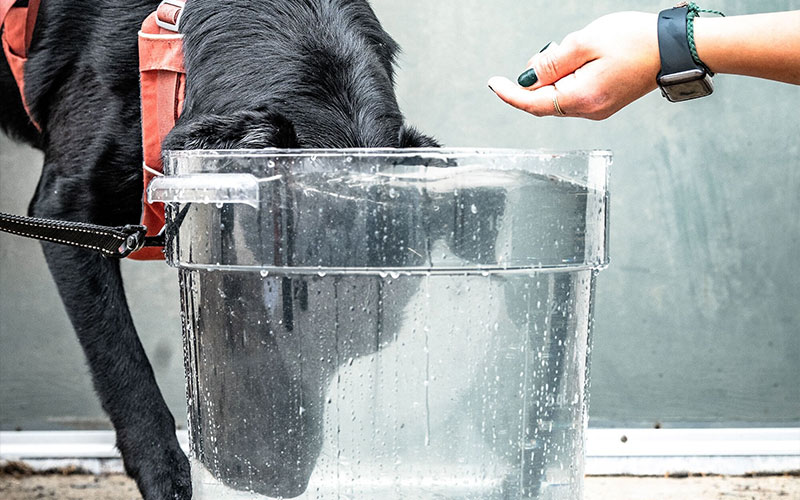
(Image: Shelby Wise/Wise K9 Photography)
The results were striking. The voluntary head dunk produced the lowest average temperatures in the first five minutes after exercise, and it was the only method of the four that stopped the dog's temperature from continuing to climb after exercise ended. It also led to the lowest temperatures over the full 40-minute cooldown period that followed. All four methods eventually returned dogs to their baseline temperature, but the head dunk got them there fastest and kept them cooler the whole way.
Why does dunking the head work so well? Dogs direct extra blood flow to the head — particularly the ears, muzzle, and nasal tissue — during heat stress. Submerging the head in cool water cools that blood directly, including blood that's on its way toward the brain, which may help protect against the neurological effects of overheating. Researchers also noted that the small amount of water dogs lapped up during the dunk may have contributed a modest additional cooling effect.
Important caveats from the researchers: The dogs in the study were trained in advance — about a week of positive-reinforcement work teaching them to retrieve a toy or treat from the bottom of a water container. This is a skill to build before you need it, not something to attempt cold in an emergency. Never force a dog to dunk its head — it should always be the dog's choice. This method is appropriate only for dogs that are mentally normal and able to pause their panting. A dog already showing signs of heat stroke, collapse, or disorientation should not be encouraged to head dunk — that dog needs full-body cooling and immediate veterinary transport instead.
As a bonus, training this behavior doubles as a useful cooperative-care skill, since a dog comfortable with head dunking is often also easier to manage for eye or nose flushing. This finding is especially relevant for working dogs, sport dogs, and anyone hiking or training in remote areas without easy access to a pool or hose — but it's just as useful for an average pet owner with nothing more than a bucket and some water on a hot afternoon walk.
Cooling Methods: What Works and What to Avoid
Putting the Research Together
Strongest evidence:
- Cold-water immersion or full-body soaking (whole or partial) — submerge in a tub, pond, or lake without submerging the head
- Evaporative cooling: spraying water on the skin combined with airflow from a fan or hose
- A trained voluntary head dunk, when the dog is mentally normal and field conditions don't allow for full immersion
Use with caution:
- Wet towels: commonly used, but far less effective on their own. If towels are your only option, place them on thin-skinned areas like the belly or inner thighs, and pair them with airflow — covering the whole dog in a towel can trap heat rather than release it.
- Very cold or ice water for full-body immersion: tepid water (roughly 60–86°F) is generally preferred. Extremely cold water can cause blood vessels near the skin to constrict, which may work against the cooling effort.
Lower priority / generally discouraged:
- Alcohol applied to paw pads: sometimes used and may offer modest benefit, but it's not a primary strategy and carries some risk if absorbed.
- Cold-water enemas: rarely used, and not well supported as an effective or low-risk option compared to external cooling methods.
One rule applies across the board: stop active cooling once the dog's internal temperature reaches roughly 103–103.5°F, or once the dog is clearly showing signs of less distress if no thermometer is available. Continuing to cool past that point risks overshooting into hypothermia. If a dog's temperature drops below 100°F, they may need active warming instead.
After Cooling: Why Veterinary Follow-Up Still Matters
Looking Normal Again Isn't the Same as Being Out of the Woods
Heat injury — especially moderate to severe cases — can trigger complications that take time to show up, including:
- 1 Rebound hypothermia in the hours after cooling
- 2 Gastrointestinal bleeding or clotting abnormalities
- 3 Heart arrhythmias
- 4 Kidney injury
- 5 Seizures or other neurological effects (cortical blindness, for example, is relatively common after severe heat stroke but typically resolves over several days)
This is why "the danger has passed once the temperature reading looks normal" is a myth worth retiring. Any dog that progresses past mild heat stress deserves a veterinary evaluation, even if they seem to have bounced back.
Prevention
The Best Treatment Is Never Needing It
Pay attention to weather conditions every day and prepare when heat and humidity are elevated. Your dog will tell you when they're starting to get too warm — recognizing the signs early and listening will save their life.
- 1 Build up heat and exercise tolerance gradually — don't jump straight into intense activity on a hot day.
- 2 Keep your dog well hydrated before, during, and after activity.
- 3 Avoid exercising during peak heat and humidity hours; early morning or evening is safer.
- 4 Never leave a dog unattended in a vehicle or any enclosed, poorly ventilated space — even briefly, even with the windows cracked. Don't rely on vehicle cooling systems alone; malfunctions happen.
- 5 Remember that individual tolerance varies widely. There's no universal "safe" temperature number, and short-nosed breeds in particular can overheat with surprisingly little exertion.
- 6 Consider training cooling behaviors — like the voluntary head dunk — before you ever need them in an emergency.
Further Reading
Joint Trauma System K9 Clinical Practice Guideline: Heat Injury (K9CPG:09). Published 29 March 2025. Comprehensive clinical guidance on recognition, treatment, and monitoring of heat injury in military working dogs. Read the full paper »
Hall, E.J., Carter, A.J., Bradbury, J., Beard, S., Gilbert, S., Barfield, D., O'Neill, D.G. "Cooling Methods Used to Manage Heat-Related Illness in Dogs Presented to Primary Care Veterinary Practices during 2016–2018 in the UK." Veterinary Sciences, 2023, 10(7), 465. Read the full paper »
Parnes, S.C., Mallikarjun, A., Ramos, M.T., Capparell, T.R., Otto, C.M. "Voluntary head dunking after exercise-induced hyperthermia rapidly reduces core body temperature in dogs." Journal of the American Veterinary Medical Association, 2024, 262(12), 1613–1621. Read the full paper »
"Reducing a Dog's Temperature After Exercise with Voluntary Head Dunking." Penn Today, September 19, 2024. A plain-language companion piece covering the same study, including comments from lead researcher Dr. Cynthia Otto and lead author Sara Parnes. Read the article »
Additional Contributors
Lisa Converse, DVM — Clinical Contributor
Diplomate, American College of Veterinary Emergency and Critical Care
Dr. Converse is a board-certified veterinary emergency and critical care specialist with extensive experience treating heat injury in working and operational K9s. Clinical guidance in this article draws in part on her field-tested protocols for recognition and immediate treatment of canine heat injury.


Most Popular Articles
-
01
-
02
-
03
-
04
-
05
Related Products
-
 $65.00
 -
 $16.99
 -
$219.99 - $349.99
$199.99 - $309.99 -

$65.00$19.99




Ask Leerburg.