Dealing
with the Dominant Dog

By Ed Frawley
Questions & Answers
on Dominance
The
Theory Of Corrections in Dog Training
Before you begin to read this article I want to point
out that I wrote this article back in the 1990's.
In December of 2005 I finished my 3 1/2 hour training
DVD of the same topic. This DVD was 5 years in the
making. I have produced over 100 dog training DVD's
and think this may be my best.
The information in this article and the DVD is a result
of 45 years of experience in training dogs. Over 30
years of studying the art of protection training and
breeding over 350 litters of working bloodline German
Shepherds.
The information in this article encompasses about
20% of the information in the DVD.
If you have a serious aggression problem with your
dog there are three DVDs that you need.
Establishing Pack Structure with the Family Pet DVD
Basic
Dog Obedience DVD
Many people, including experienced dog trainers, misunderstand
dominance in dogs.
There are a lot of people who give very bad information
(dangerous information) on how to deal with dominant
dogs. Some people don't have a clue how to deal with
a dominant dog, others try what I call the HALTY APPROACH
(aka the tree hugger approach) while others feel force
is the only way to handle the problem.
Some think you just alpha roll the dog and be
done with it. This is a common approach. In most
cases, this is also the wrong approach.
In addition, many people
think that we should only be concerned with dominance
in a large dog and not a small dog - this is also wrong.
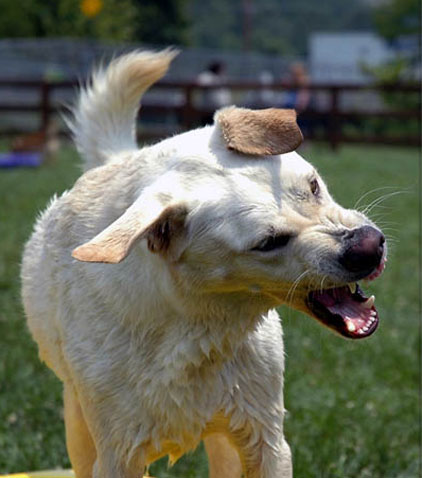
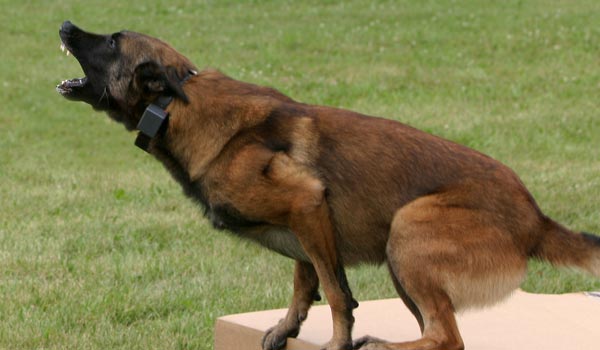
While a large dog (like the one in the photo above) can
put you in the hospital, a small dog can put your child
in the hospital. Dominance of any kind needs to be dealt
with and if not eliminated at least controlled in ALL
dogs.
I have owned a number
of extremely dominant male dogs over the past 40 years.
These dogs have forced me to study dominance. I look
at dominance in a different way today than I did 20 years
ago. I have learned that dominance is often (not always)
easier to control by using your brain and controlling
the environment the dog is placed in.
No one likes to get bit.
I look at the scars on the arms of many of my friends
and consider myself lucky. I have never had a serious
dog bite, yet I have handled some very dominant aggressive
animals. This includes more police dogs than I can remember.
When I ask people about
these scars, I always get the same answer: I made
a mistake with that dog. Getting dog bit comes
down to making mistakes in how we handle our dogs in
a given situation.
One of the biggest mistakes
new dog owners make is to fail to realize that their
family pet is a pack animal. The fact is most dog owners
don't even have a clue what this means, much less understand
how strong pack drive is in their family dog. Their lack
of understanding of this very important issue is what
gets them in trouble.
One of the best ways to
start to learn about dominance is to study pack behavior
in wolves. Look at the research done on wolf packs. A
wolf pack always has a dominant pair of animals. Wolves
don't maintain their dominant position by fighting with
pack members every day, they do it through subtle means.
Body posture and attitude play a major factor in maintaining
a dominant pack position.

Dog on Furniture causes dominance.
Rank Problems in the Pack
Structure
Rank within a family pack
is a huge, huge thing to a pack animal. A lower ranking
pack member would not challenge the pack leader for food,
or act aggressively towards a higher pack member when
they tried to get into the bed that the lower pack member
was sleeping on. Pack leaders eat first and they get
the better sleeping quarters.
What this translates down
to is this "if your dog growls at you when you go
near his food bowl or if it growls at you when you go
to bed and it's laying on the bed - or if it growls at
you when you try and take its toy away from it - the
dog does not feel that you are a higher rank in the pack
than it is." When a dog growls at the wife or kids
in the family, it sees itself as a higher rank than family
members. When that happens there is a problem brewing.
When Does Dominance start?
It is an extremely rare
situation for a dog younger than 8 months of age to show
signs of aggression related to dominance. In fact most
serious dominance problems do not appear until a dog
enters maturity. This takes place between 15 and 36 months
of age. The most common age is around 18 months.
As a dog matures, its
instincts tell it to assume a rank within the pack. As
a youngster it was willing to be a follower, but if it
grows up and does not receive the proper training or
if that training was lacking (which it often is) or if
it is allowed to display rank behavior (i.e. lay on the
bed or on furniture etc) the drive to become higher pack
member will take over. The behavior related to that drive
is often to threaten other pack members with aggression.
Dogs get themselves in trouble by growling, showing teeth,
nipping or even biting anyone it sees as a lower rank.
People often mistakenly
confuse prey drive with dominance. These are two totally
unrelated and different things.
When a pup chews on your
hands or your pant leg (even if its verbalizing by growling)
it's displaying prey drive. Puppies play with littermates
by using their mouth. When they move into a human family
they incorrectly assume that this is how you play with
your new human pack members. It's the owners job to teach
the pup manners.
This article is not about
prey drive - but I must say that I can't count the number
of emails I get where people mistakenly think they have
a dominant puppy when in fact all they have is a very
nice pup with a lot of prey drive.
We use prey drive in training.
When we reward a puppy with a toy we are taking advantage
of his prey drive. If you want to know how to do this
get my video titled Building Drive
Focus and Grip The unfortunate fact is that many
people screw up their puppy by over correcting prey drive
behavior when all they would have to have done was teach
the pup that toys are prey items and arms, hands and
pant legs are not. It always saddens me when I see this
happen. I always look at it like the pup was not dealt
a fair hand of cards.
Obedience Training is ONLY
the First Step in Controlling Dominance
Simply teaching your dog
to mind goes a long way towards establishing yourself
as a higher ranking pack member.
Think of it like this.
The alpha member of a wolf pack would never accept orders
from a lower member of his pack. When rank is such an
important issue to a pack animal - following the commands
of another pack member establishes that member as a higher
rank in the pack.

Poor Obedience Training
is Part of the Cause of Dominance Problems
When you think in terms
of rank and pack behavior it's easy to understand how
ineffective obedience training results in dominance issues
with maturing dogs.
The correct way to obedience train a dog involves three
stages of training:
-The Learning Phase
-The Correction Phase
-The Distraction Phase
1- In the Learning Phase
the dog is taught the meaning of a command through motivational
methods. This means we guide the dog through different
exercises by giving them food or a toy reward when they
do what we want.
2- In the Correction Phase
we teach a dog that it will be corrected if it does not
follow a command that it has learned in the LEARNING
PHSASE. We know the dog knows what we are telling him
to do, but he refuses to do it.
It would be unfair to correct a dog for not following a command that
is does not know.
3- In the Distraction
Phase we teach a dog that it has to mind all the time
- no matter what's going on around it. We do the training
for the learning phase in a location the dog is totally
familiar with (i.e. your kitchen or back yard)
In the distraction phase
we increase the level of distraction the dog is expected
to perform in. (i.e. in the park or in front of other
dogs)
Many obedience classes
do a decent job teaching owners the LEARNING PHASE but
they really drop the ball in the CORRECTION and DISTRACTION
PHASE. Classes that focus on CLICKER TRAINING and training
classes that focus on owners using HEAD HALTERS (Halties)
or instructors that are against physical corrections
are examples of this. Many of the pet warehouse training
classes fall into this category - they want to appease
the tree huggers and PETA terrorists.
When a dog has not had a solid foundation in all three phases it will
not mind all the time. When these dogs are faced with a high level
of distraction they ignore commands.
People who only take their
dog to puppy classes also miss the training on corrections.
The only place a puppy should be corrected is for not
coming. If they don't COME when called it could result
in a dead dog. Puppies should not get serious corrections
until they are 6 to 8 months old.
When Your Dog Won't Mind
When the Alpha wolf issues
an order - pack members listen and mind or they don't
survive. When dogs choose not to mind their owner they
are in effect saying they do not respect that person
giving the commands. Dogs that don't follow commands
think that they are an equal or higher rank within the
family pack.
Dogs are extremely observant.
It does not take them long to determine that you, or
your wife, or other family members are not consistent
in how you expect them to mind. Once a dog figures out
that it only has to mind under certain circumstances
it is a short step for the same dog to start to think
that it only has to mind when it wants to. This empowers
the dog and elevates pack drive.
They begin to think they
can ignore commands that they choose. With some dogs
(thankfully not all) this translates into challenging
an owner or family member when their confidence has been
built to the point where they want to challenge for a
higher rank in the pack.
This is the exact place
where dogs start to show their teeth, growl at the owner,
nip at the hand that tries to take a toy away etc etc
etc.
Had this same dog gone
through training for correction and distraction at a
young age the odds are this situation never would have
evolved because dogs that are brought up properly look
at the owner as a clear pack leader.
This is the reason SO
MANY DOGS seem to live happily with the family up to
12 to 18 months of age and then suddenly change into
CUJO. It's when the flowing hormones and raging pack
drive and lack of proper obedience training take over
the family pet.
Did You Wait too Long to
Obedience Train?
When owners wait until
a dog matures to start training this results in some
dogs thinking "Why should I mind this person? I
am stronger than he or she is and I don't have to do
what they say".
In other words by waiting
to train a dog or by ineffectively training a dog the
owner creates a situation where they have to use extreme
force or fight the dog to show the dog that they are
stronger. I will get into this in more detail later.
Controlling Every Aspect
of Your Dog's Life Helps Control Dominance
The remainder of this
article is going to offer ideas on how to control different
aspects of the dogs life.
While the majority of
dogs only require obedience training to get their dominance
under control, other dogs need additional work to establish
their handler as the pack leader.
Owners often inadvertently
allow things to happen that helps develop a dominant
behavior in their dogs.
Understanding subtle
dominant behavior in a dog help people learn how to establish
themselves as the pack leaders in the home. Here are
just a few behaviors many dogs will display that represent
a dominant behavior:
-
Sleeping in bed with
the owner
-
Pushing you to pet
him
-
Not allowing the husband
into the bedroom after being gone on a trip
-
Growling near food
or toys
-
Not allowing you to
take toys away by showing aggression (not just playing
keep away)
-
Always going through
doors first
-
Always going down
stairs first
-
Being extremely dog
aggressive
-
Resisting laying down
when told to DOWN
-
Showing aggression
to certain family friends and not others
Your bedroom and YOUR
BED!

Controlling dominance
begins at home. The first thing we need to do is to take
total control over the dog in terms of where he is allowed
to sleep, eat and play. The dominant dog should never
be allowed to sleep in the bedroom. The best place to
sleep is always reserved for the pack leader (you). Make
your dog sleep in a dog crate in a room other than the
bedroom. Of course, if your dog lives in a kennel out
back this is not going to apply.
When people bring an 8
week old pup home there is nothing wrong with putting
the dog crate in the bedroom for a week or so to allow
the pup to adjust to his new home. But as soon at the
dog is crate trained (does not scream in the crate) the
dog crate should be moved out of the bedroom.
I do not allow a dog to
sleep in the bedroom until I am 100% sure the dog knows
exactly who the pack leader is and I NEVER ALLOW DOGS
ON THE BED.
Your Toys
As puppies grow up they
should not be allowed to become possessive of their toys.
Your attitude needs to be ALL TOYS ARE YOUR TOYS and
you allow the pup to play with YOUR TOY.
A new pet owner should
not play tug-of-war games with their pup. Tug games are
an integral part of protection training but they have
no place in raising a pet. Playing tug with a dog creates
dominance problems. The dogs get empowered when the owner
lets the dog win the game.
The handler should be
able take every toy away from the dog at any time without
the dog showing aggression. If the pup growls, there
is a protocol that should be followed. I have covered
this in my DVD on Dominant Dogs.
In its simplest form we
look at what caused the pup to get over excited. It can
be the owner over stimulated the dog and caused the problem.
When that happens this is a handler problem not a dog
problem. If a pup bites (which is common and normal)
with normal handling we don't hit the pup we simply lift
it by it's cheeks and hold it as we stare in his eyes.
We do this until he calms down and submits.
Back in the early 1990's
I used to recommend shaking a pup by the scruff of the
neck. I no longer do this because some people take this
too far.
If the dog is older and
there is a concern over being bitten, a leash should
be put on the dog and the dog should be corrected off
the toy. If there is any growling at this point the handler
should scold the dog with a firm, deep voice.
Once the dog has dropped
the toy the handler should lead the dog away from it
before bending to pick it up. Until the dominant situation
is under control that toy is never given to the dog again.
The handler controls his dogs universe and the
dog needs to learn this. The factor in that scenario
is, You determine what toys are played with and
for how long.
If the dog will not give
up a toy when corrected on leash and the handler does
not feel comfortable with his ability to safely get the
toy out of the dogs mouth, there are 3 options
available:
- Ignore the situation, only pick
a fight that you can win. When the dog finally releases
the toy, pick it up and put it away for good. He doesn't
play with it anymore.
- Trade the dog for a piece of food.
When he drops the toy put it away and set up a training
session where you are in a better position to correct
the dog for not releasing the toy. (possibly having
a muzzle and prong collar on to make sure you will
not get bit)
- To win the toy war with a
strong mature dog takes planning. If it's done wrong
you will be bit.
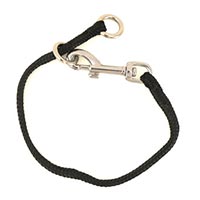
First put 2 collars on the dog. A Leerburg Dominant
Dog Collar is the best to first put on the dog. (Click
here or see photo below) The second collar can be a normal collar.
Attach a leash to a post or a tree or solid object in your home (i,e,
around a door knob and then close the door on the leash so the long
end of the leash in a different room than where the line is over
the knob.)
When the dog has the toy in his mouth,
put him on leash and take him to the location of the second leash
that is attached to the post. Clip the second leash to the dominant
dog collar on the dog. So the dog now has two leashes on, each attached
to a different collar.
Now tell the dog to
drop the toy and back up and stretch the dog between
the post and you. Put enough pressure on him that he
spits the toy out. As soon as the dog spits the toy
out verbally praise him. If you can approach without
getting bit, do so and calmly praise the dog. If he
tries to pick up the toy when you approach, don't get
mad and scream. Just calmly say NO DROP IT and back
away as you tighten the leash again.
This process should not be a wild and hectic operation. Keep your
cool and remain calm. By remaining calm you greatly increase your
image in the dog's eyes - he sees that you can choke him until
he passes out without getting mad. This procedure does not hurt
the dog. There is no real pain, it just takes the air away from
him and he submits. If the owner makes a fight out of it and gets
crazy and screams it defeats the purpose of what you are doing.
Continue to choke the dog as long as he goes after the toy when
you approach. If you don't feel comfortable picking the toy up,
then kick it out of his reach. This is one way that you only pick
a fight that you can win.
This two leash process
is only necessary with big dogs. Little dogs still need
the dominant dog collar but they are simply picked up
off the ground and hung until they drop their toy or
stop acting aggressive.
Some handlers are simply too soft in temperament and they will not
do this. My position is that when the option is to solve the problem
before the dog bites someone - or to do this rather than put the dog
to sleep - well it's a simple decision for me. I would rather deal
with handler aggression with our dominant dog collar a
few times than by taking the dog to the vet and killing it. In most
(not all) cases the problems have been caused by the owners not doing
their job properly. So here is part of the fix on tough hard dogs (toughness
and hardness are not a size issue - small dogs can be very hard dogs).
Training a Dominant Dog
Requires That You Have Quality Training Equipment
One point here. Make darn
sure you use good
equipment when you do this. Make sure your leash
is a quality leash like you see the photo below. You
would not want your leash to break when you are in the
middle of a problem with a handler aggressive adult dog.

Leerburg
Amish Leather Training Leash
If you have no plans to
protection train your dog it is not a good idea to play
tug games with puppies. This builds the dogs drive
towards being possessive of his toys.
If you do plan on doing
sport work (Schutzhund work) or have plans to make your
pup a personal protection dog or police service dog you
are going to want to play a lot of tug games with the
pup. We want to build its drive towards the tug and eventually
the bite sleeve or body bite suit. What needs to happen
at an early age is to develop a relationship with the
dog that after allowing him to win the game of tug a
few times, the handler can take the tug away from his
dog. I have found that giving the pup a piece of food
after taking the tug away is a way of rewarding the dog
for releasing the tug. This also is the beginning of
teaching the dog to OUT.

This photo is an example
of exactly how NOT TO KEEP YOUR DOGS. One of the biggest
mistakes dog owners make is to allow dogs on furniture
or beds. This causes dog fights and increases the potential
for dominance problems. In this case the small dog on
the back of the couch was almost killed by the other
dogs.
Dinner Time
A dog with dominance problems
is never allowed to be in the kitchen or dining room
while the family eats. The worst thing that can happen
is to feed a dominant dog from the table. Again, the
pack leader always eats first and gets the best pieces
of food. If your dog is a house dog, put him in the dog
crate or another room at mealtime.
Feeding the dog from the
table enhances your problems.
Aggressiveness Around the
Food Bowl
Being aggressive around
the food bowl is a common problem with some dogs. There
are two issues about food aggression:
I look at the food issue
differently than many people. A lot of trainers will
tell you to practice taking your puppy's food away at
a young age. I prefer to look at it in a different light.
I don't want my dog to be aggressive around his food
bowl. I am not sure that this translates into "me
taking his food away."
In fact I think that many
people make mistakes by taking their dog's food way too
much. Why not look at it from the dog's point of view:
You are starving and your
mother gives you a plate of mashed potatoes and turkey.
As you are eating your father reaches over and takes
your food away for NO APPARENT reason. You never said
anything wrong or did anything to be punished by losing
your food. After awhile your father puts the plate back
but then takes it away again. This creates confusion
in your mind because you look at it as if you were being
punished. If your father does this all the time when
you are a kid it will eventually piss you off and at
some point you will put your foot down and say ENOUGH
OF THIS CRAP. STOP IT !!!
I feel a better way is
to build trust in my pups. Teach them that I am a good
guy and that I am always fair with them. I will train
them that they must SIT before I put the food bowl down.
This is something they have to do their entire life.
When my pup eats I will
softly talk to him and very slowly pet his back. I try
and be very very calm about this - not hectic patting.
I want the pup to learn that me being around him when
he eats is a good thing. I may put my hand in the bowl
but I never take his food. If he shows aggression I will
shake him and scold him. But if this is done properly
he will learn that me being around the food bowl is not
a bad thing.
With older dogs I am not
sure its worth the fight to win the battle. If
I buy a dog that is already aggressive around his food
I usually do not force the issue. I still make the dog
sit for the food bowl. But with these dogs I feed them
in their dog crate or dog kennel. I put the food down
and walk away.
With food aggressive dogs
I NEVER LEAVE FOOD IN A DOG BOWL and I NEVER FEED A DOG
OUTSIDE OF THE DOG CRATE. To do so only courts disaster.
If there is still food in the bowl 10 minutes after feeding
I open the door on the crate, take the dog out and close
the door. The dog goes outside and I remove the food.
They only get food one time a day - if they don't eat
they are either too fat or not hungry. It does not hurt
a dog to go a day without food. In fact FASTING a dog
for one day is healthy for the dog.
When and How to Pet and
Praise the Dominant Dog
Having a good bond with
a dominant dog is critical. These dogs live and die by
pack order. The only way to maintain control is to maintain
a good relationship. But this must be done on your terms.
A dog that comes to you
and tries to force you into petting him when you are
reading the paper or working on the computer is displaying
a form of a dominant behavior. Do not allow this to happen.
Make the dog go lay down. In fact, controlling his behavior
through the use of a long down is one of the very best
ways of establishing yourself as the leader.
Almost all dogs want to
be petted. But there is a difference between a happy,
friendly dog that just wants a pet and a dominant dog
that wants to force his attention on you when you are
busy doing something else. Understanding the difference
between these situations may come down to experience.
If your dog doesnt display any other symptoms of
dominance except wanting to be petted, you don't have
much of a problem. The solution is to always make a dog
do something before you pet him. Give him a SIT command,
or give him a DOWN command then pet him.
What Do You Do at Doors
and Stairs
Never allow your dog to
go into a room or through a door or down a stairs before
you. This means very little to humans and a lot to a
dog with tendencies for dominance. Make the dog sit at
the door every time you take it outside. Just like you
make it sit every time you put the food bowl down to
feed it.
If one of my dogs tries
to rush past me to go down stairs I use my knee to slam
it into the wall. I teach the dog the WAIT command on
our walks. I then use this command at doors and steps.
If I have to have the dog wear a prong collar and a drag
line in the house I will do it. A Drag line is a short
leash that does not have a handle. The dog can drag it
around and it will not get caught on furniture the way
a normal leash with a handle does.
Showing Aggression Towards
Family Friends
When a dog shows aggression
to certain visitors to the house this is a form of dominance.
People with small dogs think this may be cute, while
others are pleased that their dog is acting protective.
Both are wrong. This behavior needs to be controlled.
The dog needs to be taught that this behavior is unacceptable.
The easiest way is to
verbally scold the dog and put him in his crate or put
him in a different room. When you show him that you control
his environment all the time you are establishing yourself
as the leader. In a pack, the pack leader is the one
that determines who fights and when. If we allow our
dogs to determine who to attack on their own, we are
allowing his dominance to take hold.
People that protection
train dogs (in Schutzhund or police work) may be thinking
that this is bogus because these dogs go out and work
on their own. The fact is that Schutzhund dogs, personal
protection dogs and/or police service dogs do not work
on their own. Through training the handler establishes
the rules of engagement. The dog learns when it is and
is not acceptable to bite. The
fact is that protection training helps establish pack
order as long as everything else in the dogs life
related to dominance is done properly.
Doors and Stairways
Living with a dominant
dog requires a number of small subtle things being done
to make the dog understand that you are his master, the
leader of his life, the person he looks up to and respects.
One of the small things you can do is always make the
dog let you walk through a doorway or go down a flight
of stairs before he does. This may seem like a small
thing but in fact it is not. If you enforce small things
like this (that do not require a fight to accomplish)
you are setting the tone for the relationship.
Dog Aggression:
This is a difficult situation.
I have found that its easiest to control this at
a very young age and get a grip on it before it becomes
a serious problem. I do not allow my puppies to fight.
I step in and shake the snot out of them for getting
too serious about fighting. They quickly learn that I
am the one who determines if and how hard they are allowed
to play.
Controlling dog aggression
in adult dogs is the topic of a completely different
article. It involves using electric collars and muzzles.
The fact is that with some adult dogs that have not had
this early training, no amount of work is going to completely
eliminate dog aggression.
Alpha Rolls ARE STUPID & VERY
DANGEROUS:
If I tried to alpha roll
one of my stud dogs without a muzzle on he would eat
me for lunch. When I hear people talk about taking an
adult dog and alpha rolling them I shake
my head and compare it to Russian Roulette.
For those that don't understand
what an alpha roll is, let me explain. When a dog shows
signs of dominance many trainers will tell new handlers
to take his dog and force it down on its back on the
ground and stare in their eyes until the dog looks away.
The handler is supposed to get down on top of the dog
and grab it by the sides of its cheeks and stare right
into his eyes until it submits.
Well, this is fine for
some little FOOFOO - or with a dog that is not very dominant.
But you had better not try it with a large dog that truly
is dominant. I just got an email from a friend who told
me about an episode in his California Schutzhund club
where two dogs got into a fight. After the fight was
broken up one of the dog handlers (who was not very big)
alpha rolled her large male German Shepherd male (who
had not been obedience trained during its first year
of life). Well, the dog attacked her and bit her in the
face and upper body leaving her with permanent disfiguring
scars. The dog was subsequently put to sleep. The lady
had over 100 stitches in her face.
The unfortunate thing
is this did not have to happen. The lady had been given
bad information. If things had been done differently
this would not have happened to this poor woman and the
dog would probably still be alive today.
I
am not a fan of Alpha Rolls.
Always remember that if
you are going to pick a fight with a dominant dog, you
had better pick one you know you can win.
My feeling is that in
most cases with extremely strong tough dominant dogs
I accomplish as much through subtle body language and
voice commands. In other words, rather than create a
situation where I have to string a dog up on a leash
(and damage the bond with the dog) I will avoid the situation
all together or I will scold the dog with a deep voice
and stare at him. Think of it like this - the Alpha Wolf
in a pack does not have to attack pack members to get
his way. Through body language and verbalizing the Alpha
is able to do almost everything he needs to do.
There are times with
a real kick-ass dominant dog that I will not even force
the issue with a direct stare because this could trigger
an attack. I will wait until I solve the rank issue in
a different way or I will wait until I can control an
attack and win the fight. In other words I fight on my
terms and not his terms. I will assume a subtle alpha
position by scolding the dog and then either lead him
away or call him to a heel and walk away from the situation.
Here is where we need
to know our dogs. You may know that a truly strong, stubborn
dog may fight you if you try and force him into a down
position after a confrontation. I am a firm believer
in not having a fight with my dog (unless it cannot be
avoided). I believe that you lose a lot more than you
gain in coming to blows with the animal. Its always
better to control him a different way. For example, if
you see him stiffen up and hump his back after a situation
occurs, don't try and down him to illustrate how much
of a higher rank you are, rather heel him away and put
him in his dog crate. Do something to show the dog that
you are the one that is in control of him and his environment.
If a handler forces a
situation to the point where the dog attacks, then that
handler has made a mistake. He has misread the situation
and now has a problem. The goal is to see the potential
for a fight before it happens and avoid it without losing
face with the dog.
For example, when I first
got my last police dog he was a very dominant dog. In
the beginning I used a Tri-Tronics electric collar to
get the dog to release his drug toy. The collar helped
the dog spit the toy out on command, but he had such
strong drive for that particular toy that he would guard
it. In the beginning there was a risk of being bit if
I tried to reach down and try to take it away. So I would
heel the dog away from the toy and go back and get it
when the dog was not standing over the toy. As I built
my bond with the dog and gradually established my position
as pack leader I could take the toy without ever using
an electric collar. But this took 6 months of consistent
work.

Allowing a dog to lay in
bed greatly increases Dominance in the Dog
(child's face has been
intentionally masked)
REVIEW
So as I close this article
there are a couple of things that need to be remembered:
-
Only pick a fight
that you can win
-
Whenever possible
use your head and think about a problems cause
and a solution
-
In most cases you
lose more that you gain in a fight with your dog, even
if you win.
Always remember that once your dog relinquishes
pack order to you he will be a much happier dog. Its
like a great burden is lifted off their shoulders. As I
work through the various problems on dominance with a dog
I always remember that in the end this dog is going to
be a much happier dog.
Breaking Up a Dof Fight without Getting Hurt Podcast
Dog fights are violent, loud and dangerous
events. I get emails every day on dog fights. As I wrote this description
I got 2 emails.
In email the family had two dogs. Their female GSD had just killed their
dachshund. In the second email this family's dog had just been in a fight
with a neighbors
dog and done $1,400 damage.
In the mid 1990's I wrote an article on How
to Break Up A Dog Fight - that article is still on my web site. This 52 Minute podcast
is an update of that article. The information in the podcast
has more details on making the decision of even trying
to step
in to break up a fight,
it
discusses
many
methods used to break up fights and it tells how to break up a fight when
you are alone. There is an also extensive section on preventing dogs fights.
Our Basic Dog Obedience DVD demonstrates
how to break up a dog fight without getting hurt. I actually
demo the procedure with two dogs.
Additional
Articles Related to Dominant Dogs
The
Theory of Corrections in Dog Training
The
Ground Work to Becoming a Pack Leader
Raising
2 Pups at the Same Time - Why its a bad idea !!!
Dog
Fights and Questions on Dogs that are Animal Aggressive
Introducing
a New Dog Into a Home with Existing Dogs
Using
Breaker Bars in Dog Fights
Chow’s & Chow
Mixes - know what you are buying!!!

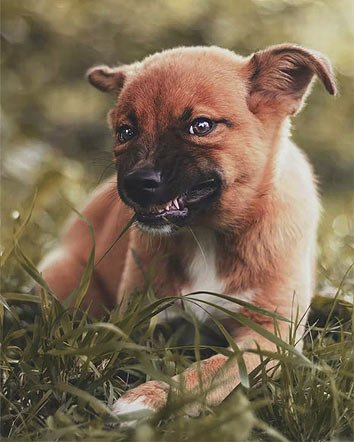
This pup may look cute now
-
when
the dog is 18 to 24 months old this could come back to
haunt you.
DOMINANT
DOG EMAIL QUESTIONS
Question About Dangerous Dogs:
HELP!!!!!!!!!!!!!!!!!!!
I am writing this in a desperate attempt
to keep my sanity ...I have been arguing with my husband
for the last 6 months about his dog. We are expecting our
first child in 5 days and still nothing has been done.
At first my husband pacified me with "I'll find somewhere
for the dog to go" to now "I'm not getting rid
of the dog".
If I could simply explain----we have been
together for 5 years, when we first met I owned a male
Pit who he eventually became very close with. Two years
ago the male Pit died from cancer, to say the least we
were devastated to the point of grief counseling and antidepressants.
We loved the dog. Four weeks later John comes home with
a female Pit. She was cute enough and having her here did
alleviate some of our pain; I begged him to take her back
and he didn't. I wasn't ready to give my heart to another
animal. She is now at 22 months and I believe beginning
to show real signs of dominance. The other night I awoke
and came out into the living room and she was laying on
our comforter on the couch, I immediately pulled the blanket
out from under her and scolded her to get off which she
did, but when I came out of the bathroom she was in my
bed laying next to my husband! I went to grab her collar
and she growled at me for the first time. I couldn't believe
it and for a split second I didn't trust the dog. Maybe
she feels my animosity once we had a neighbor over with
his 7 year old, as they were leaving the child walked into
her "space" she is frequently on a runner in
our yard,,,she pinned him down and started like she was
trying to bite him, although she didn't. I thought then
my husband would get rid of her. He later rationalized
and said she didn't know the child and our child would
be different. I am in a state of terror over this .....I
am having nightmares of killing the dog out of fear it
will bite my not yet born son. My husband refuses to see
it any other way. Every time someone brings a child around
he tries to let the dog near it. Needless to say anyone
who has a child will immediately remove it. The dog is
extremely hyperactive, when John plays with her he plays "rough
wrestling" the dog sounds ferocious. I never play
with the dog. She nips and dodges right for the face. One
time I went to pet her as she was sitting there quietly
looking cute, I made the mistake of getting too close and
she head-butted me right in the FACE! INSTANT FAT BLOODY
LIP!
Like I said my due date is in 5 days, he
swears the dog will not be here when we arrive from the
hospital. If he plans on the dog coming back I have threatened
to have it taken away. I've told him about my visions of
killing the dog if it comes near the baby. Do you have
any suggestions for this no win situation?
Thanks -------Desperate and Pregnant in RI
Answer About Dangerous Dog:
Your husband's problem is bigger than the
dog problem. If you don’t solve that first you will
never solve the dog problem.
Bottom line is this is a dangerous dog and
he does not admit it. You both need to read my article
on Dealing
with a Dominant Dog.
If you change the way you live with this
dog it could be saved but it does not sound like your husband
has a clue. He falls into the category of STUPID STUBBORN
DOG PEOPLE – the worst kind – owners like him
are the reason for 95% of dog bites to kids.
So with all this said you have three choices:
1- Have him read the article and promise
to make the changes
2- When you husband is at work – take
the dog to a shelter and leave it
3- Leave your husband.
There are no other options.
-------------------------------------
Dear Mr. Frawley,
I just spent the better part of my day looking through your website,
and I wanted to tell you how much I appreciated the "dumb and dumber" section.
I haven't laughed that hard in a very long time! It's so refreshing to
see someone being honest even if it's not what people want to hear.
Last year I finally got up the courage to consult a trainer about my
dogs. My ex-husband left me with two backyard bred female Pit Bulls
who I unfortunately loved very much but could not control and nearly
lost a finger splitting them up from fighting (I REALLY would have
been on your dumbEST section if I went into detail!) As a last resort
before putting one of them down, I began working with Roland Fox
who is a certified master trainer and runs a program called K-9 Solutions
NYC. His training methods run parallel to yours and quite literally
changed my life. I now have full control over my two formally unmanageable
dogs, and no longer fear what next potential disaster is around the
corner. The change in mine and my dogs behavior so drastically improved
all of our lives that I have decided to become a full time trainer
and now work (as an apprentice) with Roland. One of the tips he gave
me to improve my capabilities was to study and learn from your website,
particularly to see how ignorant the average dog owner is! I'm sure
you get thousands of emails and I don't want to take up any more
of your time, but I thoroughly enjoyed reading your web pages, they
have been of unmeasurable help to me, and I wanted to thank you.
Very Sincerely,
Rachel
PS...Not that you need me to tell you, but crate training my dogs saved
their lives. I am taken aback every time I hear someone say that crating
a dog is mean or unnecessary. My dogs not only needed crates, but they
love having their own space!
-------------------------------------
Dominant/Aggressive Dog Problem Question:
Mr. Frawley:
Your website is very informative, thank you for making all this knowledge
available, it truly changed my mental paradigm on dog behavior. I read
your articles on aggressiveness and would really like to ask for your
advice on a time bomb my father (Edward) is keeping at his house, a
2-yr-old intact Bullmastiff, aka “Bruce”.
Just a quick overview on the dog's temperament:
Gets along with his 2 feline companions, occasionally will
press his chin against the younger cat's back (which is
the cat that gets petted the most) but still lets the cat
eat/drink from his bowl and they lick each other’s
forehead occasionally. He doesn't display aggressive behavior
towards dogs either, when he was younger he would be afraid
but now just ignores them (unless the dog is unrestrained
and barking, then he will start barking but never actually
fight).
With people it's a different story. He loves
all the family members but is weary of strangers, will
get along with just a select few. I know you're thinking "this
dog was never properly socialized", and you're right,
he also wasn't taught basic commands such as "sit", "stay",
etc.. He's always been treated by my father like his “kid”,
my dad would constantly play with him, hug/pet, let him
sleep on the couch, sometimes climb into bed. He would
also make this huge commotion when getting home (whistle,
call the dog's name and give the dog full attention as
soon as coming in through that front door).
Now this loving relationship between the
two has changed, I think Bruce is trying to challenge my
dad's "leadership" in the pack, but I'm not sure
since there are other factors involved.
We live in Florida and Hurricane Wilma made
a mess in our neighborhood, destroyed the fence on the
backyard, the roof, the streets were chaotic. We were stuck
in the house with no electricity for a few days. Bruce
was probably confused to see his environment change so
much, during those day he also couldn't see what was going
on since we had shutters blocking the windows (his favorite
spot in the house).
As soon as it was safe to roam the streets,
my dad took Bruce for a walk but had placed the prong collar
on the wrong side (he never really used the prongs for
training since he thought It'd be cruel, he got the collar
as a gift from my sis and would use the “pain-free” side).
Bruce felt the prongs and made a sound like he was hurt,
my dad immediately fixed the collar and spoke to bruce
softly "I'm sorry, etc.."
After this day he started
to sometimes growl at my dad.
One person advised us
to show Bruce the prong collar every time my dad
was about to take him for a walk and throw it on the
floor and say "this hurt Bruce. It's bad.. bad!" and
get an alternative plain collar and show as being ok,
so that the dog would associate the pain he felt with
the object and start trusting on my dad again.
A few days after, just when we thought things
were going back to normal, my parents were coming back
from work and as my father opened the front door Bruce
just snapped. He growled and tried to bite him, during
that instant my mother pushed my father back, commanded
Bruce to stop and got bitten on the arm. When she started
yelling the dog stopped, he realized he wasn't getting
his primary target. I came rushing from the bedroom to
see what was going on, and my parents were behind the door,
I immediately bribed Bruce into one of the bedrooms and
left him there in the dark the whole night (btw, he hates
sleeping in the dark).
He then was kept in the patio and backyard
for almost a week. The veterinarian prescribed him a tranquilizer
and an anti-depressant and told us to get him neutered.
My mom would show him her arm and say “bad dog, look
what you did”and he would sometimes look away and
sometimes bark. He's been taking the meds for 11 days (with
progress) up until yesterday when my father decided not
to give him any and the same episode happened. As soon
as they opened the door Bruce growled. This time he couldn’t
bite, since he wouldn't get close to the door - there was
this piece of crown molding on the floor blocking his way
there. He could have easily jumped over it since it was
so low, but if the path in front of him is not clear he
won't go over objects (he's had this fearful behavior since
he was a puppy, so imagine when he saw the hurricane mess).
He stops growling and barking when my parents reprimand
him loudly but stares defiantly.
Shortly after the incident I gave him his
medication, put him outside and am leaving him there for
a while (he's an indoor dog, who's constantly left sleeping
on the couch when my dad is at work). He hasn't tried to
challenge me yet (I never really established a bond with
him or praised him constantly, I just don't intrude on
his space and he doesn't intrude on mine), he seems ok
with my mother but has stared her straight in the eyes
after she told him to shut up and stop growling. His main
target is really my father. My dad is so heartbroken, his
reaction is more like "why are you doing this to me?".
I think he needs to hear that he has to be
tough with this dog, he can't act like everything is normal
and try to pet the dog, take him off the medication and
just wish for things to be normal in a few days. I'm here
on a short vacation while my husband is out to sea w/ the
Navy, so I won’t be able to help my dad with this
situation for much longer (I only have 2wks). I'm sorry
this e-mail is so long, but I felt you needed to know the
details in order to better comprehend the situation. I'd
truly appreciate it if you could take the time to answer,
the stress level here is pretty high. My mother found a
no-kill shelter which accepts aggressive dogs. No one wants
to euthanize Bruce and I'm a firm believer of new beginnings.
Thank you very much for reading, your advice is gold.
Alexandra P.
Answer to Aggressive Dog Problem:
I recommend that you
go to my web site and read the article I wrote on my
philosophy of dog training. I think you will get some
good ideas there http://leerburg.com/philosohy.htm
This dogs is dominant. He became this
way because of the way your father and mother raised him.
Many people make the same kinds of mistakes. It's too bad.
I have a saying: I have a saying that
I tell people – it goes like this” Everyone
has an opinion on how to train a dog – just ask you
barber, your mailman and your neighbor” The problem
is very few people have the experience to back up their
opinions. This results in a lot of bad information being
passed out So people like yourself need to figure out who
has the experience to warrant being listened to.
The information you have been offered
falls into this category. In fact its stupid advice. I
strongly recommend you and your parents read the article
I wrote titled THE THEORY OF CORRECTIONS IN DOG TRAINING.Your father failed
your dog in not properly correcting the dog.
In addition you need to read the article
I wrote titled Dealing with Dominant Dogs. Allowing dogs
like this on furniture and on the bed is insane. It’s
a recipe for disaster. But then you are living the disaster
right now with this dog.
In my opinion this dog has gone beyond
your families skills to handle it.
If you think you want to try - it will
need training and a new lifestyle. You may want to read
the article I wrote on GROUND WORK BEFORE OBEDIENCE TRAINING.
Regards,
Ed
-------------------------------------
Dominant Dog Question:
Dear Ed,
About ten days ago I was attacked by my 3 year old Basset Hound. I had
to go the hospital and Simon was placed in Animal Control.
During this past ten days
I have tried to find a home for him with a strong trainer.
I know that a family situation was out of the question.
In ignorance, I thought maybe a rescue group would take
him. I could not find a home for him. With children still
in my home, we could not bring him back. This has really
been a heartbreaking experience for me because I was so
close to this dog and I loved him so much.
Simon's behavior had increasingly gotten worse from growling and snapping
to as of this instance running and attacking. As I lay on the floor
and was bitten over and over again I thought he was going to kill me.
The more I fought back with my legs and arms the more he bit. I did
not know he was capable of this especially with me who loved and cared
for him.
I have had dogs all of my
life and I have never come across this aggression situation.
After seeing your website , I now realize how ignorant
of dogs and their emotional and behavioral needs I am.
I have such a soft heart
(especially for that Basset Hound face), that I truly let
this dog take over. Disciplining him was hard because he
would come at you. What I don't understand is that having
always been around dogs raised in our home from puppies
why hasn't this happened before. I grew up on a farm and
dogs ran wild with no training .
I have been informed by
several area rescue groups that there is a definite problem
with the breeder we chose. There supposedly have been complaints
to the American Kennel Club. I was told I needed to add
to these complaints. I now realize there were warnings
that I didn't respond to. There were possible training
techniques to be used as puppies develop that I knew nothing
about. After speaking to my vet many times about this he
would just say that there have been cases of Bassets being
aggressive and that I might have to give him up.
I would eventually like to have another dog but I want to do all the
right things. Should I choose a different breed of dog? I have always
loved beagles and bassets and was raised around them. I would appreciate
any advice you might give me.
Thank You,
Cheryl
Ed's Comment:
Your experience is not unique.
Not properly raising a pup can have dire consequences.
You are not alone - so many people ignore pack instinct
in their dogs - they don't see RANK issues when they start
to develop.
The fact is that serious
obedience training at 5 to 6 months (with a correction
phase) will often eliminate these kinds of problems. People
need to neuter dogs at 6 months, they need to use dog crates
and they need to train their dogs. When these three things
happen you will seldom have problems like you just had.
It's a terrible thing to
be attacked by any dog, much less your own. It's also a
sad thing to have to put a dog to sleep - but in this case
that's what should happen to this dog. Once a dog like
this has attacked an adult member of the family there are
very very few people who have the experience to correct
the problem. 99.9% if the so called behaviorists out there
would not have a clue on how to fix this dog. Vets fall
into this category. Medication would not work.
-------------------------------------
Dominant Dog Question:
Dear Mr Frawley,
I wanted to shoot you a quick email to let
you know the great improvements I'm already making with
Hunter (training him myself). I watched your tape, which
by the way was fantastic, it was like showing the secret
behind a magic trick. It was inspirational and encouraging
and it got me really excited and motivated to train Hunter
the right way and it made it seem possible (I even made
the liver treats).
Also I've been reading the book "The
Dog Listener" by Jan Fennell, which I've found to
be very interesting. Just by working with him everyday
my problems have almost diminished completely already.
I can have people (friends & family) come to the door,
ring the door and actually have them come in without a
fuss. Now hunter barks at the door when the door bell rings
or he hear someone coming up to the door, and once I open
the door and greet the people he's fine and walks around
and smells them with no agitation (actually seemingly social).
I always make him sit before I open the door, maybe that
helps. Also now on walks no more barking and lunging, I
do keep him by my side when we pass people or I will have
him sit or down so that he gets used to seeing people pass
by and that it's no big deal.
As a side note, every week the housekeepers
come by and I always put Hunter outside because he's always
barked when they're around, and through the glass when
he's outside, they aren't friends or family so I still
like to play it safe in fear of being sued. Today I thought
I'd put him on a leash and work with him in the house while
they were cleaning. Everything was fine he was paying attention,
and I saw that he wanted to smell the housekeeper who was
standing next to me so I thought why not (mistake! mistake!)
the second he smelled her he started barking like crazy
at her. He was on a leash so I corrected him and he immediately
stopped but I couldn't figure that one out. Any insight?
Well I've just only started training him
so I know I've got a long ways to go, but I was so excited
with his major improvements and I wanted to share them
with you. Also I noticed in your catalog that you have
a newly updated basic dog obedience on
DVD, but I couldn't find it on your website. Could you
direct me to that page because I would be interested in
purchasing the basic dog obedience tape
on DVD as well.
Thanks.
Regards,
Yvette
-------------------------------------
Dominant Dog Question:
I have some of your video tapes and equipment
and I just can't tell you enough how much they have helped.
You deserve an award for your videos! Out of my first litter
of German Shepherds, I have chosen a male to keep and train
for my own personal protection dog. My husband & I
manage a small motel now and he is a city cop and works
at night, so I'm here by myself a lot. I feel very confident
that I have chosen the right dog for me because of your
videos and articles on testing pups. This puppy "Zeus" and
I "clicked" when he was 2 or 3 weeks old, it's
one of those hard-to-find bonds between owner and dog,
that no amount of money will buy. I am so proud of him.
He's 14 weeks old and we have mastered "sit" very
well and now we are working on "down" and also
working with a leash some. Your videos have taught me a
better way to train and I am more patient because I have
seen the outcome. I get so frustrated with some of my customers
that buy my pups, as I'm sure you do too. I can't seem
to get the fact through that a well trained dog doesn't
just happen or that it takes more than a month or two to
get a wonderfully trained dog and just because a puppy
has a good working bloodline doesn't mean that he will
automatically be "wonder-dog", that it does take
some training. I recommend your articles and videos to
my customers and give them your web address because I believe
you are wonderful. We've been able to accomplish much more
with our dogs since we discovered you. We even have a 1/2
Rott. that has been a pleasure to train. I always said
I would never have a Rott. I thought they were "time-bombs".
He has proven me wrong. He is about 18 months old and is
a little slow maturing, but we're not rushing him. He is
just now starting to show some aggression. Thanks to your
articles on "Dominance" and "Aggressive" dogs,
we better understand all dogs now and I'm not so afraid
that this Rott ( Rabi ) will be out-of-control. My husband
brought him home from the pound because he had a good bite
and because he had a very even temperament. ( not to mention
that he's a little soft hearted and could not stand to
see him put down ). And I am so glad he did. I have to
tell you though, that when strangers or friends are over
and they hear us tell Rabi "fooey", that think
we've lost our mind. This is Texas, "fooey" isn't
in the vocabulary ! But it DOES work. My husband was told
that you never are suppose to say your dog's name along
with "no" or "fooey" that they associate "no" with
their name after awhile and you have trouble getting them
to "come". Is that true? It makes sense. The "Dominance" articles
really helped with my stud dog. At 2 yrs. he started getting
pretty dominant towards my husband mostly. It really didn't
take a lot of effort to make him quit, just persistence.
He's fine now. Before reading your articles I wouldn't
have known what to do with him because I have never had
a dog with that much dominance before. Again thank you
so much for taking the time to write all those articles
and make all those videos.
Sincerely,
Lisa
-------------------------------------
Dominant Dog Question:
I copied this letter in this article after
it was posted on my web discussion board by Julie Gausten
This is a sad story, but I have learned
the hard way:-
When I was a Teenager, my parents got
me a Corgi (Pembrokshire). I called him "Ross" and
he was a real sweetie as a pup and grew to be a very handsome
adult.
He was not neutered, as my father just
winced at the idea and the only reason he was not allowed
on the beds or furniture, was because my mother hated to
see dog hair! (a lucky break?).
Anyway, we were asked to leave ob training
classes, as he was so disruptive. To their credit, they
did advise us that "we would have problems with this
dog". But did not offer any other advice.
The odd growl here & there, progressed
to food and toy possessiveness & finally (after about
5 years) a fully fledged "attack" on a family
member. (Me! - when I tried to pick him up to give him
a bath!). How he missed my face I will never know.
After this, none of the family could
ever trust the dog and he was put-down.
We gave this dog no leadership, guidance
nor training. He did pretty much what he wanted, no wonder
he thought he was head of the house. We just thought he
was "The Dog"! and knew no better.
If only I had known then, what I know
now about the treatment & training of a dog.
I have always wanted another dog, but
was very wary about the prospect. However, having researched
dog training, I took the plunge. I now have 2 well mannered
dogs, who know their place & receive leadership, guidance& training
- as well as play & lots of love!.
Ross died because he lived with people
who "killed him with kindness", It saddens me
so much when I think about what happened.
If he is waiting for me at the bridge,
I hope he will forgive me for failing him.
RIP "Rossie Doggie," I am so
sorry.
Julie
Dominant Dog Question:
I have purchased a few videos from you
and some products your website is awesome thanks.... My
question is I have a 5yr. old Rott he has a good pedigree
with some good working dogs in it that was told to me by
a Rott person well the dog has been obedience trained and
has some some bite work I got the dog about 2yrs ago and
he has been a good dog playful and very alert but when
I purchased the dog from a K-9 trainer and breeder of Shepherds
and Malinois he said Bo has a lot of defense in him and
to be careful with him and not let him around children
as he is a one handler dog well I did just that and I keep
him in a very secure kennel around no one but here recently
when I go take him out of his kennel he will growl at me,
I tried correcting him but he still does it and when I
get him out his tail stops wagging and when I praise him
hes not excited anymore. Bo is very dog aggressive
from day one and tries to chase cars... lately Ive
had to muzzle him to put him on a chain to clean his pen
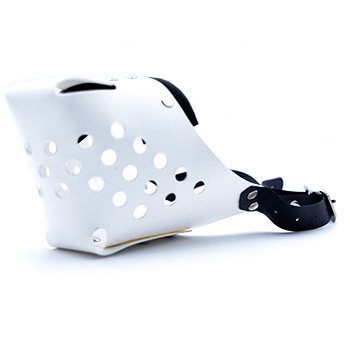
out I use a Jafco muzzle I got from you, now I have to
make a decision whether to keep him and deal with this
problem or put him to sleep,I would like to keep him but
am I putting myself in a dangerous situation of getting
bit one day or can I deal with this problem, selling him
is no option because I know he can hurt someone badly and
there are too many irresponsible dog owners out there so
what should I do?????
Thanks, Confused Allen
Answer:
It seems a little old for a dog to all
of a sudden start to become aggressive to the handler.
Usually this begins at an earlier age (around 2 or 3.)
I would begin by having the dog checked
out by a vet. Maybe there is something medically wrong
with him. Maybe he is not feeling good and just wants to
be left alone.
If the vet gives him a clean bill of
health then you need to deal with his aggression or make
the decision to put him down.
I have an article on "Dealing with
the Dominant Dog and Dealing with the Overly Aggressive
dog" - read these and make sure that you are doing
everything properly.
If the dog is used to wearing the muzzle,
make him wear it for awhile and then take him out with
a prong collar and do some obedience training. Sometimes
prong collars can over stimulate a dog. If this happed
then use one of my Dominant Dog Collar.
Every instance of unwarranted aggression
needs to result in a correction. If the dog comes after
you then you have a handler aggressive dog.
When that happens it's time to get some
help from someone who really understands rank drive. The
problem is not a lot of people know how to deal with this.
I have a DVD that goes into this area (Click
here)
It involves a dominant
dog collar and following the protocol of using it
correctly. See the article I wrote
on how this is done
This is not done with a fight. The handler
must remain very calm or it just brings out the fight in
the dog. If that happens then you lose what you are trying
to do, because the dog thinks its a fight and that's
not what this is about.
Its about a dominant dog understanding
that you are a higher rank than it is. In the wild the
leader of a wolf pack has the power to kill a lower ranking
pack member if he chooses. Very handler aggressive dominant
dogs (dangerous dogs) must have that kind of respect for
their handlers. Not that the handler will kill the dog.
They won't and don't want this.
Dogs (all dogs) are pack animals. Dogs
understand rank within a pack. Dogs that attack their handlers
don't respect the handlers rank.
This portion of my article has been mentioned
and taken out of context and written about on other web
sites. These sites choose to attack this method of handling
dangerous dominant dogs.
The people who own these sites ( like
Sue Marston in Ventura Ca )have never been exposed to a
truly dangerous dominant dog. Ms Marston would either choose
to kill the kinds of dogs I am talking about (rather than
give them a chance) or they would get severely hurt trying
their foolish Peta methods of training.
My comment to Ms, Marston is they need
a lot more training on dominant and aggressive dogs and
that should start by taking a good arm and leg bite from
a tough dog. It is surprising how that will make them see
the light of god and find Jesus in a dominant dog collar.
With this said, dominant dog collars
like any training tool can be abused. In the wrong hands
a Halty can be abused. So I am not sticking up for abusive
or untrained dog trainers. There are plenty of those out
there.
-------------------------------------
Dominant Dog Question:
I have a 2 1/2 year old who has been
obedience and protection-trained. I have used all of your
training methods for his protection work. He has been very
good with kids while still showing a strong nature to protect.
He loves to stay in the yard and play ball with the kids
to the point that he interferes.
My 10 year-old son called him in the
other day to put him in his cage so that he could play
basketball in the yard. Needless to say the dog did not
want to come in. My son ordered him in his cage. He went
in but as he put his hand to the cage to lock him in, the
dog growled at his hand. I pulled him out and gave him
a fooey with a correction. I told my son to lock him in
again with the same results. I gave another correction
and had him try it again. This third time he let him close
it. Did handle this situation correctly or should I be
considering getting another dog. Since this dog has grown
he has developed fight drive. He has otherwise been a charm
for me and my family. Please help me on this one. I'm really
shocked.
Answer:
At 18 months the dog is coming into maturity,
he is starting to exhibit some rank drive.
You need to follow the information I
have in my article on dominance to
a "T."
You did the right thing, I would probably
have kicked his butt a little harder.
I don't think I would replace the dog
just yet. If necessary get a muzzle and
a prong collar and have your son
work the dog in obedience in a muzzle.
If it were my dog I would get an electric collar, a prong
and a muzzle. I would learn how to use the collar with
the tapes I have, and then have your son works the dog
while you controlled the collar. It would not take long
for the dog to realize his position in the family pack
- (which is below the child.) Do not do this without a
muzzle.
Dominant Dog Question:
HELP! We got Tucker when he was 6 months
old, from a family that had two very small children. They
felt overwhelmed and could not keep the dog.
He was wonderful and friendly until about
the age of 1 year. He suddenly became very aggressive.
Things that occurred about that
time:
- We rented a room in our house to a
women and he was sprayed by the mailman. At it's worse,
Tucker would attack (charge at someone's feet and stand
there with his teeth showing and snarling in a way that
you knew he would attack if the person moved another
inch. This started to happen to the women who rented
from us on a daily basis.
- Eventually he would attack my husband
in the same way.
- In almost every instance this occurred
in the morning. The ritual was something like this....
My husband would get up, get dressed, take Tucker for
a walk, on returning back to the house after the walk,
Tucker would join me in bed. My husband would come to
kiss me goodbye and Tucker would VICIOUSLY (growling,
snarling, pacing, charging) keep my husband out of the
bedroom.
- Then later when I was up getting ready
(usually the same way every morning) Tucker would hang
out in the bedroom. When it came time to leave the women
who rented from us rode to work with me. When it was
just about time to leave, Tucker would begin pacing and
when she came downstairs to leave, he would run for her
feet. She would literally freeze. I would have to get
Tucker away form her or he would have bitten her and
sometimes did actually grab her foot with his teeth
Some of the ways I would try to stop
this:
-
Scream "no", keep a leash
on him in the mornings and pull him away, soothe him
out of the aggression by stoking him as he snarled and
growled, choke collar with the leash attached.
Sometimes I would literally have to come from a half asleep state to
a full dive out of bed to grab him so he would not attack my husband.
-
There were even times that my husband
would have hold of the leash and have his arm outstretched
to keep Tucker at a distance. A few times Tucker would
even be lifted off the floor and would be choking. My
husband had to do this a few times just to keep Tucker
from getting him. I have been the only person to be able
to touch him in this state.
-
I can pick him up. He is growling
and snarling the entire time he is in my arms while I
carry him off to a room or his crate.
-
We have had private training, one
group class, drug therapy, animal behaviorists look at
him. We checked for medical explanations (hypothyroid)
his blood work is perfect!
The roommate is gone, but now we have
my husband's teenage daughter living with us. He will attack
her as well. The way we have solved this mostly is adapting
the way we live. After my husband walks the dog in the
morning. He leaves him outside until he's ready to go.
He kisses me goodbye and on his way out lets Tucker back
in. WHENEVER I am getting dressed everyone just stays away
from the room and when we leave, I let everyone leave first
and then I come out.
If anyone comes to visit I lock Tucker
in the bedroom. The other day Tucker turned on me. First
time in four years! He did not bite me. I grabbed him and
pushed him down on his back, held him down by his neck
and smacked his face a couple of times (not hard) and said
No! I am not afraid of Tucker, everyone else is!!!
I am fairly certain that somehow I have
caused this monster by reinforcing this behavior SOMEHOW??????????
Can this be changed! The problem is still there even though
it happens much less than before. But it is because my
family has changed the way they live. I can't imagine why
my family would tolerate this (except that we love Tucker
very much!!!
MOST of the time, Tucker will sit in
ALL of our laps, jump for joy when any of us come home.
and at night when we go to bed....My husband is permitted
in by Tucker (in fact, Tucker cuddles with him every night)
Probably to keep him away from me. I'm sure you can tell
that this is a really bad situation. My step daughter ALWAYS
ask where Tucker is when she enters a room, you just can't
trust him and she's afraid he will be in the "attack
mood." Can you HELP?
Answer:
Can I help you? NO!!! I don't think you
can help yourself!
You mentioned in your email that you
thought that you had created this problem. Well, you are
100% right - you have. You have allowed this dog to take
over your house and it is beyond me how people can allow
this to happen. But then I am a dog trainer and the solutions
are very simple (to me).
If you want to keep this dog, which I
am not sure is the correct decision, you need to make some
serious changes in the dogs life. From the sound
of it you are not going to be able to do this.
-
The first step should be to get a
top quality electric dog collar and learn how to use
it. There are good instruction videos on this (we sell
some).
-
Get a good muzzle for the dog and
make him learn to wear it - the Jafco plastic muzzles
that we sell are fine for this.
-
The next step with this dog is to
NEVER allow him in your bedroom again. Not for any reason.
The bedroom for these kinds of dogs is 100% off limits.
He should be corrected for coming in there (make sure
to have the muzzle on him when you do this).
-
Do not ever ALPHA ROLL a mature German
Shepherd - or for that matter any large dog. I don't
care how strong you are - your face is only inches from
this animal and if you pick the wrong dog on the wrong
day you will be getting plastic surgery on your face.
I know people who have made this mistake. DON'T DO IT
- I cringe when I hear people tell me that their dog
trainer told them to "put the dog on his back and
get on top of him." You are dealing with an amateur
when they tell you this.
-
Do not ever let the dog get into your
lap. This is foolish. This is not a situation where this
dog is trying to get loving - its a way for him to demonstrate
his dominance. People totally misunderstand how strong
a dogs pack instinct is. They don't recognize when a
dog is jumping up to be friendly and when he is jumping
up just to show someone that he can do it any time he
wants. These are 2 totally different situations. So the
solution is don't ever let him do it at all.
Train the dog that it has one spot in the house that he must go to
when he is told to go there. This can be his crate or a certain rug.
Start by teaching him to go there for food. Once he understands that
when you say "Crate" he must run to it and get into it, then
you can correct him when he does not go there when told. By correcting
him with an electric collar (the way the videos show) you will have
control over the dog without having to fight him. The dog should never
be fed before you eat. He should also be fed in the garage or the basement.
This is important.
-
Finally, if the dog does attack your
husband in the way that you have said, your husband did
the right thing in stringing the dog up. His only mistake
was he quit too soon. With dogs like this they should
be stung up until they pass out or just before they pass
out. During this process there should be no screaming
at the dog, the handler should be very calm and not act
like he is fighting with the dog. It's OK to say in a
calm voice "You will not attack me - you will not
do this." The dog must feel that he is about to
die and he must understand that he has no control over
it. This is the ultimate way of establishing whom is
the boss. If done properly it only takes 2 or 3 times
and he will never have to do it again. From that point
on the dog will realize who is the boss and what can
happen if he screws with the boss.
-
But I can not over emphasize that
when this is done the handler must be very calm and very
quiet in how he acts.
If you are prepared to do these things
this dog may be salvaged. If you do not you are risking
your step daughter and any guests that you have, What kind
of a home must this be for a step daughter who is afraid
of the dog? You have a bad situation that has creeped up
on you but also caused by poor handling. If you are not
prepared to make the right steps to correct this , you
should put the dog to sleep.
-------------------------------------
Dominant Dog Question:
I will start out with a little bit of
history on our dog. He is registered. We brought him home
with us when he was 5 weeks old which I have since found
out that was not a good idea. He is 19 months old and resides
both inside the house and in our fenced yard. We had him
professionally obedience trained in which he stayed at
the trainers house for 1 month. He is still in the process
of training but he now stays with us and we take him to
an obedience class with other dogs. The trainer wants to
do this for distraction purposes. His name is Bubba. Before
he left to go to the trainers, Bubba growled at our 9 year
old son twice. Once when our son petted him while he was
eating (the dog got a major correction), and once our son
petted Bubba while he was sleeping. We were not in the
room at that time. He had never growled at our son before
this. We sent him to the trainers and told her of the growling.
Bubba has been back home 2 weeks. He plays with our son
during the day, licking his face, and rubbing up against
him, tongue hanging out and tail wagging. They play both
in the house and out in the yard. After about a week, we
came in the house one evening, our son walked over to Bubba,
petted him on his chest, and said Hi Bubba. Bubba
growled.
He doesn't show his teeth when he growls,
but looks our son right in the eye and does a belly growl.
Once again he was corrected. ( I have a horse crop and
I came down hard on his head and sternly said NO at the
same time. My son again petted him, this time on the top
of the head. Once again, the growl. Once again, a correction.
I did not have a leash on Bubba at the time. The times
that Bubba has growled at our son has all been in the house
and only in the evening, (night). We talked with the trainer.
Our son has played, teasingly with Bubba since he was a
puppy. Such things as walking up behind him and trying
to scare him. Our son has watched his dad playing rough
and tumble with Bubba and thinks that this is okay. The
trainer told us Bubba respects the dad but not the son.
We also have a 7 year old daughter. Bubba has never growled
at her. (Bubba will growl at anyone if they try to pet
him when he is eating, we have told the children not to
bother him at this time.) I am the one that works with
Bubba and we have tried to guess what the problem may be.
My son is a very affectionate child and I don't know if
any jealousy could be involved. The trainer said Bubba
is not CRAZY, the growl is a warning and she doesn't think
he would ever hurt our son. She thinks there has been something
in the past that our son has done that has stayed in Bubba's
learning block and he has not forgot it. She thinks with
pack order, the dog sees our son as the loner, and will let him in the pack only when he wants to. It was suggested
that our son hold Bubba's food bowl, sitting down for 5
consecutive days. If Bubba growls, he is corrected and
the food is taken away. After 15 minutes, try again. Bubba
does not get to eat unless he takes it from our son. If
after five days, he continues to growl, we need to get
rid of him. That is the history. Now my question is this;
is this something that will pass and we can correct? I
love the dog. He is everything that I have ever wanted
in a dog, BUT not at the risk of my child getting hurt.
If there is any way we can correct this, I would be willing
to do it, especially since Bubba seems to love our son
most of the time. Any suggestions. I don't want to get
rid of our dog, but if there is a chance of our son getting
hurt, I can't keep him.
Answer:
The dog is going through maturity and
trying to change his rank in the pack. Read my articles
on my web site about Dealing With the Dominant Dog. You
made a mistake in sending the dog off to a trainer. This
accomplishes very little with a dog like this other than
to teach the dog that the trainer is dominant over him.
It does nothing to change the way he views his family pack.
You need to do some serious obedience
training yourself. Get my training tape titled Basic
Obedience. Also get a prong collar and
learn how to use it. If the dog shows any signs of growling
during hard corrections - get one of these cheap Jafco
muzzles I sell. The dog can not bite you with a muzzle
on.
When you are satisfied with his obedience
around you (and you have done the things in the article
I wrote on dominance. Then put the muzzle on and have your
son do obedience with the dog. You can put a second 20
foot line on and follow behind him. If the dog gets growly,
you hit him so hard with a correction that he flips over
backwards. This is a level 109 correction and the SOB will
learn that you do not growl around the boy. But this always
is done with the muzzle for safety purposes and it is very,
very important to make sure he has been acclimated to the
muzzle for 2 weeks before doing this.
DO NOT DO WHAT THIS TRAINER SAYS WITH
YOUR SON HOLDING THE FOOD BOWL. You are only asking for
a dog bite. This is foolish advice from someone who needs
to learn more about dog behavior.
Do what I said above. Take the dog through
the program. Tell the kids to leave the dog alone when
he eat. Why force the issue. Just leave him alone. Put
the food down for 20 minutes and pick it up, even if he
has not eaten. He will eat the next day when the food comes
down. It only takes a couple of days for the food to be
picked up for him to learn. This is a simple way to eliminate
that problem.
Maybe after the dog has gone through
the training with the boy and learns not to fool with him
you could make a point of having the boy hold the food
bowl when there is a treat in it. The dog eats from the
bowl and it's put up. Not immediately and not when he is
growling while giving eye to eye contact. This is one step
away from a bite and to say that he will not bite him when
he is doing this is stupid.
Dominant Dog Question:
I have a question concerning my Pit bull.
Recently he has been attacking my roommate, and when we
try to leave the house through the front door. One thing
that stands out is that, if he does not let us take him
out in the morning we know to sneak out the back door otherwise
he will attack if we try to use the Front door.
He started doing this to his owner my
roommate. Three days out of the week he works very early
in the morning. He used to be able to take him out in the
morning, but recently he has not allowed him to take him
out. He does allow me to take him out instead of my roommate
. The problem is that if the dog is not in the closed room
with my other female Pit bull and me. He will sit in front
of my door and wait for my roommate to head towards the
door, as soon as he does he run towards the door and tries
to bite the door and my roommate. He has only been doing
this towards my roommate, but recently he has started to
act like that towards me.
He is like Dr. Jeckel and Mr. Hyde. One
day he does everything perfect and acts like a wonderful
dog, but there are days where he has this look on his face
where fear comes to me and my roommate. He is not neutered
from reading your literature it won't help if I neuter
him. So before I put him down I would like some advice
to what I can do to correct the problem.
Thank You,
Carlos
Answer:
This dog has a problem with rank. In
other words he is the pack leader in the house.
I have written an article on Dealing
with the Dominant Dog on my web site. I do not believe
that a dog like this will respond to JUST the work I describe
I this article.
The issue of rank can be cleared, but
it takes a lot of skill from the handler and is a dangerous
thing to try and correct. I would guess by your email that
you do not have the skill to do the work if I describe
it.
My advice would be to find someplace
that needs an area guard dog and give it to these people
(after you are sure that they treat the animals in a kind
way) or put the dog to sleep before he really attacks you.
This behavior is not going to get better, it will only
escalate.
-------------------------------------
Dominant Dog Question:
I have an American Shepherd (I look forward
to the day when I can purchase a REAL shepherd from you!)
who is 2 & 1/2 years old.
He is an outside dog. Yesterday he came
into the house through the patio door. I calmly took a
hold of his collar to take him back outside. He growled
at me.
This morning we went for our 2 mile walk.
(I can let him walk leashless where we go) He darted off
running at the geese. I told him to come. He did not come.
Usually he does. While he was peeing on a tree, I walked
up to him calmly & took a hold of his prong collar & told
him "bad boy." He growled at me.
In both situations I was not at all harsh
with him. Why did he growl? He has only done that once
before about a year ago. I corrected him with the prong
collar right at the time he did it. He hasn't done it since
until yesterday.
It scared me a little bit this time.
He has been told no many times before & not growled
at me - why now?
I haven't been able to spend as much
time with him lately as I normally do - is he mad at me?
Is it just a temporary behavior thing or do I need to have
him put to sleep?
Michelle
Answer:
Your dog is challenging you for rank
in the pack he is coming into maturity, and this is rank
drive showing its ugly head.
You also need to take this dog through
serious obedience training, in addition
to doing EVERYTHING I mention in that article.
If you are afraid of the dog then get
one of these Jafco muzzles and it
should become part of his life. He wears it all of the
time. Especially when he has the prong collar on and is
in a position where he will growl.
-------------------------------------
Dominant Dog Question:
My name is Saskia and together with my
husband and 2 children age 4 and 6 we live in belgium with
3 dogs. A rottweiler from 6, a bordeaux dog from 2 and
a mastino from 1 year old. About two weeks ago my oldest
daughter came in screaming that the dog bit a child from
11 years from next door. It was not serious so we thought
that he entered on our garden without notice and tried
to grab his sister when she was playing with my children.
This had never happened before. Last friday a women came
in with a child from 3 at her hand. The dogs all begin
barking but I remembered wondering why the mastino his
name is vito kept on barking. They where behind a fence.
I went out to escort this women and child inside. When
I opened the door vito came like a tornado bent his head
to pass me from behind and attacked the child. He snapped
her hip I let myself fall down on him while the women pulled
the child backswords. He still had a hold off the sweatshirt
and he shook his head very wild and aggressive from left
to right. We finally had to pull him away with 2 persons
and lock him up (with keys) because he opens the doors
pushing doors or pulling or sliding with weight pumps on
it he opens them all. There was no reason at all in attacking
this child. It had not spoken screamed or yelled at the
dog neither did the women. I let them in so he had to
accept there entrance. Today my husband was standing next
to him when a man and his 2 children walked inside. Immediately he stared to growl at this 2 children completely ignoring
everybody else in the room. His eyes were fixed on them
and was again very aggressive My husband lead him out off
the room. As I start wandering what could have caused
this aggression in my dog towards children? My neighbor
the mother from the child that he bit first the one from11
years she came to me and told me that her father in law
saw already that this boy sometimes is teasing the dog
through the fence. I don't know exactly what he did to
make our dog into what he is right now: a very dangerous
killing dog towards children. What can be done to make
him again tolerant towards other children, and could this
also turn against my own children. Up to know he's still
very nice but can I trust him now like I did before??
Thanks
Saskia
Answer:
There is NO SOLUTION FOR YOU. The only
safe solution is to have this dog put down. I am sure the
child next door had something to do with causing the dog
to become aggressive, but at this point it has gone too
far. The dog should NEVER EVER be allowed near children.
If you decide not to put the dog down,
the damage it does in the future rests on your shoulders,
because you know the risk this dog is to others.
If you do not have the heart to put the
dog down, find a factory that needs a guard dog. There
are plenty in your country. I know because I go there.
Make sure the factory has a fenced in kennel for the dog
to live in (look at it first) and agree on the quality
of dog food the dog will get.
This dog is just now coming into the
first stages of maturity, this problem is only going to
get A LOT WORSE as he matures.
-------------------------------------
Dominant Dog Question:
Hello there and thank you for taking
the time to read my question. For mothers day a few years
ago I received a female German Shepherd who was given to
me by my daughter. The prior owners were looking for a
home for her as they were starting to raise Jack Russell's
and the Shepherd was just too dominant with them, they
would NOT get along. At first I thought it was because
she (the Shep) was kept outside and was lacking for attention.
Well, it is going on 3 years now and her behavior has not
changed. I think life would be so much more pleasurable
for her if she would only stop trying to "rid the
world of all other living creatures, other than herself." I
foolishly had her bred last year not thinking that this
was a trait that could be passed down. I just thought it
was a behavior problem that needed to be addressed. She
had a beautiful litter of 9 pups and I have one of them
that I call my little "misfit." We love him very
much but he is now showing the same dominant behavior as
his mother. (by the way, she was spayed yesterday!!) She
is only 65 pounds, but he on the other hand is 85 and only
9 months old. He is very hard to control when he (or she
for that matter) sees another animal. It doesn't even have
to be a dog. They both love their family very much. I have
3 children under the age of 10. The only time they ever
show any signs of aggression towards the kids is if they
try to lay over them when they are petting them or snuggling.
I am the only one who can do that without any growling
or moaning on their part. The male, who hates baths, showed
his first real sign of aggression yesterday when I was
trying to get him in the tub. I grabbed his collar and
called him and he growled at me, twice. I am not sure if
I handled it correctly or not, but I just kind of ignored
him and said sharply NO then proceeded to pull him in the
tub. I gave him lots of praise for his good behavior. I
know there has to be something I can do to change this
behavior. I love them both very much and want them to be
happy, as well as myself and my kids !!! Please don't tell
me a professional trainer is my only resource as that is
not an option for me at this time.
Answer:
You have a male who is becoming dominant
at an early age. You need to read my article on this. You
also need to obedience train this dog with a prong collar.
He needs to understand his position in the family pack,
which is at the bottom. Keep the collar on during the day
with a short 2 foot line that you can grab and correct
him with. If he shows signs of growling or biting get one
of the cheap Jafco muzzles we sell.
Tell the kids "NO MORE ROLLING ON
TOP OF THESE DOGS" why even put the kids in a position
where they could potentially be bit.? No use creating a
problem yourself.
As far as the dog's aggression goes this
has to be dealt with an electric collar probably a Tri
Tronics sportsman model. They will always have to have
this on.. it's not something that ever goes away for good.
-------------------------------------
Dominant Dog Question:
January 27, 1999
Hi Ed, My name is Jill, I live in
WA. state and breed German Shepherds. I do obedience training,have
been in schutzhund and behavior problem dogs are my specialty.
I just got on-line for the first time a few days ago. I
wanted to tell you how much I enjoyed your articles, WHY
IT'S A BAD IDEA... and DEALING WITH THE DOMINANT DOG. I
can't tell you how refreshing it is to see someone tell
it like it is! I have been using the pack/alpha theory
in my training and consulting for years. Because of the
huge popularity of the Rottweiler breed, I have lost count
of how many have come to me with behavior/dominance problems. For
the last 4 years my behavior consulting has been 75% Rotts. It
sickens me to see a breed gain such a bad rep because of
the stupidity / negligence of owners. I'm glad that the lady
whose Rots killed the boy was convicted, she deserved it! If she was training with these dogs and had some knowledge
of SCH. then she cannot claim she didn't know their capabilities
as the average pet owner claims. Just yesterday in our local
newspaper there was a jogger that was mauled by 2 Rots.
He's hurt badly. When the police came on scene one dog attacked
the car. They were shot. These dogs had gotten out before,
My neighbors bred their Ratty bitch and kept 3 pups. These
pups are now over a year old, 2 intact males, 2 intact females
all running together. They have a renter on their property
that had a 13 yr old malamute. He had been there long before
she had these pups,and the dogs got along. The pups started
trying to play with the old dog when they were quite young
but when she would try to scold them the mom would jump
in. The old dog stopped coming out from under her owner's
trailer except to potty.The old dogs owner, Scott, told
me that the Rots would sometimes run circles around his
trailer and bark at his dog. The owners of the rots would
laugh as they thought this was cute! I told Scott that
something had to be done because this "game" would
escalate and his dog would be hurt or killed.One day,I
heard their dogs really carrying on and saw them running
circles around Scott's trailer. I tried to call the rots
owner and quickly realized no one was home. By this time
rots had Sheba. I just reacted and ran down there, on
the way breaking a branch off a tree. I beat those dogs
with everything I Had in me and it still took awhile to
get them off her. Then they just circled. If it were not
for another neighbor coming to my aid I don't know how
I would have got her out of there. I do realize it was
stupid of me to put myself in that position but I couldn't
just sit there, it is not in my nature. Unfortunately Sheba
died. The root owners are making up excuses for their dogs,and
saying it was Shebas fault because she use to try to bite
the pups when they were younger! These dogs have no obedience
training and they all still run together. I don't try to
push my knowledge on people and the things I have told
them is ignored (they are very defensive and I'm labeled
as a know-it-all).Something bad is brewing and I cant do
a thing about it. Plus what is really scary is Rott owners
just had a baby! Ed, these people are just a small example
of what I see going on around me, It's unbelievable! Anyway
thanks again for such good articles.
Sincerely,
Jill
-------------------------------------
Dominant Dog Question:
Hi Ed,
I work with tons of behavioral problem
dogs and aggression counts for a good # of them. I agree
with the obedience being paramount & the dog learning
to mind. I recently finished a couple of dogs with this
same problem and have heard from the owners who tell me
the dogs are doing great. The key was teaching the owners
how to establish basic control over the dog and how to
correct for bad behaviors. The "behaviorists" around
here are really just dog trainers w/a different name so
they can charge more by the hour. I use a lot of motivational
training but in this case the dog has to be taught boundaries
- and correction is essential. A lot of what I would call "90's
type trainers" who only believe in food and praise
will never be able to finish a dog like this reliably.
Or it may take forever. There has to be a consequence to
bad behaviors. The dog needs to learn limits and the owners
how to train and handle such a dog. In short, I agree.
Regards,
Nick
Dominant Dog Question:
Hi Ed,
Thank you for all the info you have posted on your site. I have a situation here and unfortunately I only see one conclusion, which is to find our
dog a home. I have an 8 year old Dalmatian, Bear, and he has always been known
as an alpha dog...even got suspended from doggie day care for fighting with other male dogs. I raised him from a puppy and he knows all his commands
and he can even be walked without a leash and sent home on command....Bear
is pretty much the perfect dog. About a year ago we adopted a male Great
Dane, Blake, he was days from death. We brought him home and got him healthy.
Our goal was to get him healthy and find him a home; Blake is still living
with us, guess we fell in love with him. Bear would always let Blake know
who the boss was and being that Blake is not aggressive at all, after a couple
of butt kicking's Blake knows to stay away. None the less they have actually become pretty good friends now, I come home to find them laying together
and they always are playing, they have not had a fight in over 6 months but Blake still knows his place in the pecking order. For example, even though
I
feed them separately when I get their food ready Blake goes in the other room to wait for bear to go outside and eat.
The problem is that all three of us..My wife, daughter 14, and myself
have no problems with Bear, Bear is actually quite tolerant, my daughter used
to put little hair clips all over him and he would just come to me to take
them off. But the bottom line is we are always careful when people come over,
we tell them to not get in his face and pet him, we actually mostly keep
him up in our room when we have company over. All that ended the other day,
when a 5 year old boy came over and while bear was on our bed he went over
to see him and Bear took the boys nose off. Thank god after some plastic surgery the boy is doing well but we now are about to adopt a 5-year-old and
I am not willing to take the chance of this happening again. I don't think
we have any choice but to find Bear a home but I am willing to listen to any suggestions....One idea was to find the Great Dane a home and even though they are doing ok now maybe in bear's mind he is working overtime as
Alpha dog. Bear has never attacked anyone out of the blue but has always been alpha dog and aggressive that way. If you get in his face, you will lose it...Its still not expectable and we cant take the chance of a little
boy not listening to us and testing the water on his own like most kids do.
We have done a pretty good job in training him but my wife and daughter
find it cute to cuddle with bear on our bed and kind of have bear tell them what
and when he wants something. They laugh and say how I'm alpha but he is second in command and I always tell them that it is not funny and it will catch
up with them someday. We love both Bear and Blake but Bear is like a son
to us...I had his mom and now have Bear so even though Blake is a great
dog I would find him a home before I found one for Bear. One other thing about the great Dane and small children...Blake is the kindest dog you would ever find...anyone can take his bowl away or pretty much do anything to him and he just looks at you, but considering his
size, he is 125lbs and really tall, my wife is afraid that when Blake wants
to play he can end up accidentally hurting a small child out of pure innocence. Is there anything we can do to control that from happening or should
Blake also go to be on the safer side. We love animals more than anything...actually more than most humans so this is a very hard thing
to do.
Thank you very much,
Manny
-------------------------------------
Dominant Dog Question:
Mr. Frawley,
I have a 3 year old Dalmatian, Lab, Pit bull
mix weighing about 65 lbs. Two days ago, while loading
up our car for a trip, we were walking in and out of the
house with the dog. While the dog was left unattended momentarily,
a city worker pulled up at just that moment and walked
on the property. In a split second, my dog charged him
and bit his ankle severe enough to require stitches. Currently,
my dog is in quarantine at Animal Control and we are faced
with having to put him to sleep after the 10-day period.
We are not required to put him down, but I am afraid that
this could happen again--even if we are being super diligent,
I don't know if I can guarantee he would never get out
again by accident or other unknown circumstance. This was
the first time he has broken skin or bit a stranger--but
I can't stop feeling in my gut how bad this could have
been if it were a child who wandered on the property at
that moment.
He has been territorial since a puppy. He
has snapped at or lightly bitten guests in my home who
came near his feeding area or touched his food. When someone
comes near the house, or if he is in the house and the
doorbell rings, he barks in a vicious way. When I walk
him and someone else is on the road, especially if they
have a dog, he pulls to get to them and I hold him back
because he has snapped at other dogs and I am afraid he
may bite. He is very strong and will not listen to my commands
to stop without my holding him back. I now realize that
pulling him back probably has made the situation worse.
When I have taken him to a friends house and put him in
the fenced backyard to keep him away from my friend's two
small children and their toy poodle, when he sees them
on the screened patio overlooking the back yard, he barks
and growls and will even attack the closed door if they
were to venture near. This behavior has made me extremely
uncomfortable for some time--it seems to be getting worse
as he gets older. Around the family, including cats, birds
and his best buddy, a small Chihuahua, he is very friendly
and sweet. In the past, we have had him kenneled when we
go out of town and he has not had a problem. Also, when
he has gotten out and run away, he is never aggressive
to other people or animals ( a stranger picked him up and
took him to the humane society shelter once and I have
found him playing with other dogs on another occasion).
This situation is breaking my heart because I know that
we made a mistake in not getting him professional training.
My husband often roughhoused with the dog and sometimes
I feel encouraged (unintentionally) his aggressive behavior
during their play games. My husband is definitely the leader
of the pack--but he is often away on business and my daughter
and I are left to care for the dog. I need to know if it
is possible to retrain a dog of three years to not be so
aggressive and dangerous to others or if putting him to
sleep is the only responsible thing we can do. We love
the dog and my daughter is crying and can't sleep over
this, but we want to do the right thing. Thank you for
any advice you can provide.
Sincerely,
Diane
Answer:
If you asked me, I would recommend putting
the dog to sleep. This behavior could be corrected but
I don’t think you are capable of doing the work that’s
required.
The aggressive behavior should have been
addressed when this dog was young. Your husband's play
did not cause any part of this. Read the article I wrote
on DEALING WITH A DOMINANT DOG.
In reality you are correct. We are talking
about a dog that was not trained. You are also correct
in saying that this could be a lot worse. Had this dog
ever gotten a child, you would have a very bad dog bite.
It is never an easy decision to say that
one should put a dog to sleep. It must always be the last
option and I seldom recommend it.
-------------------------------------
Dominant Dog Question:
Hi,
My son has a staffy cross, not
sure what the cross is, but she is mainly staffy to look
at. He had two dogs, the dog that was attached by the staffy
was a border collie named Jess, she was 17 years old. Molly,
the staffy, is 5 years old. They were alone in the house
together, when Molly attacked and so severely injured Jess
that she had to be put down. Molly must have thrown and
shook her around. The injuries that Jess received were
horrific, to her throat, her lung was punctured and the
rib that would have covered her lung was missing. The vet
also suspected her pelvis was fractured, and it was at
this point that it was requested of the vet that he put
Jess to sleep. She did not deserve to die this way nor
for that matter, any dog/child etc.
Jess had always been a quiet,
gentle dog, never showed any aggression to anyone.
My son asked me to try and find
some information on the internet relating to the above
attack, and if you can to please give an opinion at to
whether, his son, who will be turning two in June is in
any danger from Molly. I know that perhaps you can`t give
me a direct answer as to whether Molly should be put down
or not, but perhaps with letters that you have received
there may have been similar experiences. Could Molly attack
again now that she has been "blooded" so to speak?
It`s just very hard to know what to do, putting Molly to
sleep won`t bring Jess back to life, but by the same token
if Molly should attack again, how does one forgive one`s
self for giving her a second chance?
And that is why I`m emailing
you, as my son , and myself included, just don`t know what
is the best way to deal with this situation. I hope to
hear from you soon.
Regards,
Shirley
Answer:
I feel badly for you and this
poor dog. Can you imagine what the last minutes of life
were like for this very old dog? To end 17 years of life
in this way is a terrible thought.
I will guarantee you that it is not a matter of “IF” this
dog will fight– it’s only a matter of time and "WHEN" it
will happen again.
Dogs like this need to be totally isolated from other dogs. They can
never come into contact with animals. This needs to be accomplished by
keeping them in secure dog kennels, secure dog crates and through the
use of very solid dog training that results in the dog being 100% under
control even in the face of the most severe distraction (i.e another
dog that is challenging it).
Read the article I have written titled DEALING
WITH THE DOMINANT DOG. You can find this article in the list of training
articles on my web site. I believe you will find the answers you
need in that article or in the Q&A section of
my web site. There are simple solutions to these problems. The question
is if you are willing to do the work necessary to make the changes that
will fix the problems.
A dog like this needs to be trained with an electric collar. I use a DOGTRA
1700NCP.
If you would like to learn more about the principles of obedience training
a dog, read the description for my Basic Dog Obedience
video. You will probably find that you have not had a clear understanding
of the steps of training a dog must go through before it can be considered
fully trained. You can also read why I am not a fan of taking an untrained
dog to obedience classes. I think if you read the testimonials on that
tape you will see that my customers feel the same way.
-------------------------------------
Dominant Dog Question:
I came across this site while searching for
dog obedience, It would be great if you could help me.
We have a mixed breed, 1 and a half year old, Australian
Shepard / Lab / Collie. He is a great dog, easily trained.
Our main issue is that when he is lying down
and you go up to him calmly and pet him nicely and gently,
he will most of the time growl at you. I describe the sound
at growling with your mouth shut. Like a humming. He doesn't
show his teeth, only if you take it one step further and
try to scold him (To be honest when he first did this and
we figured out that it was bad we would scold him by giving
him a swat and shoving him outside, and also yelling at
him. When we do this he cowers in the corner and his back
legs shake nervously.) he may show his teeth..
When this first started (about a month after
his first birthday) we were trying to figure out if this
was a good sound or bad. As sometimes when we would stop
petting him he would get up and come to you and ask for
fuse, although while doing this his tail would be between
his legs and head down.
There was one time once when he came up to
me for fuss and I gave it to him and 20 seconds later he
started growling and slowly cowers away. As I was saying "NO
BARE" loudly.
Now we firmly tell him "NO" and
when we do that he continues to do it, when he stops and
we reward him by saying "Good boy" and pet him,
he does it again.
There are also times when I will call him
and say "Bare Come!" and he won't come he will
walk away with his tail between his legs and low head,
looking very sad. With my husband he get's a better response.
This doesn't happen all the time with myself, there are
times when he will come and I will tell him "good
boy" and reward him. We have tried to walk him more,
on a daily basis. Myself doing it more as I am home all
day.
When we walk in the front door he doesn't
come up to us like he is happy to see us. Whenever anyone
else comes over he is excited and happy. He doesn't display
any of the symptoms when he is at my moms with me or for
a walk, he actually looks happier whenever we are elsewhere
or its playtime.
We have 2 small kids, 5 and 2. They don't
pay much attention to him when he is lying down, but time
that they do he has growled at them. We want to fix this
so hopefully it won't get worse.
I called a behaviorally specialist and he
told us to try the Umbilical Cord Theory for a week. meaning
that he is attached by leash to my waist and has to go
everywhere I go within the house, whether he is sleeping
or not. I am then showing him that I am the boss and he
can't do anything unless I let him. He said his growling
was him telling me that he doesn't want to be touched right
now and that it needs to be corrected. If he does growl
I am suppose to give a sharp yank on the leash and say
no, or growl at him using a deep AAAAAAAAA sound. When
he stops right away tell him good boy. Problem his while
I am yanking on his leash and doing this he is continuously
growling, there is no chance to say good boy, or even if
I touch him and give praise it starts all over again. I
have to wait till he stops and tell him good boy and not
touch him. I think he is winning.
I hope this email makes sense, I am on day
3 or this theory and don't know if it is working. Hopefully
you can help me. I look forward to hearing from you.
Do you just post your responses on the web
or do you send me an email back as well so I know when
to look on the web.
Thanks,
Lorraine
Dominant Dog Question:
We have 5 cocker spaniels, one aged 10
one aged 5, one aged 4 and two aged 9 months. We are having
major dog fights. The two puppies are ganging up together
with the 4 year old and fighting the 10 year old. Three
dogs on one. What can you suggest. I am sure it is for
dominance, but how can I prevent this. The vet costs are
horrendous with the damage done to the 10 year old. Up
until the puppies arrived everything was fairly quiet.
It is one of the puppies that is initiating the fighting.
I really need some advice.
Please help,
Brenda (in the UK)
Answer:
Brenda,
You own a dog pack and you don’t
understand pack behavior. This is a RANK issue and they
will kill this old dog unless you change your ways.
There is not a MAGIC BULLET that someone
is going to give you to help these dogs live together.
ITS NOT GOING TO HAPPEN !!
Either find homes for some of these dogs
or get 5 dog crates and keep the dogs separated, or build
5 dog kennels. That's the ONLY SOLUTION to this problem.
Let me pose a question to you – how
would you feel if you lived a long happy life in the same
house with your family. When you were 70 years old your
family brought a couple of gang members into your home
(which you were not allowed to leave) and these gang member
kicked the living shit out of you ALL THE TIME – so
bad you had to see Doctors. After these medical visits
your family brought you back to the house where the gang
members waited?
THIS IS EXACTLY what you are doing to
this old dog. I cannot imagine what’s going on in
his head. But it is very sad.
-------------------------------------
QUESTION on Aggressive
Dog:
Hello,
I had a question about your DVD on Dealing
with Aggression and Dominance in Dogs. I am looking for
a training video for my mom and was wondering if the problems
she is having with her dog would be covered in this DVD
or if another one would better suit her. She has a Cairn
Terrier that is about a year old. It has shown aggression
since she got it. It bites, hands, feet. It bites when
you try to bring it inside, when you try to pick it up,
if you are trying to take something away from it, sometimes
just when you reach down to pet it. It also shows a lot
of aggression, say if you want to bring it in and it doesn't
want to come, and if it sees other people or animals, it
will just freak out like it is going to eat them alive. My
mother is terrified of her, and I think that this is part
of the problem, the dog knows that my mom is scared. Do
these characteristics fit in with this specific training
video, or is there another one that would best suit this
problem, any info would be greatly appreciated. Thanks.
Jessica
Answer:
Well you are correct – this is a pack
structure problem and your mother needs to learn to be
a leader – she is not at this time.
There are actually 2 DVD's that she needs
to study – notice I said study and not watch. It
is IMPOSSIBLE to watch my work and consider yourself trained.
That’s just not going to happen.
The two DVD’s are
Basic
Dog Obedience
Dealing
with Dominant and Aggressive Dogs
Obedience is about 25% of the solution. She
will never solve the problem without obedience but in and
of itself she needs to address pack structure more (dogs
are pack animals and the average person has no idea how
strong those genes are in dogs like this.)
In many cases the final step is to control
the dog with a remote collar – this is where the
maintenance training comes in for the life of the dog.
This is covered in my DVD Remote
Collar Training For the Pet Owner. I recommend an Innotek
ADV300 for that work.
So with this said – the solution to
these problems is in these DVD's. The question is --does
your mother wish to put in the effort and educate herself?
The fact is she has more to learn than the dog.
Good luck
QUESTION:
Dear Ed,
This is incredibly long and I apologize in advance for
its length. You had been nice enough to respond to my initial
email about a problem with my young Dobe and recommended
one of your DVD's which I purchased.
Doberman. Neutered (@13mths) now 18months. Is great around
dogs here at the house or when I set up situations in public
with other owners with dogs on leash.
While I am walking him, if another
dog is being walked on leash and comes towards us, is
being walked at a distance
or if another dog is off leash and approaches him or worst
case if a dog lunges, barks or aggresses at him he will
engage. His reaction can be controlled by diversion or
a "leave it" verbal correction sometimes. Sometimes
he can ignore another dog at a distance and sometimes he
cannot. But if a dog barks at him or lunges, forget about
it. He's in.
I had tried a prong collar on him for pulling and on
leash aggression.
Once, he aggressed on leash at a young female Dobe (about
4 months) who was lunging at him in an excited state pulling
his owner towards us. He aggressively went after that puppy
and I gave him a strong leash correction and he redirected
on me biting my arm, I stumbled backward and was on the
ground. I am a pretty calm person even though his action
certainly attracted the public, but I ended up on the ground
with him biting at my very thick coat (glad I was wearing
this coat) I kept him away from me via the leash, I was
able to pull him to the ground with my foot on the leash
as he was still going off as I got up. That stopped him
and we continued our walk with this other dog owner and
dog with no issue as I did not want to leave this park
on a negative note. I had him sitting and walking around
this dog and we passed other leashed dogs with no issue.
This was about 4 months ago.
He started exhibiting assertive, lunging behavior towards
dogs coming towards him around 10 months and I was correcting
him for it, but based on your emails, not hard enough.
OR, he was associating the pain of the correction with
the approaching dog?
His level of frustration to get at another dog does not
make sense to me based on how much exposure he has had
to just about everything. He has been on and off leash
around horses, llamas, many, many other dogs, my cat. No
issue until about 10 months of age. He has been walked,
hiked with other dogs, been with other dogs on and off
leash since he arrived here at 9 weeks of age. He has been
to dog shows and handling classes with no issue. He was
entered in a dog show and handled by me at 11months without
an issue with other dogs although I could see that he was
not relaxed in that environment. I could walk him around
the show grounds with no issue but I did feel he was not
relaxed just by watching his body language. I was quite
relaxed, just not sure why he was in that state of arousal.
Could it have been all the hormones in play at this show?
After the show around 12 months he was terrible to any
and all dogs on leash. And if they are off leash and try
to approach him in any way, he will absolutely go ballistic
on leash trying to go after them. When walking him or any
dog, I keep a loose leash and do not act tense but am watchful
of behavior to try to correct or redirect him before he
acts. He is a powerful boy, however.
His behavior when frustrated or agitated is a very tense
posture. He wants to get away from me and get at the dog.
When he sees the other dogs and wants it, he sometimes
vocalizes with either a high pitched sound which I read
as frustration, which then goes to a low growl and aggressive
barking. first at the dog , then me upon being redirected
or corrected. I have found over the years being around
aggressive Dobes, that some get a look. Like they are in
another zone. My dog gets that look.
I do not have the physical power, due to injuries, to
correct this dog via a pinch at the level you suggest.
But based on his aggressive reaction to a strong collar
correction I am not sure that is the best path for me to
take. I ended up getting a head halter for him as it will
at least keep his mouth closed should he try to redirect
his frustration on me and it gives me a bit of control
over his head, more so than the pinch. This has worked for
me to date. However, it is not my collar of choice but
at the moment it is one of protection if needed.
You did not think this was a hard case and recommended
an E collar. I bought your E collar DVD and learned from
it. Before I purchased a collar, I had tried out a couple
E collar systems, one older Tri-tronics from one friend
and an Innotek300 from another friend. I ended up buying
a Tri-tronics Sport3Basic.
The collar via your DVD training methods have worked very
well. No issues. He only needs a low setting for obedience
and distraction work, when there are no dogs around.
I dog sit for dogs at my home and he is fine here with
all of them.
His obedience is very good, sits and downs, he kennels
up, does long downs, heels, recalls. I do some agility
work in the back yard. He will also do obedience on a long
line with distractions unless there is another dog around.
He will recall off leash outdoors as I can go to some areas
where I know no other dogs will be. He can be out of site
(trails) and will recall in an instant.
Then he gets aroused to frustrated and as I mentioned,
in some cases gets quite vocal. I have worked with the
E collar per your video and get great results, have used
a verbal marker and either verbal praise or treat, and
also have started using a spray bottle on some walks. Yes,
I know, but it seems to help him come to his senses with
absolutely no aggressive response to me or the other dog
and we can walk very close to other dogs where we cannot
if he is being corrected with either the E collar or a
leash correction since those corrections seem to agitate
him.
I am waiting to buy your DVD on training aggressive dogs
with an E collar as I am a bit confused after reading some
of the the email on your site. Then am a bit more confused
after reviewing the DVD E collar training suggestions coming
with this collar. I do not see my specific issue demonstrated
which I am hopeful you will have on your DVD.
One of your emails stated do not use a high level of stimulation
if the dog aggresses at another dog or he will think the
pain came from that dog. If I read your emails correctly
one gives a verbal NO and if the dog doesn't listen, then
it gets a nick from the collar. I have read mixed advice
as to using this type of collar for aggression.
I do use the E collar when he pulls and in experimenting
with levels, he is good much of the time but needs more
reminders than he should to get back into place. I alternate
between just using a regular collar with his E collar or
if I am going to work with him at parks that are very busy,
I use the head halter so if he goes ballistic I can at
least control his mouth. It has come in handy. Even with
a correction from the E collar.
What is odd is that he will sit for attention from me,
will sit for food or any toy, will wait to get out of the
car until told, has great down stays with distractions
unless a dog will walk by or worse bark or aggress at him.
I can take anything out of his mouth . Food, toys, anything
without issue. He will also drop items when told.
He loves people, and children thank goodness.
So, either he is not the right dog for me, or with your
help I can get him to a level I can control and trust in
all situations like my other Dobe. I would appreciate your
insight. I am an avid hiker and walker and am used to taking
my dogs everywhere, off leash. I hate to think that he
will either be a home bound dog or when outside in public
wearing a muzzle. It is not the life I want with a dog.
If your opinion is he is not right for me, or I am not
the right owner for him I can start looking to rehome him.
Meanwhile, I just got off the phone with the company who
sold me the collar and although they state they are not
trainers, they do not recommend using an E collar for aggression.
Your thoughts?
Diane
ANSWER:
Your right. A very long email.
You have to make up your mind that you want
to keep this dog. If you do you need to stop doing a bunch
of things
you're doing wrong.
This dog does not accept you as a pack
leader – the
way you live with it you're not.
A head halter is a useless piece of
equipment. It’s
not a training tool. If you have concerns for being bit
then have the dog wear a muzzle (not a cloth one). We sell
wire basket muzzles for Dobes.
This dog has no place in a dog park. Read
the article I wrote on dog parks. My web site has a large
number of
FREE
eBooks that I have written.
It should also be in a dog crate when you
house sit other dogs. If you allow this dog to be around
other dogs then
you cause your own problem and this is then an owner problem
not a dog problem.
When you walk this dog and it even looks at another dog
it needs to get a HIGH LEVEL corrections. It gets corrected
for looking at a dog not growling at a dog. If the dog
gets to the stiff legged posture position you screwed up,
because you should have corrected him way before he got
to that level.
Read the ebook I wrote on establishing
pack structure with adult dogs. Don’t for ONE SINGLE
MINUTE make and excuse for this dog taking you to the
ground and then
continuing to bite you while you were there. THAT IS NOT
REDIRECTED AGGRESSION. Redirected aggression is a dog that
gets stimulated with a prong collar correction and turns
and snaps at the handler. It’s not a dog taking the
handler to the ground and continuing to bite. That’s
a dominance problem.
Your dog
is dominant. Neutering at this late of an age (13 months)
was a waste of money – that needs to be done
at 6 to 9 months to be effective.
Comment:
I don’t know if this will go through, but finally we have hope for our 8 month-old Labrador, who thinks he’s the boss of the house and has shown some aggressive tendencies (which Labs don’t usually have, we were told). It’s a concern because we have 5 grandchildren in our home, ages 9 to 16. We have immediately put into practice the advice given in the dominant dog article, and in less than a day we can see some results!
Thanks so much.
Question:
Hi Ed,
I have a question about my dog but I'm ashamed to be writing this because everyone is writing of problems with Pit Bulls, Germans, etc. Well, I have a little SOB West Highland Terrier. Yep, 20 lbs of sheer terror in my life.
I'll give you some background quickly, he was the only dog for a year and all was wonderful. Then our son wanted a puppy and we researched the breeds, finding a Golden to be great with kids. We bought a little boy and that is when all heck broke out at our house.
The Westie has taken the term alpha just a little too far. We've taken him to trainers but the problem is, when he is alone, he is an angel. It is when he is at home that he is a little "Napoleon". He is rude and pushy, he abuses the golden and just recently, he has taken it one very scary step further. He tried to bite one of our son's friends and broke the skin. The kids were running around and I could tell the Westie was getting upset, but still ... once he is focused on something or someone, he won't even come back when called.
I understand Terriers are bred to kill rodents, so I understand the chasing squirrels, etc. I could live with that but it is the dominance thing that is really difficult. He does almost everything on the list you put on your website .. he is pushy and rude. We always give in to him because he makes the most GOD AWFUL screams when he is ignored. If we try to put him in his kennel or leave him out of the room, he screams and it goes on for hours. The bark collars don't work on his constant yelping and whining. AND NOW, the sweet Golden is starting to make the same noises so obviously the Westie has taught him how to also get his own way with us.
Can you please help us with a place to even start?? I've considered finding a new home for the Westie at least once a month and then I end up feeling bad. When he is being good, he is really really good. But when he is bad, he is evil!
Thanks so much!
Pamala
Answer:
This is 100% a result of how you have lived with this dog. I will also say that it is very very very common because people simply don’t know how strong pack instincts are in their dogs. Your dog lacks pack drive and respect for you as a leader. That part jumps right out of your emails at me.
This can be changed but only if you are willing to get some education on this and then change the way you live with this dog – actually both dogs.
It starts with these DVD’s:
Establishing Pack Structure with the Family Dog
Basic Dog Obedience
Remote Collar Training for the Pet Owner
I don’t know the brand of the bark collar but I can tell you it’s not a Tri Tronic’s. That’s the only brand I use and the only brand I will sell. The rest are crap. Dogs don’t bark through these.
Cindy and I both use a Dogtra 280ncp remote collar when we train our dogs. This collar has a very small receiver (on the dogs neck) in addition to a digital readout on the transmitter. This is critical in fine tuning the low level stimulation we use in the training.
I suggest that you read some of the free ebooks on my web site. Read my philosophy of dog training and The Theory of Correction in Dog Training.
If I had a dog like this is would go through my pack structure program.
It would be trained with markers - (READ THIS !!!) and it would be finished with a remote collar. In the end it would be a different dog.
Kind Regards,
Ed Frawley

|