


Hard Surface Tracking With the Rotterdam Police


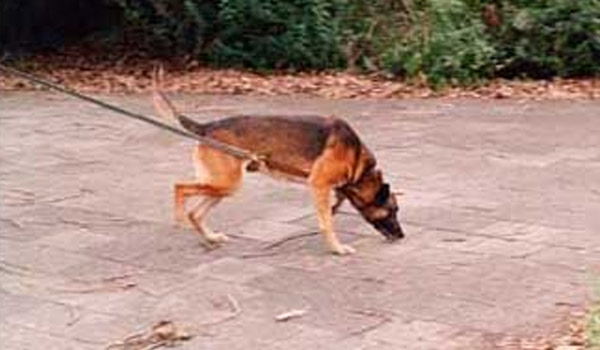
In September of this year, I went back to the Police Dog Training Center in Rotterdam Holland with my friend Kevin Scheldahl. We went there with the express purpose of getting as much information as possible on hard surface tracking. In earlier visits with Lt. Jan de Bruin (in 1988 and 1996), I learned that Rotterdam had between 45 and 50 police dogs of which 3 or 4 were tracking specialists. I had heard about the skills of their specialty dogs and I wanted to find out how they trained them to follow our old tracks on busy sidewalks of concrete, brick, and asphalt.
I originally met Jan de Bruin at a local KNPV trail in 1988. When I heard of his work with dogs and human scents, I was skeptical of the claims. After visiting with de Bruin, I quickly found out that I was 100% wrong. These early visits led me to writing two articles on scent discrimination:
In my opinion, Jan de Bruin and the instructors in Rotterdam are the undisputed human scent specialists (as it relates to dogs) in the world. Notice that I did not say tracking specialists. These people study human scent. Their dogs are trained to follow human scent and not the smell of crushed vegetation.
Over the years, the Germans have led us to believe that human scent only survives on a track for 20 to 30 minutes and that after that time, the dog simply smells crushed vegetation and the odors this vegetation leaves as it decays. The Dutch have proven this wrong from the simple fact that their police dog tracking certification involves following a track that is one hour old over a considerable distance on concrete and asphalt.
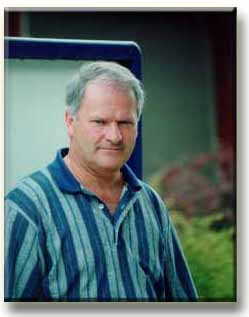
The Dutch through their KNPV have taken a different view of scent work than Schutzhund, IPO, WPO, or DPO trainers. In the KNPV, the dogs are taught a small article search exercise. The Dutch also place emphasis on scent discrimination which is very similar to AKC scent discrimination. Both of these exercises are the beginning of teaching the dog to look for human scent and not crushed vegetation.
One day, de Bruin explained how his interest in the dog's ability to identify human scent began. It was all based on being lucky many years ago. He was assigned a police dog that had an exceptional nose. One day, he was called to a burglary during the middle of the day in Rotterdam. By the time he and his dog arrived, a large crowd (including members of the media) had gathered. The inspector on the scene pleaded with de Bruin to try something (anything) with his dog to make it look like they were attempting to solve this crime. De Bruin explained that with so many people in the area and the fact that it was the middle of the day, there was virtually no way his dog could track anyone from this crime scene. The investigator's comments were "THEN FAKE IT!"
De Bruin took his dog to the crime scene door and held the dog's nose to the door handle leading into the room where the open safe was located. When he gave the dog the command to track, it put its nose to the ground and set off at a slow methodical pace. As they approached the crowd of spectators, they moved aside (like the parting of the Red Sea) and the dog tracked right through the middle of the people, across the street, and down the block. As he went by, the crowd of people fell in behind him and followed. De Bruin explained that he felt like the pied piper with several hundred people following behind.
The dog continued to act like he was tracking for a number of blocks. They crossed several busy streets and went around several corners. At one point, they even went into a store and back out again. At this point, de Bruin thought his dog was taking him for a walk. The track ended when the dog went up to a vehicle parked outside a house and then to the front door of the house. The investigator called in the licensed plate of the vehicle and found that it belonged to a man that had been released from prison for burglary charges several months before and that same individual lived at this house. A warrant was issued and the stolen money and items from the safe were found in the man's apartment.
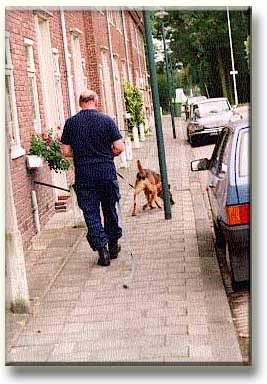
This incident and that particular dog led de Bruin on a career of studying human scents and dogs. De Bruin has since proven that he can now collect scent from a crime scene and save it for 7 years. He can then uses that saved scent and a trained dog to identify a suspect from a lineup of scents. Read the articles listed above to get the details on how this is done.
The success of the Dutch tracking method begins with the selection of the dogs for this work. Most of their dogs come to them from the KNPV sport. Most are certificate (PH1) dogs so they have already had a great deal of training. But the tracking dogs have to be the ones with a lot of prey drive.
Not every KNPV dog can be trained for hard surface tracking. The fact is, not very many dogs at all can be trained in this skill. It's hard to define in words what I mean when I say that they (de Bruin and his people) want dogs with extreme prey drive. Few people in America have been exposed to their level of "extreme." These dogs (Malinois or Mechelaar, as the Dutch prefer to call them) have an intense crazy drive for their toys that it borders on aggression for the toy. It is almost to the point where you look at them and wonder how this drive can be harnessed.
De Bruin and his instructors also look for the dog that has a propensity to locate things with his nose and not his eyes. When these dogs get out of a vehicle to pee, their nose is on the ground and it pretty much stays there. Again, this is a subtle judgment based on experience. It's not possible to explain in words to someone how a dog that uses his nose more than another dog when they are both looking for a place to pee. But when the dogs are searching for a toy or a man, some will definitely use their eyes more than their nose. If you have been around working dogs for a while and watch these Rotterdam tracking dogs, you will notice the subtle difference in their behavior.
When a candidate has been selected for the program, it is the beginning of their tracking training. To a new handler, this work may resemble Schutzhund tracking. It is slower and more methodical to track. The Dutch dogs are much more intense on a track than any Schutzhund dog I have ever seen. The main difference between the Dutch tracking dogs and competition Schutzhund dogs is that the Dutch dogs are free in their tracking. They stay in a footstep-to-footstep style of track, not through pressure or force (like 99.9% of the Schutzhund dogs) but simply through an intense desire to follow the scent.
The image of a tracking dog in Schutzhund today is a result of obedience and sometimes strict compulsion. The Schutzhund judges have come to accept this image as one of a true tracking dog. If these same judges ever had an opportunity to view what we saw in Rotterdam, they would understand what a "V" rated track was. As it is, they are simply judging the training and not the dog's scenting ability. That's too bad for the breed because these judges have lost the fact that the concept of the sport of Schutzhund is to gather information that can be used for breeding. By ignoring the actual scenting ability of the dogs and only judging obedience on the track, they are doing a disservice to the breed as a whole.
The Dutch are slower than what we have seen in tracking through drive (TTD) from the RCMP. I believe that this is a factor of the type of police work they do and the additional training they are prepared to put into the dogs. The Dutch concentrate more on using human scent than the Canadians do. I will go into this in more detail later in the article. They do not use any food and the articles are pieces of pipes. These pipes are similar to those used in small article training and scent identification training. So the dogs already view them as toys or prey items.
Once the dog has shown the ability to follow a 200- or 300-yard handler track, he is switched over to tracks laid by strangers (a quarry) and he is never allowed to track his handler again. When he is moved onto quarry tracks, the dog is always scented with an article from the stranger at the beginning of the track. This part is similar to what bloodhound people do with scent articles at the beginning of their tracks. The dog's previous experience with small article training or scent identification training teaches it to locate that human scent on the track.
It is not important for the Dutch to have a human at the end of every track the way the RCMP do it. One reason for this is that these dogs have such a strong prey drive that they get just as much satisfaction from their prey item as they would from finding a person at the end of the track. Not only that, the Dutch don't train their dogs to bite at the end of a track or in a building search. The dogs are trained to bark and that's all. They never get a bite in a building (very different than here in America, but the subject of another article).
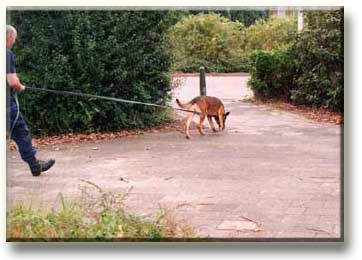
When the Dutch dogs are ready to move on to hard surface tracks, the initial training tracks are moved out in the country to bike paths. The reason for this is that these paths are free of recent foot traffic. So there are less cross-tracks or contamination. The tracklayer will lay the initial tracks in stocking feet after taking his shoes off. When I asked if it would be better to lay them with bare feet, they said "yes", but it was hard enough to get the trainers to lay them in socks much less barefooted.
When the dogs can do a reasonable job of following a straight track in socks (the end always has an article), the tracklayer will put sandals on and lay tracks that way. From there, they progress to different kinds of shoes, so the dog is trained to follow human scent and not the smell of the type of shoe being worn.
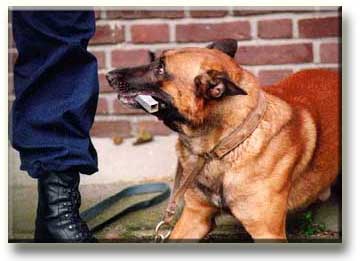
In the beginning, the tracks are not aged at all. The track is laid and then the dog is worked. As the dog gains proficiency, the track is aged up to one hour old. The articles used are small pieces of metal like you see in the photo below.
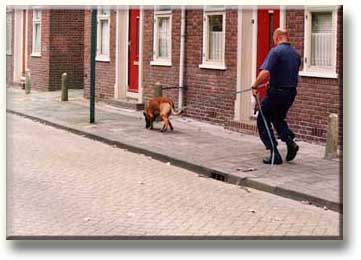
I had heard of another way to help dogs on hard surfaces and I asked their opinion. In this method, a tracklayer is asked to go out and run until he works up a good sweat with a T-shirt on. The T-shirt is then put in a gallon of distilled water. The water is put in a garden pressure pumper and the tracklayer sprays the track as he goes along. The mist is gradually eliminated as training progresses. De Bruin felt that this was a waste of time. My feeling is their selection test is so good that they do not need to worry about these kinds of training steps. With lesser dogs, it may come in handy.
I notice a difference in the style of tracking between Holland and the RCMP. The Dutch want their dogs to track a lot slower and with the nose on the ground (like Schutzhund) all the time. For this reason, they do not use a harness but rather a collar and line with the line going between the back legs or at least through the front legs and then out the side and to the back.
My feeling is that the Dutch are faced with way more city tracking and the tracks are not as long as we can get into in this country. The thought of following a 5-mile track is unthinkable in Holland. So their needs are different than ours (except in our big cities).
When the subject came up about only 3 or 4 tracking dogs out of 45 or 50 police dogs, de Bruin stated that he hoped to make some changes in the next year. He wanted to try and have all of the patrol dogs tested for tracking. He had hoped to have every patrol dog that had the drive for the work and the natural talent trained in tracking. He admitted that not all of the current dogs were suitable and that it was a lot of work that some handlers simply would not do. It does take 2 tracks per day for 5 months to get a dog to the point where he can do consistent hard surface work.
What I have noticed is that just as this program requires a special dog, it also requires a special handler. The average handler is never going to train a hard surface tracking dog. The average police dog handler does not have the work ethic to get the job done. Notice I did not say "skill." In this work, if the desire and work ethic is there, the skill will come. Training a hard surface tracking dog is not something that we will ever see police dog vendors offering in this country. No one could ever afford to put the amount of labor into training one of these dogs and then be able to sell it and make a profit. A hard surface tracking dog is something that is created out of the love of the work.
If Schutzhund Judges were to see the Rotterdam Police Dogs track, they would have a better understanding of what a "V" track should look like. If Judges saw these dogs' intense desire to follow scent, they would not accept the current image of a sport dog that is only tracking because it's been FORCED to track.
A special thanks to Lt. Jan de Bruin, Instructor Nico Ram, Theo Ophuis (K-9 Handler), and A.D. van der Hoel (K-9 Handler) for the time they spent with Kevin and me while we were at the Rotterdman Police Dog School.


Most Popular Articles
-
01
-
02
-
03
-
04
-
05
Related Products
-
 $10.00
 -
$92.50$86.95 -
 $65.00
 -
 $50.00



Ask Cindy.