


Police Service Dog Work in Holland


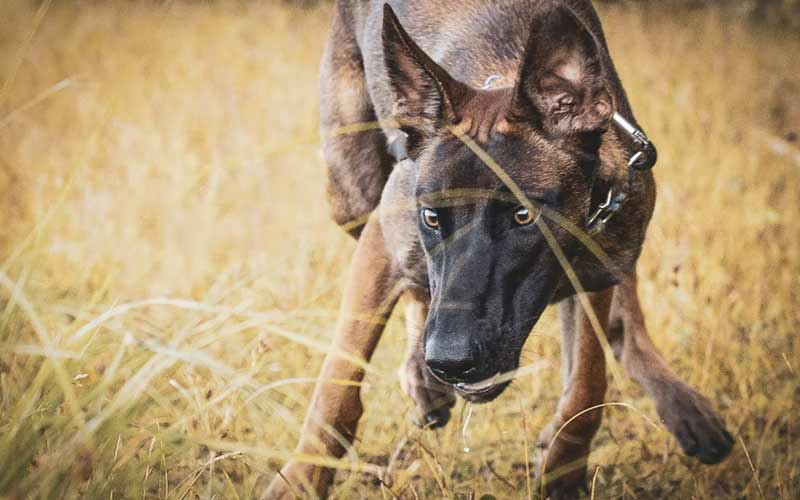
In 1988 on a visit to Holland to produce a documentary video on the Royal Dutch Police Dogs, I met Brigadier Jan de Bruin with the Dutch Police Department in Rotterdam. Brigadier de Bruin is a supervisor in the Rotterdam canine unit. He is an expert in the scent discrimination of dogs and has developed a method of collecting and storing human scent from a crime scene. He has stored scent for up to 3 years and later used the stored scent and dogs to identify an individual. The courts in Holland have started to accept the dog's identification as evidence to convict suspected criminals.
When I first heard this story, my initial reaction was "disbelief”. But it was such an interesting concept, I had to learn more about it. This article discusses the methods and techniques which Jan de Bruin and Dr. E.P. Koster developed to train dogs to identify humans through scent discrimination. Dr. Koster is a world-renowned expert of human scent. He is a professor with the State University of Utrecht (Holland) and has determined that a dog is capable of recognizing an odor 10,000,000 times better than a human can.
Here is how Brigadier de Bruin has put his police dogs' noses to work. If the dog locates an article at a crime scene, he is trained to bark. He does not touch the article. When an article is found, the police officer has to make a decision whether the article is to be sent to a forensic laboratory for evidence or if it can also be used for the collection of human scent.
There are several different methods in which dogs are used to identify a suspect from stored scent:
1. Selecting People from a Lineup
To illustrate this method, let us say that a pistol had been found at a crime scene. The gun has been carefully stored in a sterilized glass jar.
The police dog is allowed to smell the "BUTT" of the gun and then allowed to go through a lineup of people to identify the scent of the person that is on the gun. The dog indicates the suspect by barking. To keep from inadvertently influencing his dog, the handler does not touch the gun and is not in the room when the search takes place.
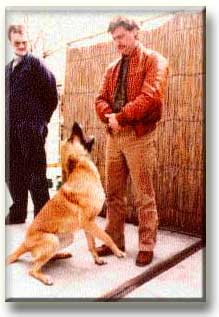
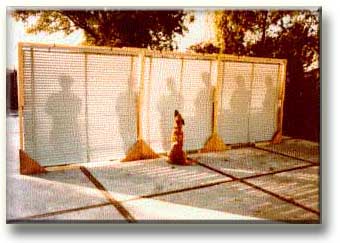
It was found that some people were unduly influenced by the dog and became afraid. To eliminate this response, the lineup of men (or women) were placed behind a Venetian blind type screen. When the dog smelled the suspect, he sat and barked in front of the blind where the man is standing.
These tests are repeated twice after the suspect changes places with others in the lineup and no positive motivation is given to the dog in between tests.
2. Selecting Small Pieces of Pipe
This is the method Brigadier de Bruin likes the best. It is similar to our AKC article discrimination in utility work.
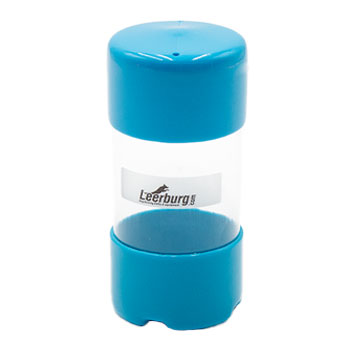
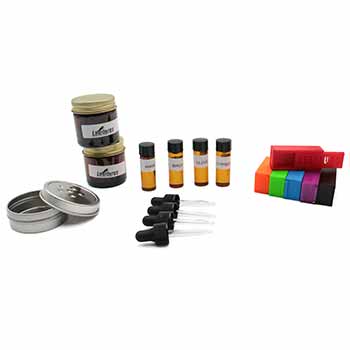
In it, eighteen 5-inch pieces of stainless steel pipe are cleaned in a pressurized steam cleaning machine. After cleaning each piece of pipe, it is then stored in its own glass container. Five people are selected for a lineup (in addition to the suspect) and each is assigned 3 bottles with pipes in each.
Each person in the lineup washes his hands with a neutral soap to eliminate all foreign odors. The odor of the soap and the towels is the same for every member of the lineup. The 6 people all sit at a large table and open all three of their bottles at the same time. Every individual holds his three pieces of pipe in his hands for 5 minutes and then puts them back into the jars. Each set of jars has a different colored lid so that there is no way the suspect's jar can get mixed up with someone else's.
The pipes are then laid out on the floor (50 cm apart) and the bottle removed so that the handler cannot tell which pipe has come from which bottle. The person that lays out the pipes leaves the room before the dog and handler team enter. In this way, there is no way to influence the dog as to which pipe belongs to the suspect.
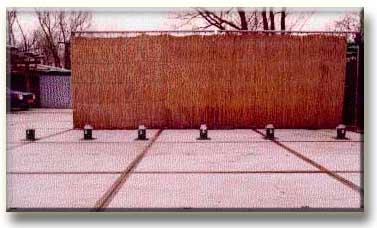
The dog is brought into the room and allowed to sniff the pistol. The handler leaves the room before the dog goes to the pipes. The dog indicates the pipe that has the same scent as the pistol and the suspect by sitting and barking.
This test is repeated two more times in different areas of the room. The pipes cannot be laid in the same spot. During each search, there is no way the dog can be influenced by the handler because he is not in the room. This test definitely shows that there is a connection between the odor of the pistol and the suspect.
3. Collecting and Storing Human Scent to Identify at a Future Date
If there is not a suspect available when an article is found at a crime scene, the police will collect the scent and store it to be used in later lineups. This is done with the use of a sterilized gauze cloth. Special tools are used so that nothing touches an article that would leave scent on it during collection.
The article (again, we will say that we have found a gun) is carefully wrapped in these gauze pads for about 20 minutes. The scent collection pads absorb the scent on the gun. After the 20-minute period, the pads are placed in the glass jars for storage.
The advantage of this system is that after the odors are collected, the article can be sent to a forensic laboratory for examination. If a suspect is later found, the police form another lineup. This time, everyone washes their hands in the same manner as was done when the pipes were used. The only difference is that the people hold sterilized gauze pads in their hands for 5 minutes rather than the steel pipes. The pads are then placed in the sterilized jars with each person's name on the jar.
These jars are then placed in steel containers on the floor by an assistant wearing sterilized rubber gloves. The handler allows his dog to smell the gauze that had been wrapped around the "BUTT" of the pistol. The dog is then presented with 6 identical steel containers, each containing a glass jar that has a piece of gauze from the people in the lineup.
Before the dog begins to search, his handler leaves the room. The dog performs his search alone and alerts by barking when he finds the correct scent. After the dog makes the first indication, he is taken out of the room and the assistant switches the jars around in the steel pots (the assistant is wearing fresh sterilized gloves). The dog is again, allowed to smell the gauze from the gun and then do another search with the handler out of the room. The dog does three searches before he is finished. If there is any question concerning the results, the tests are done with a second dog.
If the police are concerned that the gauze pad will damage fingerprints on the article, they place the article in a sterilized box that has a small fan on one end and the other end is covered with the sterilized gauze. The fan is allowed to blow (very gently) over the gun and into the gauze for about 20 minutes. The gauze is then stored in a bottle.
If a hand or palm print is found at a scene, the gauze is carefully placed over the top of the prints for 20 minutes and then stored in a bottle.
Getting the courts to recognize this type of work requires accurate training records. The dogs establish their credibility through the controlled testing of scent that has been collected from known individuals. Accurate records of work done in each of the above phases need to be fully documented. In Brigadier de Bruin's experiments, he has stored the scent of police officers from his department in the glass bottles for 3 years. The dogs are still identifying the correct individual. He is carrying on with his experiments to see how long they can successfully store the scent.
The training of each dog takes about 18 months of hard work. Certain individual dogs have much more talent for this work than others and selection testing is important. It has been proven that as training increases, the dog's sensitivity to odor increases. This is why they can continue to distinguish between progressively weaker scents. Conversely, they have proven that dogs that are not worked by their handlers lose some of their ability to discriminate scent.
When the dog is used in a professional manner, he can be a great asset in the collection of evidence in criminal investigations. It is my opinion that this form of scent work with dogs has a great deal to offer law enforcement. The training concepts that Brigadier de Bruin uses are sound. The results need to be documented here in America but I feel that with the right effort, this type of police work can become as effective as narcotic detection work, bomb disposal work, or tracking with police service dogs. It is just going to take an individual like Brigadier Jan de Bruin to make it happen.
If you are interested in training police service dogs, enroll in our self-study online courses on the subject:
If you would like to read a follow up article to this that was done 7 years later, see my article titled Scent Identification in Rotterdam, Holland.


Most Popular Articles
-
01
-
02
-
03
-
04
-
05
Related Products
-
 $6.99
$6.99 -
$76.00$69.92 -
$20.35 - $20.59
$17.50 - $20.59

Ask Cindy.