



One Dog, Many People - And What Happens When You Add Other Dogs


Introduction
One Dog, Many People — and What Happens When You Add Another Dog
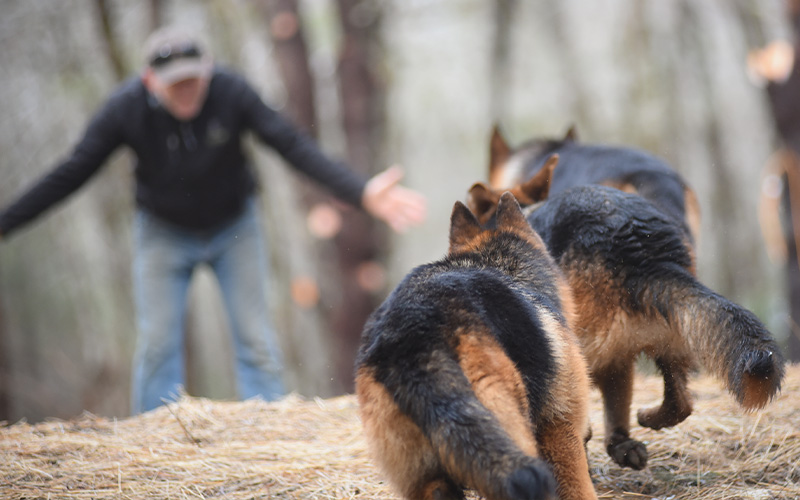
Most dogs don't live with one person. They live with a couple, a family with kids, roommates, or extended family under one roof. Every one of those people talks to the dog, feeds the dog, lets the dog out, and — whether they mean to or not — trains the dog.
That's where things start to go sideways. The dog sits perfectly for one person and ignores another. He's calm on walks with Mom and drags Dad down the street. He's allowed on the couch on weekends but not weekdays, depending on who's home. None of this is the dog being stubborn. It's the dog accurately learning that the rules depend on who's in the room.
Add a second (or third) dog to that household and every crack in the system gets wider. Now there are more relationships to manage, more resources to compete over, and more opportunities for one person's well-meaning shortcut to undo another person's work.
This article is split into two parts. Part One covers how to run a home where several people handle the same dog. Part Two covers how to bring a new dog into that home without creating conflict between the dogs — or between the people.
How Dogs Relate to Each Person in the House
Your Dog Has a Separate Relationship With Every Person
Dogs form genuine attachment bonds with their people. Research using an adapted version of the Strange Situation Test — originally designed to study attachment between human infants and parents — has shown that dogs play and explore more when their owner is present and show distress when that owner leaves. The owner functions as a "secure base," much as a parent does for a child.
But in a multi-person home, that bond isn't one shared thing. Your dog has an individual relationship with each person in the house, and those relationships can look very different. Early research comparing a dog's attachment to two different owners in the same household suggests that each owner's warmth and sensitivity — how consistently and appropriately they respond to the dog — is the best predictor of the kind of bond the dog forms with them.
This explains something every family sees: the dog doesn't "listen to" everyone equally. That isn't the dog ranking the humans. Dogs attach cues to a specific voice, tone, body posture, timing, and — most importantly — follow-through. If one person always follows through and another sometimes does, the dog learns exactly that. A cue from the second person is a suggestion, not a request.
The key idea: Your dog isn't confused about what "sit" means. He's very clear about what "sit" means from each person. Consistency across the household doesn't just make training faster — it makes your dog's world predictable, and a predictable world is a less stressful one.
The Primary Handler: Why One Person Should Lead the Training
Many People Can Handle the Dog — One Person Should Own the Training Plan
In a multi-handler home, the single most effective structure is this: one primary handler teaches, and everyone else maintains.
The primary handler is the person responsible for introducing new behaviors, deciding what the criteria are, choosing when the dog is ready to move to the next step, and setting the rules everyone else follows. This is especially important for sport, protection, and working dogs, where training is layered and precise and where a well-meaning family member "helping out" can undo weeks of work in an afternoon.
Everyone else in the house still matters enormously. Their job is to reinforce what the dog already knows using the same cues, the same rules, and the same follow-through. They don't teach new behaviors, they don't change criteria, and they don't invent their own versions of commands.
This isn't about one person being in charge of the household. It's about the dog getting a single, clear training picture instead of three competing ones. The best primary handler is usually the person with the most time, the most patience, and the most interest in training — not necessarily the person who brought the dog home.
What the Primary Handler Is Responsible For
- 1Teaching all new behaviors, and deciding when a behavior is solid enough for others to use it.
- 2Keeping the household cue list current (see the next section).
- 3Showing each family member how to give each cue, mark it, and reward it — hands-on, not just by explanation.
- 4Handling any corrections, if your training program uses them. Corrections from multiple people with different timing and intensity are one of the fastest ways to create a confused or worried dog.
- 5Noticing when something has drifted and bringing the household back into alignment.
Course: Basic Dog Obedience »
The House Rules Meeting
Agree on the Words, the Rules, and the Non-Negotiables
Before you can be consistent, you have to agree on what "consistent" means. Sit down as a household — ideally before a new dog arrives, but any time is better than never — and settle three things: the cues, the house rules, and the non-negotiables.
A useful exercise: have each person, one at a time, ask the dog to sit and down while someone records it on a phone. Almost every family discovers that each person does it differently — different words, different hand signals, different body posture, different tone, a different number of repeats. The dog's response will vary right along with it.
1. The Cue List
Write down one cue for every behavior, and post the list somewhere everyone sees it daily — the fridge or the back door. The exact word matters much less than everyone using the same one. A household that uses an unusual word consistently will get better results than a household that uses the "textbook" word inconsistently.
| Behavior | Verbal Cue | Hand Signal | Common Mix-Up to Avoid |
|---|---|---|---|
| Lie down | "Down" | Flat palm toward the floor | Using "down" to also mean "get off the couch" |
| Get off furniture / people | "Off" | Point to the floor | Saying "down" for this |
| Come to me | "Here" | Both hands to chest | Saying "come here," "c'mon," and "here, boy" interchangeably |
| Hold position until released | "Stay" or "Wait" (pick one meaning for each) | Open palm toward dog | Using both words for the same behavior |
| Release | "Free" or "Okay" | — | Some people releasing, others letting the dog wander off |
| Marker (yes, that's right) | "Yes" or a clicker | — | Saying "good" as a marker and also as general praise |
Say the cue once. Repeating "sit, sit, sit, SIT" teaches the dog that the real cue is the fourth one — and different people will have different "fourth ones."
Course: The Power of Training Dogs with Markers »2. The House Rules
Decide, together, where the dog stands on the everyday things people tend to handle differently:
- Furniture and beds. Allowed, not allowed, or allowed only by invitation.
- Doors and thresholds. Does the dog wait before going outside or getting out of the car, or not?
- Meals. Does the dog wait for a release before eating? Is the dog allowed in the kitchen during human meals?
- Greeting. Is jumping up ever okay? (If one person allows it, the dog will keep trying it on everyone.)
- Table scraps and treats. Who can give them, and when?
- Leash walking. What does "good walking" look like, and what happens when the dog pulls?
3. The Non-Negotiables
Some rules exist for safety and should never bend, no matter who's home: the dog is crated or confined when unsupervised (especially with a new dog in the house), gates and doors stay latched, the dog is leashed in specific areas, and nobody leaves food or high-value chews lying around when more than one dog is loose. Put these at the top of the list.
Keep it going: A household that says "we'll all practice" usually means nobody practices. A five-minute check-in once a week — what's working, what's slipping, what the primary handler is teaching next — keeps everyone on the same page far better than one big meeting.
Dividing the Work Without Dividing the Dog
Spread the Care, Keep the Picture the Same
Sharing the work of a dog is a good thing. A dog who is fed, walked, played with, and handled by several people tends to be more adaptable and less dependent on any one person. The trick is to divide the tasks without dividing the rules.
Assign Jobs, Not Just Chores
Instead of "whoever's home lets the dog out," give each person defined responsibilities. Predictable routines are easier for the dog and make it obvious when something isn't getting done. A typical split might look like this:
| Person | Responsibilities |
|---|---|
| Primary handler | Training sessions, teaching new behaviors, corrections (if used), vet and health decisions |
| Second adult | Morning walk, one meal (hand-fed or used for a short practice session), weekend training reps under the primary handler's plan |
| Teen | Evening meal with a "wait" before release, short practice of known cues, supervised play |
| Younger child | Filling the water bowl, scatter-feeding a handful of kibble, practicing "sit" with a parent present |
Make Everyone a Source of Good Things
One of the easiest ways to build a dog's relationship with every person is to spread out the dog's daily food. Rather than feeding everything from a bowl, divide a portion of each meal among family members and use it to reward known behaviors throughout the day. The dog learns that every person in the house is worth paying attention to — and the household gets dozens of extra practice reps without anyone scheduling a "training session."
Watch Out for the "Fun Person" Problem
In many homes, one person does all the structure and another does all the play. The dog quickly learns that one human means rules and the other means a party — and often stops listening to the "fun" person entirely. Everyone in the house should play with the dog, and everyone should ask for a known behavior before good things happen. Play doesn't have to be structure-free to be fun.
Course: Developing A Relationship With Your Dog with Michael Ellis »Course: Relationship Games »
Children as Handlers
What to Ask of Kids at Each Age
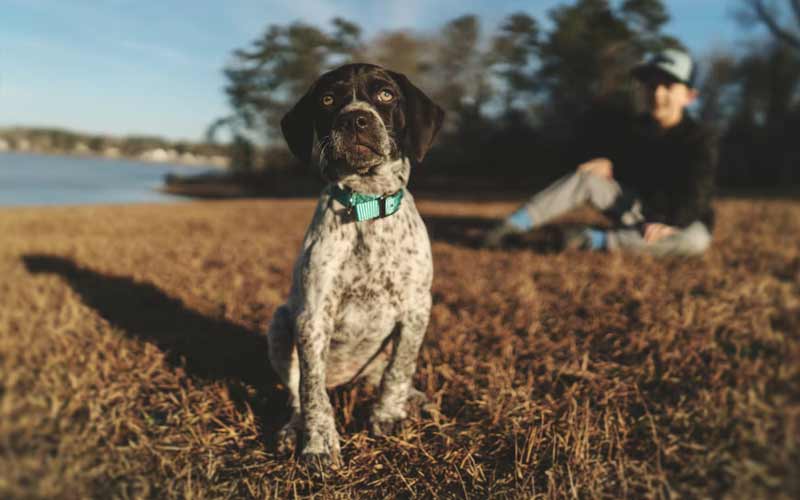
Kids can be wonderful handlers, and including them builds a dog that is comfortable and well-mannered around children. But children are also the household members least able to be consistent, and the most likely to be in situations a dog finds stressful — hugging, running, high-pitched excitement, grabbing toys.
- Under about 7: Always with a parent present. Simple, low-arousal jobs — tossing a treat, scatter-feeding, asking for a sit with an adult guiding. No walking the dog, no tug, no reaching into crates or food bowls.
- About 7–12: Can practice known cues with parent supervision, help with feeding routines, and take part in calm play. Walking a small, well-trained dog in a safe area with an adult nearby can be appropriate.
- Teens: Can take on real handling responsibilities, provided they've been taught by the primary handler and follow the same cue list and rules as adults. Strength, judgment, and the dog's size and temperament all matter more than age alone.
No matter the age: children should never be left unsupervised with any dog, should never be responsible for breaking up any kind of conflict between dogs, and should learn to recognize when a dog wants to be left alone — moving away, turning the head, lip licking, freezing, or showing the whites of the eyes.
Course: Raising a Puppy in a Household with Kids »Common Multi-Handler Problems — and How to Fix Them
"The dog listens to one person and ignores everyone else."
This almost always comes down to follow-through. Watch the person the dog ignores: are they repeating cues, not rewarding, or giving a cue and then walking away when the dog doesn't respond? Have the primary handler coach that person through a few short sessions using high-value rewards. The dog needs to learn that this person's cues pay off, too.
"The dog is clingy with one person and anxious when they leave."
When one person does everything, the dog's whole sense of security rests on them. Spread out feeding, walking, and enjoyable activities so that other household members become sources of comfort and good things as well. If the dog shows real distress at separation — destruction, vocalizing, house-soiling only when alone — treat it as a separate issue and get qualified help.
"The dog guards one person from the rest of the family."
Growling when someone approaches a person on the couch, or stiffening when another person (or dog) comes near "their" human, is resource guarding — with a person as the resource. Don't laugh it off or treat it as loyalty. Remove furniture privileges, have the guarded person stand up and walk away when the dog stiffens, and have other family members become the source of high-value rewards. If it escalates, get professional help.
"Everyone corrects the dog differently."
Inconsistent corrections are worse than inconsistent rewards. A dog that gets a sharp correction from one person and nothing from another for the same behavior often becomes worried and unpredictable rather than better behaved. Corrections, if your program uses them at all, should come from the primary handler only. Everyone else should prevent the unwanted behavior through management (leashes, crates, gates) and reward the right choice.
Before the New Dog Comes Home
The Decision Has to Be Made by the Whole Household
Bringing a new dog into a home with several people means the decision — and the work — belongs to everyone. Before anyone starts browsing litters or rescue listings, the household should be able to answer these questions honestly:
- 1Why do we want another dog? "Our dog needs a friend" is often a human idea, not a dog one. Many dogs are perfectly content as the only dog.
- 2Is our current dog ready? If your existing dog has unresolved reactivity, resource guarding, or training gaps, those problems will follow — and the new dog may learn them.
- 3Who will be the new dog's primary handler? It doesn't have to be the same person as the first dog's. In many homes, giving each dog a different primary handler works very well.
- 4Do we have the time for two separate training programs? For the first several months, a new dog — especially a puppy — needs a lot of one-on-one time away from the other dog.
- 5Do we have the space to keep the dogs separated? Separate crates, gates, and a feeding setup where the dogs can't reach each other are not optional in the early weeks.
Set Up the Home Before Day One
Each dog should have its own crate, its own resting area, and its own feeding spot. Put away high-value items — chews, bones, favorite toys — that could start an argument. Install baby gates so you can split the house. Update the household cue list and rules so the new dog learns the same system from day one.
Choosing the Right Match
What the Research Says About Which Pairs Struggle
The single most predictable factor in household dog conflict is the pairing itself. Research on dogs that fight within the same home points to a few consistent patterns:
| Finding | What It Means for You |
|---|---|
| Same-sex pairs | Most household fighting involves dogs of the same sex, and same-sex pairs are associated with worse outcomes. Female–female pairs are the hardest to get along consistently: in one study of households with fighting dogs, treatment reduced fighting in about three out of four male–male and male–female pairs, but in only 57% of female–female pairs. An opposite-sex pairing is the lower-risk choice. |
| Newer and younger dogs | In one well-known case series, the newer dog in the home was the instigator around 70% of the time, and instigators tended to be the younger dog. Plan to manage the newcomer especially carefully as they settle in — and again as they reach social maturity (roughly 1–3 years). |
| Resource guarding | In a study of 305 pairs of fighting dogs, guarding of resources was the most common trigger, involved in nearly three out of four cases. Food, toys, beds, doorways, and access to people are all resources. |
| Owner presence | Owner presence and attention are a frequent trigger for fights. Dogs can compete for you. In a multi-person home, that can mean competing for a specific person. |
| Multiple owners | Clinicians studying household fighting have flagged inconsistent handling across several owners as a risk factor — another reason Part One of this article matters. |
Beyond sex and age, match energy and play style. A high-drive young working-line dog may overwhelm a mellow older dog. A dog with a big body and rough play may frighten a small or timid one. If you're adopting an adult dog, ask about their history with other dogs specifically — not just "good with dogs" in general.
A note on puppies: A puppy is often easier to introduce than an adult, because most adult dogs give puppies more tolerance. But that tolerance has an expiration date. A pairing that is fine at 6 months can become a problem at 2 years, when the youngster reaches social maturity. Don't let early success make you skip management.
The First Two Weeks: Go Slow
Decompression, Crate and Rotate, and Structure From Day One
The first couple of weeks set the tone for the dogs' relationship — and for the new dog's relationship with each person in the house. The most common mistake is doing too much too fast: turning the dogs loose together on day one, having every family member and friend meet the new dog, and expecting the new dog to slot right into the routine.
Let the New Dog Decompress
Whether you're bringing home an 8-week-old puppy or a 4-year-old rescue, the new dog has just lost everything familiar. Keep the first days quiet and predictable: crate, potty, short walks, meals, rest. Hold off on visitors and outings. Let the dog figure out the household before the household tries to figure out the dog.
Crate and Rotate
In the early weeks, the dogs should rarely be loose together, and never unsupervised. "Crate and rotate" means one dog is out with a person while the other is crated or behind a gate, then you switch. It protects both dogs, prevents bad first impressions, and — critically — guarantees that each dog gets individual time with its people.
Protect the First Dog's Routine
Your existing dog didn't ask for a roommate. Keep their routine — walks, meals, training sessions, sleeping spot — as close to normal as possible. A new dog shouldn't mean your first dog loses time with their primary handler. In a multi-person home, this is easier: one person can focus on the new dog while another keeps the first dog's day intact.
One Handler Per Dog
Whenever both dogs are out together — on walks, in the yard, during early introductions — each dog should have its own handler. One person trying to manage two leashes, two dogs' body language, and their own reactions at the same time is how early introductions go wrong.
Introducing Dog to Dog
A Step-by-Step Approach
Every introduction depends on the individual dogs, so treat this as a framework rather than a schedule. Move to the next step only when both dogs are relaxed at the current one — loose bodies, sniffing, able to take food, able to disengage from each other. If either dog stiffens, stares, or can't take food, go back a step.
-
Scent first Before the dogs see each other, let them get used to each other's scent. Swap bedding, or have one person walk the existing dog while the new dog explores the house, then switch so the existing dog can sniff where the new dog has been.
-
Parallel walk on neutral ground Meet somewhere neither dog considers home territory. Each dog has its own handler. Walk in the same direction at a comfortable distance — far enough that neither dog is fixating — and gradually close the gap over the walk. Reward both dogs for calm behavior and for looking back at their handler.
-
Brief, loose-leash greeting If both dogs are relaxed, allow a short sniff — a few seconds — with leashes loose (tight leashes create tension). Then call both dogs away, reward, and continue walking. Several short greetings are far better than one long one.
-
Enter the home in order Walk home together. The resident dog enters first, then the new dog. Keep leashes on (dragging, if safe and supervised) so you can calmly separate them if needed. Remove toys, chews, and food bowls from the area beforehand.
-
Short, supervised time together Start with brief periods together in an open area, ideally the yard or a space that isn't the resident dog's favorite resting spot. End each session while things are still going well. Gradually extend the time over days and weeks.
-
Barriers for everything else When you can't actively supervise, the dogs are separated by crates or gates. This continues until you've seen weeks of relaxed behavior — not days. For many pairs, separating the dogs when no one is home becomes a permanent rule, and that's fine.
Critical caution: Don't "let them work it out." Dogs do communicate through ritualized warnings — a lip curl, a freeze, a growl — and those warnings are useful information. But letting tension build without intervening can turn a minor disagreement into a real fight, and a single serious fight can change the dogs' relationship permanently. If you're seeing growling, stiffening, or blocking, calmly separate the dogs, increase management, and slow down.
Introducing a Dog to a Household Cat
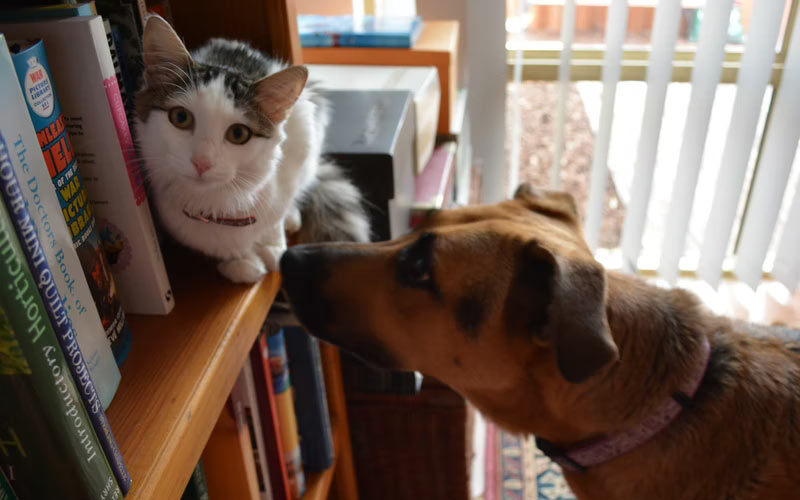
The same principles apply: gradual, owner-led introductions with plenty of management. A large study of puppies introduced to resident cats found that early introductions (under about 12 weeks of age) and gradual introductions were both linked to calmer puppy behavior around cats — and so was living in a home that already had another dog. Give the cat escape routes and high places the dog can't reach, and keep the dog leashed during early meetings.
Resources, Attention & Conflict
Remove the Things Dogs Fight Over
Because resource guarding is behind most household fights, the simplest prevention is to take resources out of the shared space.
- Feed separately. Each dog eats in its own crate or behind a closed door or gate. Pick up bowls when meals are done. This one rule prevents a huge share of household conflict.
- High-value chews only in crates. Bones, bully sticks, and stuffed toys are crate-only items when more than one dog is in the house.
- Toys are supervised. Don't leave a pile of toys out for the dogs to compete over. Bring toys out for supervised play, then put them away.
- Watch the bottlenecks. Doorways, hallways, and the back of the car are where dogs bump into each other. Use "wait" at doors and release dogs one at a time.
- Furniture is earned, not assumed. If either dog guards a spot on the couch or bed, the dogs lose furniture privileges while you work through it.
People Are a Resource, Too
Owner presence and attention are a common trigger for fights. In a multi-person home this shows up in very specific ways: one dog shoves between another dog and "their" person, fights break out at the front door when someone comes home, or tension spikes whenever a particular family member sits down on the floor.
The fix is structure. Greet dogs calmly and one at a time when you come home. Ask each dog for a known behavior before attention, petting, food, or going outside — this gives the dogs a clear, predictable way to earn what they want without competing for it. Don't pet one dog while the other is pushing in; ask the pushy dog to go to a place or lie down, reward that, and then share your attention.
This kind of consistent, structured interaction between people and dogs — sometimes called a leadership program — has been part of successful treatment plans for household dog aggression. It works best when every person in the house follows it, not just one.
Course: Establishing Pack Structure with the Family Pet »Give Each Dog One-on-One Time
Even once the dogs live together comfortably, each dog needs regular time alone with its people — individual walks, training sessions, and play. This is where a multi-person home has a real advantage: two handlers can take two dogs in two directions. Dogs that only ever experience the world together often become overly dependent on each other and harder to train individually.
Training the New Dog in a Multi-Handler Home
One Teacher, Many Maintainers — Again
Everything from Part One applies to the new dog, with one important addition: the new dog should learn your household system from the very first day, and each dog should be trained separately.
Use the same cue list for both dogs. If your first dog knows "here," the new dog learns "here." Two dogs with two different vocabularies doubles the work for every person in the house.
Train the new dog alone first. New behaviors are taught one-on-one, away from the other dog, by the new dog's primary handler. Trying to train a new dog in the presence of an experienced one usually means the new dog watches the old dog instead of learning, and the old dog's training gets sloppy.
Add the other dog later. Once a behavior is solid, practice it with the other dog nearby — first crated, then on a down-stay, then loose. Teaching each dog to hold a place or down-stay while the other is working or being rewarded is one of the most useful skills in any multi-dog home.
Use each dog's name as a cue. In a home with more than one dog, every cue should start with the dog's name ("Rex, down") so only the dog you're talking to responds. Make sure every household member does this.
Watch for learned habits. A new dog will copy the existing dog's habits — good and bad. If your first dog barks at the mail carrier or bolts out the door, expect the new dog to learn it quickly. Tightening up your first dog's training before the new one arrives pays off double.
Course: Raising Your Puppy with Michael Ellis »Course: From the Rescue to the Home »
Warning Signs & When to Get Help
Know What Calls for Management — and What Calls for a Professional
| What You See | Level | What to Do |
|---|---|---|
| Occasional growl or lip curl over a toy, followed by both dogs moving on | Monitor | Normal dog communication. Remove the item from shared space and tighten management around resources. |
| One dog blocking the other from doorways, beds, water, or a person | Manage | Increase structure, separate during high-value moments, ask for behaviors before access to resources. |
| Staring, stalking, or stiffening every time the dogs are in the same room | Act now | Separate full-time and consult a qualified professional. Aggression on sight is linked to poorer outcomes. |
| Any fight that breaks skin or needs veterinary care | Act now | Separate with crates and gates, consider muzzle conditioning for safety, and get professional help. Skin-breaking bites are a strong risk factor. |
| Sudden aggression in dogs who previously got along | Vet first | Pain and medical problems can lower a dog's tolerance. Get a veterinary exam before starting behavioral work. |
Safety first: Never reach between fighting dogs with your hands, and never let children intervene. Agree as a household — before you ever need it — on how you'll separate dogs safely (a board or barrier, leashes left attached during early weeks, a door between them). Fights are where the multi-person home either works very well or very badly. Everyone needs to know the plan.
Not every pair of dogs can live together safely, and that's no one's failure. With good management, most households can make it work — some by keeping the dogs together most of the time, others by permanently rotating them. In a small number of cases, rehoming one dog is the kindest outcome for both. A qualified trainer or veterinary behaviorist can help you decide.
Course: Dealing with Reactive, Aggressive, & Dominant Dogs »Course: Conditioning Your Dog to a Muzzle »
The Bottom Line
A home with several people can give a dog a rich, stable, deeply social life — or a confusing one where the rules change every time someone new walks in the room. The difference isn't how many people live there. It's whether those people are working from the same plan.
Pick a primary handler. Agree on the cues and the rules. Share the work, but not the confusion. And when a new dog joins the family, slow down, manage the resources, give each dog its own time and its own handler, and let the dogs' relationship develop on their timeline — not yours.
Further Reading
Wrubel, K.M., Moon-Fanelli, A.A., Maranda, L.S., & Dodman, N.H. (2011). Interdog household aggression: 38 cases (2006–2007). Journal of the American Veterinary Medical Association, 238(6), 731–740.
Characteristics of intrahousehold interdog aggression and dog and pair factors associated with a poor outcome (2020). Journal of the American Veterinary Medical Association, 256(3), 349–361. View abstract »
Kinsman, R.H., et al. (2022). Introducing a Puppy to Existing Household Cat(s): Mixed Method Analysis. Animals, 12(18), 2389. Read the full paper »
Mariti, C., et al. Owners as a secure base for their dogs. Behaviour. View record »


Most Popular Articles
-
01
-
02
-
03
-
04
-
05
Related Products
-
 $65.00
 -
 $16.99
 -

$219.99 - $349.99
$199.99 - $309.99 -

$65.00$19.99



Ask Leerburg.