



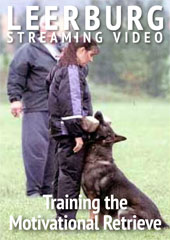
 Training the Retrieve -Bernhard Flinks

1 hr, 40 min
March 8, 2002
Training the motivational retrieve has evolved over the past 20 years. This video was produced in the late 1990's with Bernhard Flinks from Germany. Back then the methods shown in this video were new to most dog trainers.
The kind of dogs suited to the motivational retrieve are those dogs that do well on Bernhard's drive building work. These are dogs that have good prey drive. A dog must have prey drive if it is to MAKE THE DEAL with the handler.
I have to say that not all dogs can be trained using the motivational methods shown in this training video. To make this work you have to have a dog with prey drive. When it comes down to it, if you cannot motivate your dog into drive, you are not going to motivate him into retrieving a DB for you.
I provide information in this video that will help you determine if these methods can work with your dog. I hope you can use these training techniques because even though I have produced a video on training the forced retrieve, I am not a fan of that method of training. Unfortunately, for some dogs there is no other way than force.
Update
Since 2002, training the retrieve motivationaly has come a long way. In 2010, I produced a 4 hour training DVD with Michael Ellis. If your a serious dog trainer that wants to learn the motivational retrieve I would recommend the Ellis DVD.
This video with Bernhard is being offered for its historical significance. The methods shown work for a very specific type of dog.

Video on Demand

Instant access for a lifetime

Get huge savings on the DVD (view details)

Stream from anywhere around the world

Easy to jump to chapters

Add bookmarks/notes while you watch
Need help? Check our FAQ.
Training the Retrieve -Bernhard Flinks
 Add to Favorites


Uploaded on March 8, 2002 •
1 hr, 40 min
Training the motivational retrieve has evolved over the past 20 years. This video was produced in the late 1990's with Bernhard Flinks from Germany. Back then the methods shown in this video were new to most dog trainers.
The kind of dogs suited to the motivational retrieve are those dogs that do well on Bernhard's drive building work. These are dogs that have good prey drive. A dog must have prey drive if it is to MAKE THE DEAL with the handler.
I have to say that not all dogs can be trained using the motivational methods shown in this training video. To make this work you have to have a dog with prey drive. When it comes down to it, if you cannot motivate your dog into drive, you are not going to motivate him into retrieving a DB for you.
I provide information in this video that will help you determine if these methods can work with your dog. I hope you can use these training techniques because even though I have produced a video on training the forced retrieve, I am not a fan of that method of training. Unfortunately, for some dogs there is no other way than force.
Update
Since 2002, training the retrieve motivationaly has come a long way. In 2010, I produced a 4 hour training DVD with Michael Ellis. If your a serious dog trainer that wants to learn the motivational retrieve I would recommend the Ellis DVD.
This video with Bernhard is being offered for its historical significance. The methods shown work for a very specific type of dog.
The kind of dogs suited to the motivational retrieve are those dogs that do well on Bernhard's drive building work. These are dogs that have good prey drive. A dog must have prey drive if it is to MAKE THE DEAL with the handler.
I have to say that not all dogs can be trained using the motivational methods shown in this training video. To make this work you have to have a dog with prey drive. When it comes down to it, if you cannot motivate your dog into drive, you are not going to motivate him into retrieving a DB for you.
I provide information in this video that will help you determine if these methods can work with your dog. I hope you can use these training techniques because even though I have produced a video on training the forced retrieve, I am not a fan of that method of training. Unfortunately, for some dogs there is no other way than force.
Update
Since 2002, training the retrieve motivationaly has come a long way. In 2010, I produced a 4 hour training DVD with Michael Ellis. If your a serious dog trainer that wants to learn the motivational retrieve I would recommend the Ellis DVD.
This video with Bernhard is being offered for its historical significance. The methods shown work for a very specific type of dog.
Comments

alexnds05
July 25, 2021
This is a 20 year old video, and the "hold" has improved as a separate training step and the methods have really changed over the years. There are somewhat better methods these days. But the basic idea of using a ball reward in exchange for the dumbell and how to play tug with the dog, have all pretty much remained the same. I see large portions (not all of it) of these training techniques still in use today and in many ways, this is still a very relevant videos. I was really glad to see something from 20 years ago and I feel it's still a pretty darn good video.

amossordi
August 16, 2015
excellent video !!!
-
 $29.99
 4.7
1 hr, 28 min
4.7
1 hr, 28 min -
 $8.99
4.1
1 hr, 3 min
$8.99
4.1
1 hr, 3 min -
 $18.99
4.4
1 hr, 5 min
$18.99
4.4
1 hr, 5 min -
 $29.99
4.1
1 hr, 58 min
$29.99
4.1
1 hr, 58 min -
 $14.99
3.1
1 hr, 47 min
$14.99
3.1
1 hr, 47 min -
 $59.99
4.3
1 hr, 59 min
$59.99
4.3
1 hr, 59 min -
 $19.99
4.2
4 hr, 1 min
$19.99
4.2
4 hr, 1 min -
 $29.99
4.7
2 hr, 58 min
$29.99
4.7
2 hr, 58 min -
$12.99
4.2
1 hr, 40 min
-
 $54.99
4.5
4 hr, 58 min
$54.99
4.5
4 hr, 58 min -
 $35.99
4
4 hr, 23 min
$35.99
4
4 hr, 23 min -
 $19.99
0
11 hr, 0 min
$19.99
0
11 hr, 0 min -
 $39.99
4.6
2 hr, 49 min
$39.99
4.6
2 hr, 49 min -
 $39.99
4.6
2 hr, 54 min
$39.99
4.6
2 hr, 54 min
