Leerburg »
Articles »
Dominance & Aggression »
The Theory of Corrections in Dog Training
by Ed Frawley
Your dog's behavior is a direct reflection of your ability as a dog trainer.
One of the most misunderstood areas of dog training,
by beginners and professionals alike, is how, why and when
to administer corrections to their dog.
Since the early 1990s there has been a movement in the dog training world that promotes strictly motivational
methods to train dogs. Some people call this clicker training; others, like ourselves, call it marker training. The purists in clicker training don’t feel
corrections are ever needed.
I would have to agree to disagree with those people. 99% of all dogs are going to need corrections to maintain consistency under distraction.
Determining when corrections are introduced, what type of corrections to use, and how they are applied determines how effective they will be in your training.
The wrong kind of correction, a poorly timed correction,
or even the lack of correction results in inconsistent training and poor communication with our dogs. This article will attempt to explore the world of corrections in dog training.
Force Training Vs Corrections
If you are around dog trainers long enough you will hear the term "FORCE TRAINING". In my opinion, force training is not a good thing. I have done it, and it works, but unfortunate it hurts our relationship with our dogs.
To understand what force training is, you should first know how to motivate a dog. There are only 4 methods to motivate a dog to do what you want it to do:
- You can motivate a dog by using food rewards
- You can motivate a dog with a toy rewards
- You can motivate a dog with praise from his handler
- You can motivate a dog to follow commands by forcing him to do what you want
Most (not all) professional trainers force train their clients' dogs. Pros have a limited amount of time to teach a dog behaviors ( Sit - Down - Come). They don't have the time it takes to develop a bond with a dog and then build on that bond to motivate a dog to want to work with them, so they force train a dog.
They put a prong collar, choke collar or remote collar on a dog and then force it to comply. It's very effective and it produces results, but the problem is that owners don't understand the timing and application of this method. Their dogs become stressed and the compliance goes away.
Asking a dog to perform a behavior that it has never been taught to do and then correcting that dog until it does perform that behavior is forced training.
Correcting a dog for refusing to comply with a command that it absolutely knows the meaning of IS NOT forced training.
Here is an example of forced training: A dog owner has a problem with their dog pulling them down the street on their walks. This is a dog that has never been trained, so the owner takes it to a professional dog trainer for help. The pro puts a prong collar on the dog and takes it for a walk. As he is walking down the street, he reverses direction and gives a strong leash correction as he says "HEEL." He does this again and again and again until eventually the dog is closely watching the trainer so it can turn quickly and avoid the correction.
That's forced training.
Unfortunately, in my career I have used forced training. In some small way this article is written as an apology to past dogs that deserved better than what I gave them.
In our opinion, the only time to apply a correction while training your dog is after you have taught your dog the meaning of a command. When you are 110% sure your dog knows what you mean when you say "SIT" or "DOWN" and the dog refuses to comply, then the dog needs a correction for non-compliance.
Now, the art of dog training is to know what kind of correction to apply, what level correction to give (within a rang of very slight to very hard), and how or whether to offer a reward after the dog complies. This knowledge comes with a handler's training in the art and with experience.
NEGATIVE PUNISHMENT
There is a concept in dog training called negative punishment. Negative punishment is used by trainers who use food rewards and toy rewards. It simply means when a dog makes mistakes the trainer says "NOPE - YOU DON'T GET YOUR TREAT; YOU HAVE TO DO IT AGAIN" or "NOPE - YOU DON'T GET THIS TOY". There is no physical correction because withholding the reward is enough punishment for many dogs, s withholding the reward becomes the negative punisher.
This concept is explained in detail in the DVDs I produced with Michael Ellis titled The Power of Training Dogs with Food and The Power of Playing Tug with Your Dog.
Dogs learn to understand this concept with repetition, which we see all the time in our training. If we are training jumps and our dog knocks the top bar down and we say "NOPE - you have to do it again," the dog turns and runs back to the start position and waits while we reset the bar. There is no anger or threat involved and there is no change in your voice to signify a change in your attitude.
Another example of this uses pet dogs that jump up on the owner. When the owner has a reward in hand (food or a toy) and the dog jumps on them, they simply say "NOPE" and wait until the dog backs off before giving the high value reward. If the reward has a high enough value to the dog, it will not take long for the dog to learn that the only way to get the reward is to NOT JUMP UP on his owner.
POSITIVE PUNISHMENT
Positive punishment means the dog gets a physical correction.
For some dogs negative punishment is not enough. These dogs need positive punishment (some call this a direct aversive). This means the dog knows what he is supposed to do and chooses not to do it, either as a result of lack of motivation or a lack of concentration. Some people who are far more technical than myself call this "COMPETING MOTIVATORS."
Competing motivators mean that the dog wants something else more than he wants what you have. At this point the dog needs to get a correction and the correction needs to be more than the removal of what he wants.
This is where we add positive punishment. This means we add a correction after the word "NOPE." Some trainers will use two words: one for negative punishment (withholding a reward) and one for positive punishment (adding a correction). Over time, every dog is going to figure this out.
It is critical that trainers not add positive punishment until the dog knows exactly what he is expected to be doing. To introduce positive punishment before the dog understands the meaning of a command is simply "forced training."
The way positive punishment works is to say "NO" and split second later give a leash correction---or in later training, a correction with a remote collar.
Mature dogs are going to quickly figure out that when you say "NO" they need to immediately change their behavior and do what you want or you are going to correct them. They are basically going to anticipate the correction and quickly change their behavior as if to say "I AM SORRY - I DIDNT MEAN TO DO THAT."
In other words, they are going to behave as if you just gave them a leash correction. When you test your training and you see behavior changes immediately after you say "NO," that's when you don't need to give a physical correction every time you say "NO."
Here is the reason: All to often I see trainers saying "NO" - "NO" - "NO" and the dog's behavior doesn't change at all. This tells me that what that trainer is doing isn't working, and that the dog doesn't respect the positive punisher. Either the correction was not strong enough or the correction did not follow the "NO" often enough for the dog to believe the correction was going to come.
The bottom line for positive punishment to work is that the handler needs to do something to have the word "NO" mean something to the dog. Withholding a reward doesn't mean anything because the dog is so involved with whatever else is going on that he doesn't care about the reward being withheld and he has not learned to respect the word "NO."
The fact is, we would much rather work with reward-based training. It's more fun to do, the dogs like it and it's way more forgiving to handlers mistake mistakes---especially when the dogs are learning. If the handler makes a mistake when the dog is learning, it's not a big deal. They can get past it with a bunch more reps.
Handlers that make mistakes with positive punishers have dogs that slink around and act like their world would just as soon not be there because they don't understand what just happened and they don't want it to happen again.
Think about that for a second. You're trying to learn something in school and your teacher comes up and whacks you over the head with a book (happened to me all the time in third grade). You have no idea why you got whacked - all you know is you thought it was unfair. How motivated would you be to study the next lesson?
My point here is that as soon as you start POSITIVE PUNISHMENT your timing needs to be perfect. The handler/trainer needs to know if his or her timing is correct because if you screw it up you are not going to fix it very quickly.
Handlers must also be very careful with distractions and punishments. The reason for this is because when it's done poorly the dog will associate the distraction with a punishment. It's very easy for a handler to screw up and make a dog fearful of certain distractions that he was not concerned about before the handler error.
Here is an example: If you have a dog that's a little nervous and you overcorrect this dog for not paying attention to you around a strangers (which makes the dog nervous), you can end up with a dog that gets more nervous around strangers because every time it happened to be near a stranger in the past, you corrected it.
Bottom line is this: It's not easy to figure out. I wish it was, but it's not.
One thing all new trainers can do for certain to reduce a potential problem is to do hundreds of reward-based reps. Do this until the dog can do it in their sleep so when the time comes for them to get a correctio,n they get their correction and they think, "OH YEAH - I KNOW WHAT I WAS SUPPOSED TO BE DOING."
Let me use the example of strangers and a nervous dog once again. The handler walks their dog on a bike trail where there are many strangers walking. Every time a stranger passes, the handler gets out a toy the dog is obsessed with or gives their dog 3 or 4 pieces of steak (not some stupid Walmart biscuit). After the 300th time that dog is going to see a stranger coming and he is going to be looking at his handler for the toy or steak.
If, after 300 reps, it doesn't look at the handler, then the trainer can give a pop on the leash and have the steak or toy ready so the dog thinks "OH, I KNOW WHAT I SHOULD HAVE BEEN DOING." They think, "I DON'T WANT THAT TO HAPPEN AGAIN" the next time they see a stranger and focus instead on the handler.
Now lets assume this new trainer thinks they have their dog trained to ignore strangers. They take their dog to a new location (like downtown) and expect it to walk on the street with strangers, and when the dog wigs out they correct it. This dog is then going to associate the corrections with downtown rather than with strangers.
So you see, the world of POSTIVE PUNISHERS is not as simple as it may seem.
Now here is the other side of that card: Lots of people (when they try and be nice because they love their dog) give the dog lots of little corrections that in effect mean nothing to the dog. These are not aversive events anymore---the dog thinks this is normal. He gets pulled back or gets these annoying little pops, but it's not big deal. He doesn't think he needs to try and avoid them (we call this nagging). These handlers are training their dog to ignore the punisher. The bottom line is that a punisher needs to mean something to the dog.
The interesting thing is NAGGING corrections teach a dog to CHECK OUT. By that I mean the dog learns that when they are getting the nagging correction, they need to pay attention, but as soon as the nagging corrections stop they can check out. A correction needs to be an experience the dog respects and unpleasant enough not to want it repeated.
There is a saying I have used for 30 years: ONE WELL TIMED DESERVING CORRECTION IS WORTH 1000 NAGGING CORRECTIONS.
What trainers need to think about is that if a correction is warranted because they know the dog knows what's being asked, but the handler finds himself having to correct the dog over and over again for the same thing, then something is wrong. Either the correction isn't hard enough, the dog didn't understand what was being asked, or the distractions are to much for the dog.
When the handler knows their dog knows what they are asking them to do and gives a correction for noncompliance, and this becomes a pattern where the handler finds himself continuing to correct the dog for the same thing again and again and again, then the handler needs to step back an reevaluate what they are doing because it's not working
This is the ART OF DOG TRAINING.
By that I mean handler thought their dog knew what they wanted them to do when in fact the dog did not know because it had not generalized the command. They gave the dog a correction for sniffing a fire hydrant and it blew the dog's mind, so now they have the problem where the dog freaks out every time it passes a fire hydrant.
Formal Obedience Training vs Pack Behavior
First let us examine the difference between corrections used in obedience
training and corrections used for inappropriate pack behavior.
If you have our Basic Dog Obedience DVD you will
have heard me say that “you
never correct a dog in formal obedience training unless you are 110% sure
the dog knows the meaning of the command he is refusing to follow.” There
are not a lot of rules in dog training but this is one of them
that stands the test of time.
With that said, once a dog understands the meaning of a command the handler needs to enforce that command every time he uses it. If you get one thing out of this part of the article it should be to remember this: "TO A DOG, SOMETIMES MEANS ALWAYS." That translates into the dog thinking it should always try to ignore a command if the handler only occasionally enforces the command.
With that said, a dog should receive some form of correction
for inappropriate pack behavior even if you have never trained
the correct behavior.
To a degree, dogs instinctively
understand pack behavior. I will explain this later in the article.
Pups and Corrections and the Beginning of Pack Behavior
A pup learns to respect his mother from the early days of his life. This
is the beginning of the pup understanding the concept of a pack leader
and rank within the pack.
When pups are 3 ½ to 5 weeks old many mothers
will often begin to growl when pups come near her food (some mothers don't do this - some do). When she
growls or even nips a pup she is
teaching them respect. Littermates also bite one another during
play. This play biting establishes rank within the pack.
The stronger members bite and fight harder than lower ranking members.
When pups move into our human environment they
expect their lives will continue just as they did within the litter.
That’s why pups bite
hands, socks, ankles and kids. They are playing just like they did with
littermates. This play is also used to test their rank within their new
human pack. They are doing it in the only way they know how – with
their body postures, with their voices (through barking and growling)
and with their mouths by grabbing and biting.
When human owners respectfully correct this biting behavior
the pup accepts them as their new pack leader, just as the
pup accepted their mother’s position
of authority when she growled or nipped them for coming too close
to her food bowl.
It’s not difficult to correct a pup for play biting
behavior. With that said, novice pet owners can overcorrect a puppy at
a level that
does permanent damage its temperament.
15 years ago when I was breeding some very hard
puppies I wrote an article titled “Teaching Your Puppy the Meaning
of the Word NO.”
In it, I recommended grabbing the pup (when it was biting you
or a family member) by the nape of the neck and shaking until
it squealed like a pig.
Well, that advice was wrong. It worked for my very hard high drive pups because they recovered quickly from a correction. Soft
puppies could easily have serious problems with this treatment.
Today I recommend that we can get the point across
with most (not all) pups by first trying to redirect the pup into a game of tug or redirect the pup using a high value food reward. Using force should be the last resort.
Pack Behavior
So with all this said, what are pack behaviors?
- When a dog jumps
up and/or humps your leg, that’s a pack behavior.
- When a dog growls
for moving it aside when you get in your bed or on your
furniture. That’s
pack behavior and needs to be dealt with.
- When a dog growls
at you for disturbing it as you walk by as it sleeps that’s
a problem with rank behavior in the pack.
This is the short list of just a few of the most common forms of pack
behavior. It provides an example of pack behavior issues that deserve
corrections even though the owner has never trained them. I deal with
pack behavior corrections in a section near the end of this article.
While you would not correct a dog for not coming
when called until after you have taught the meaning of the word COME,
you can justifiably
correct a dog either verbally, with a training collar, or by putting the dog in a crate for inappropriate
pack behavior (i.e. getting on the bed or growling at you).
So let there be no misunderstanding. Formal obedience
means teaching the dog the meaning of sit, come, stay, lay
down or go to your place and
lie down. Don’t correct a dog for not following these commands until
you are 100% sure in your mind that your dog understands the
meaning of what you are asking him to do.
Training Collars
By definition a collar cannot be called a training collar unless it is
able to administer a correction to a dog.
There are only 4 kinds of training
collars.
- A flat leather or nylon buckle collar
- A prong collar
- A dominant dog collar
- A remote trainer (electric collar)
Some soft dogs only need correction from a flat collar (refer to my article
on hard and soft dogs). In fact, many soft dogs only need a voice correction
to make them hit the ground and crawl on their bellies.
When owners of soft dogs recognize the temperaments
in their dog they find that these dogs become easy dogs to
train. Unfortunately, most novice
trainers can’t read temperament, which results in over correcting.
This then results in nervous insecure dogs that submissively
urinate---or worse, show fear aggression.
Prong Collars vs Choke Collars
Determining what collar to use on a dog involves some early experimenting.
Most people should start training with a flat collar.
If a voice correction followed by a leash
correction with a flat collar doesn't
produce the results you want, then it's time to up the ante, so to speak.
Some dogs and some training requires work with a prong collar. With that said, some dogs over-stimulate with a prong collar, which results in them becoming hectic, or worse it can result in redirected aggression towards the handler. If that happens then using a dominant dog collar is a better choice.
Another way of saying this is a prong collar can add drive into a dog by making them step up and say "HEY, WHAT DO YOU REALLY WANT ME TO DO?" and a dominant dog collar can take drive out of a dog. For example, if a dog is acting with unwarranted aggression, a dominant dog collar will take that drive out of that dog.
I have written an extensive article on “How
to Fit a Prong Collar.” You
can find it on my web site at http://leerburg.com/prong.htm.
New trainers need to be aware that they don’t
have to correct at the same level with a prong as they do with a flat
collar. I tell people that prong collars are like power steering on dogs: if you had been correcting at level 5 or 6 with a flat collar you may
only have to correct at level 2 or 3 with a prong. That’s one of
the benefits to small people using a prong collar. They don’t have to use as much force
to accomplish the same task. Prong collars can turn dogs that pull into nice walking partners.
At the same time a using a prong collar on a dog that's acting aggressively to another dog can result in the dog getting overstimulated and getting more aggressive - often towards the handler.
The dominant dog collar (which is a modified nylon choke
collar) works much better on these kinds of dogs because it takes drive
out of the dog
without overstimulating them.
Metal choke chain collars are never recommended for obedience
training. The mechanics of how these collars are used in obedience training
(constantly popping the leash and collar) will do long term muscle damage
to dogs' neck muscles This damage occurs right at the spot where the chain
slips through the ring on the collar. The entire force of the
correction is applied to this
one spot whereas with a prong collar the force of the correction
is applied around the entire circumference of the dog's neck.
This has been proven
through autopsies done in Germany on dogs that were trained their
entire life with choke collars vs dogs trained with prong collars.
Head Halters
In the past 10 to 15 years head halters have come
over from the UK. I personally don’t like them. Diverting the
gaze of a dog with a head halter is not a correction. I guess
I am old school enough to need more.
For those who wish to use them, I would have to put them in the
category of flat collars.
Types of Corrections
I will first list the various types of corrections used in training and
then come back to each type and explain each in more detail.
In my opinion the verbal correction is one of
the most powerful tools any trainer can develop in his or her training
program. It’s also one of
the most poorly administered and misunderstood corrections used
in dog training today.
Using the word “NO” as a means of
communicating with a dog can become a tool to shape behavior
in marker training. Simply saying "NO - YOU HAVE TO DO THAT AGAIN " is a powerful motivator to a dog that has a foundation in marker training.
Let me first explain that a voice correction
should not sound like you're MAD. Controlling the inflection in your voice is important.
Saying “NO” the exact same way every time means you are doing
a good job.
People who raise their voice, or sound mad, or
repeat “NO” and
raise the intensity in their voice by repeating “NO” are making
a mistake. These people are teaching their dog to wait until they really
sound mad before he has to comply. These people are turning the word “NO” into
a warning.
Timing of Corrections
For a correction to be effective the dog must associate the correction
with the infraction (the same goes for praise). If a correction comes
too long after an infraction the dog becomes confused and the training
goes downhill.
There is a rule of thumb that a correction must
come within 1 ½ seconds
of an infraction.
Another benefit to the voice correction is that
it allows us to pinpoint the exact moment in time when the dog is doing something we don't want him to do.
Using "NO" to mold the dog's
behavior in a positive manner
One of the most gratifying moments in your dog
training career is going to be when you simply tell your dog “NO” (in a normal tone
of voice) and he stops doing something and looks at you as if to say, “OK,
what do you want me to do?”---or better yet, when you ask your dog to perform an exercise and he makes a mistake, you say "NOPE" and he goes back and repeats it on his own because he knows he made a mistake. When that happens you have not only reached a new plateau in dog training
but also a point where you can literally communicate with your
dog during the learning phase of training by molding his behavior.
What is an automatic correction?
I will offer
an example. Old school training 25 years ago said to teach
your dog to heel, you walked in a
straight line and at some point you made a turn or reversed your
direction of travel, and at the exact moment of the turn you automatically
corrected
the dog with a leash correction. The theory was that the dog would have
been out of position when you turned because he was not paying
close enough attention.
The thinking behind it was that with enough of these automatic corrections, the
dog would quickly learn it was in his best interest to keep an eye on
you so he could anticipate your movements and stick with you in the turn,
thereby beating the correction---never mind the fact that you had not set up a method of communication
between you and your dog so he could have learned what your signal would be to
warn him that a turn was about to happen.
This is a very effective way to train a dog. When I first started training
I used it on more dogs than I care to think about, but the fact is this is
also very unfair form of training.
A much better method of training is to motivate
the dog with the possibility of a food reward, a toy reward, or handler
praise so he wants to stay with the handler while heeling.
The automatic correction is still commonly used today
in protection training dogs. When dogs are sent to a standing
still helper and expected to bark (not bite) at the helper, many
trainers administer an automatic correction as the dog approaches
the helper just to remind the
dog that his job
is to bark, not bite.
In my opinion this is backwards thinking.
It is a much better idea to allow mistakes to
happen, give a “NO” correction
followed by a leash/remote trainer correction and then take the
dog back to the point where the exercise started and repeat
the exercise. Let the
dog figure out that you are giving him another chance to do it
right or to do it wrong. If his choice is to again be disobedient
then the level
of correction the second time around needs to be increased significantly.
I always tell people that the role of the trainer
is to make things very clear to our dogs. Mistakes must be
allowed to happen. They are an important
part of dog training. When mistakes do happen, the handler must
make it very clear to the dog that he screwed up. This is accomplished
with a “NO” command
followed (if necessary) by a second correction.
Automatic corrections can be clear but they are also unfair to the dog,
which goes against my philosophy of dog training.
Escape Training Corrections with a Remote Collar
When remote trainers were first developed in the
1970s, Tri-Tonics
(a leading manufacturer of remote collars) hired professional
trainers to help develop and promote a method of training for their
collars.
They came up with what is labeled “escape training (ET).” This
method of training is very effective and still used by many professional
trainers today.
ET was initially used by the field trial trainers but
over the years has migrated into police service dog training, Schutzhund
training, and
even pet training. The training DVD that comes with Innotek
collars uses ET methods.
I want to make it clear from the beginning that even though ET is effective
I am not a fan of this method of training. With this said, I will do my best
to explain it.
In the simplest form of ET the trainer gives a command and at the same
moment in time he stimulates (stem) the dog with the remote trainer. The
dog gets continuous stem from the collar until it begins to comply, at
which point the handler stops the stem. In essence, the dog learns how
to turn off the stem by complying with the command. Trainers will tell you that when the dog begins
to understand it will perform an exercise
faster because it tries to beat the stem.
The fact is ET is very close to automatic corrections. The difference is that in automatic corrections, the correction comes at some point
in the middle of an exercise, whereas in ET the correction comes at the
exact same moment the command is given.
There is a misconception from the general public that a remote trainer
shocks a dog and causes pain. When used properly, this most definitely
is not true.
I use the term "STEM" to describe the stimulation from the remote collar. Some people call it a "shock" and some call it a "STIM" (for stimulation).
Back in the early 1980s I learned to train the bark and hold in protection training by turning on the dog's defensive drive in front of the helper. We would give sharp prong collar corrections just as the dog got to the front of the helper. These corrections combined with restraining the dog with a line switches dogs from prey drive to defensive drive, which results in them barking at the helper. We called this work STEMING THE DOG. So, the old school trainer in me kept the term STEM to describe the stimulation from the remote collar.
Every dog is different and each dog needs to go through
a short testing phase to determine what level of stem to use in training.
For simplicity's
sake, in this article I will categorize stem levels as low, medium and high (even
though it's far more complicated than this). I like the flexibility of the new collars that have digital readouts ranging from 0 to 125. These collars allow really fine tuning of stem levels in training.
The fact is, a working level for most dogs in "low level stimulation training" used in my DVD cannot even be felt by many humans. It's described as more of a tingle.
The vast majority of dogs will have an appropriate reaction (i.e. something
between a blink of the eye, sniffing the ground, itching an itch, or a very slight twitch or jerk of the neck) when they reach their lowest working stem range. This is the level to start to train with. These levels will increase as the level of distraction increases.
We have also found that the stimulation from some brands of collars is more objectionable to the dogs than other brands. In addition, the level of stem for some dogs is in between the available settings offered on some models of collars. In other words, a level 5 correction on a collar may not be strong enough for a dog while a level 6 is too high for effective training on the same dog.
In the entire 2 hour
and 45 minutes of training on my remote collar DVD I never got
above the mid-medium stem setting on the collar I was using.
So with this said I am not against ET because
it is painful to the dog. The fact is when used properly it
is not. I am against ET because I don’t
agree with the concept of correcting a dog before I give it a
chance to comply with a command. This goes back to what I said
about goals in the
beginning of this article.
I would rather add speed to a exercise by motivating a dog to want to
perform faster because he gets something he likes (i.e. food, a toy, playing tug or
praise) and not because he is trying to beat the stimulation (a correction)
from an e-collar.
ET trainers will tell you that their goal is to eliminate
the need for the stem by eventually delaying the stem when they
see the dog performing
with speed. This does not change the fundamental difference in
the concept of how this training is put together. In my opinion
this method of training
is not fair for the dog. There are many who will disagree with
me about this and that is their right to do so.
In my opinion remote trainers can and should be
used in the same manner as a leash and collar. The dog must
go through a learning phase for an
exercise (see my DVD on Basic Dog Obedience). In the distraction
phase where the dog does not comply because the distraction
is too high, it
is given a “NO” correction followed by a stem from the collar.
In the beginning this is always done on leash.
My goal with an e-collar is no different than my basic goal in training
with a leash and collar. I want the dog to follow a voice command and
I want him to know that should he refuse to comply after a voice correction
I can reach out and touch him with a correction from a remote trainer.
This is very clear to a dog.
ET trainers will also tell you that their training is
also very clear to the dog and they are right. It is clear. But
it does nothing to build
the bond between the dog and his owner. How can it? The dog is receiving
a correction at the moment the command is given. This is why
I call ET old
school dog training.
Corrections that Take Drive Out of the Dog
Once new dog owners begin to educate themselves on the art of dog training
they will learn that some exercises (i.e. heeling) require a dog to stay
in drive. This means the dog acts excited and alert and stays by our side
trying to anticipate a stop or a turn. Other exercises require a dog to
come out of drive and remain calm (i.e. the stationary exercises - down,
sit and stay).
Trainers need to learn that some corrections can motivate a dog to come
into drive or go higher in drive while other corrections can take drive
out of a dog.
Corrections that Add Drive to the Dog
It may seem like a contradiction to say that a
correction can add drive to a dog, but in fact that’s exactly what
can happen when done properly.
To add drive, multiple corrections must be given
very successively and quickly. They don't need to be "take your head off" corrections. Light little pops on the leash can have a positive effect.
When this is done during heeling it will bring
a dog up in drive. In essence what
happens is the dog's nerves are turned on. This means it becomes
excited because the handler is saying NO! NO! NO! Pop! Pop!
Pop! with the leash
(or remote trainer). These low level corrections elevate the
dog’s
level of excitement (or concern). These multiple corrections
cause the dog to quickly move into compliance.
The concept of escalating corrections can be done with a leash and training
collar or a remote trainer.
To understand the concept of escalating corrections
we must first understand how to determine what level of correction
to use on a dog. Dogs have different
personalities and temperaments-- no two are alike. This is the
reason that each dog needs to be trained as an individual.
To determine what level of correction to use on a specific
dog we can look at levels of corrections as being between level 1 and
level 10. With
a level 1 correction being a simple voice correction and a level
10 correction being the hardest correction one can give.
An example of a level 10 correction would be a leash
correction hard enough to jerk the dog off its feet. Just to
make it clear, a level 10
corrections is seldom used, just like high level stem in remote
trainers is seldom used.
To determine what level of correction to use on a dog we must first examine
his temperament. Is the dog a hard dog or a soft dog?
A hard dog recovers very quickly from a correction.
Hard dogs require mid level corrections. When a hard dog is
given a low level correction
it either ignores the correction and continues on, or it looks
at the handler as if to say – “is that the best you can
give?”
A soft dog, on the other hand, does not recover very
quickly from a correction. When a soft dog is given a hard correction
it goes into avoidance
by lying down, refusing to work or it may even try to flee. Soft
dogs, therefore, need much lower levels of corrections.
There are a number of ways to gauge hardness and softness in a dog. Here
are just a few:
- If a dog has food drive, will it take a food reward after a correction? If not, then the correction was probably too high.
- If a dog has prey (play) drive, will it play after a correction? If not, then the correction was probably too high.
- Will the dog continue to work and follow commands after a correction? If not, then the correction was probably too high.
First time handlers can have a difficult time in determining
what level of correction to use on their dog. They have to experiment
and remember what kind of reaction different levels of corrections have
on their dogs. This all begins by determining the level of correction
to use in a normal distraction free training environment (like your
kitchen or back yard).
New handlers will quickly learn that the level of correction
used in the kitchen means very little to a dog when it is taken
to the park or
when taken for a walk and faced with neighbor dogs barking
from behind a fence.
The fact is, just as there are different levels of correction,
there are
also different levels of distraction.
The way to look at this is each level of correction
is an individual training tool. In other words, a level 3 correction
can be used for certain
infractions, and a level 6 correction is a different tool used
for a different infraction. That may seem obvious but many
new trainers think a correction
is a correction is a correction. No wonder their dogs act like
they don’t
like their owner.
Determining what level of correction to use is
a normal ongoing part of dog training. Good handlers determine
different levels of distraction
for their dog. These levels can be rated just like a correction – level
1 to level 10. This is not to say that a level 10 distraction
required a level 10 correction – that’s not the case.
Levels of Distraction (Examples)
- A level 1 distraction is working in the kitchen.
- A level 2 distraction is working in the backyard.
- A level 3 distraction is working in the backyard when the neighbor is cutting his grass.
- A Level 4 distraction is working in the backyard when your wife tosses a ball across the yard.
- A level 10 distraction is going to the park where 3 or 4 dogs are running off leash around you and your dog.
Most obedience instructors tell their students, “If a dog refuses
a command that it knows and understands, then the dog needs to be corrected,” and “If
the dog again refuses to comply after the correction, then the
initial correction was not hard enough.”
Where most instructors fail is they don’t explain how to escalate
the level of corrections after the initial correction has failed. In most
cases this is because instructors themselves don’t have a clear
understanding of how this should be done.
First, let us examine the theory behind what we are doing. When a pack
leader gives a lower ranking member of the pack an order, the lower ranking
member complies because it accepts its position in the pack and it is
not ready to challenge the authority of the leader.
When a dog refuses a known command from his owner this is a clear indication
that there is confusion in the relationship between the handler and his
or her dog. This is often a sign that the dog does not respect his handler.
The way I approach escalating corrections is to be very clear in my training.
When a dog first refuses a command I simply give a voice
correction (NO!) along with a delayed leash or collar correction that
is appropriate for
the dog's temperament.
If the dog still does not comply, I repeat the command
and give the dog an opportunity to again comply. If it continues
to ignore the second command
the level of the second correction is much much higher. In other
words, if the first correction was a level 4 the second correction
is going to
be a level 8 or 9 correction.
I make it very clear that the dog MUST comply.
I don’t escalate from level 4 to level 5
and then level 6 to level 7 until I get to a level that the
dog submits and complies. I jump right
from level 4 to level 8 with the second correction.
The way I look at this is, I know in my mind that
the dog understands the command. (It’s a huge mistake to do this
if the dog does not fully understand the meaning of the command.)
I am fair with the dog in
giving him a normal correction the first time. When he
refuses that command a second time he is disrespecting me.
In essence he is challenging
my rank in the pack, so I must make it very, very clear that
this will not be tolerated.
There is an old saying that goes like this: “One
good correction is worth 1,000 nagging corrections.” Dog owners
that under-correct their dogs are nagging their dogs and doing nothing
to build
their relationship.
With this said, it is also mistake to overcorrect a dog.
If the initial correction is to high for his temperament, that is simply going
to hurt your relationship with your dog. But if you make your
work VERY CLEAR and you have done your work in determining the
relationship between
temperament, drive and distraction, you will find that your dog
learns at an accelerated pace and gains respect for you as a
pack leader.
Many
people think that if they administer hard corrections their dog
will automatically respect them as a pack leader. These people
are wrong. The dog will do
what he is told to do, but he will not respect his owner. More
than likely he will fear the owner and act like he hates working
for him.
Escalating Corrections with Remote Trainers.
The concept of escalating corrections can be applied to escape training
(ET) with e-collars.
I will use the example of a recall and a Dogtra e-collar. When a dog
refuses to come and moves away from the handler, the trainer can administer
a continuous correction and gradually increase the intensity of the stem
as the dog moves away.
The concept is this: the dog finds that the further he goes from the handler,
the higher the stimulation level gets. When the dog turns and come towards the handler, the dial is turned back
down so the stimulation amount is reduced as the dog gets closer to the
handler.
The thinking is to teach the dog that the safe place is by his handler.
I have made it clear that while ET works I am not a
fan of this method of using e-collars.That includes this method
of escalating corrections.
It’s my opinion that the dogs go into a
panic mode and stop thinking when the stem level is increased
above their working level. In addition,
these collars have a 10 second time out. That means if the dog
has not turned and started to come back in 10 seconds the collar
shuts off for
a period of time. I believe there is too much of a chance of
the collar turning off at the wrong time, in which case the
dog gets the wrong message.
ET instructors that tell their students to take
their finger off the button before 10 seconds and then re-stimulate
the dog. This usually does not
work because the students get wrapped up in what’s going on and
forget. It’s hard enough for students to focus on the exercise, much
less remember to keep track of their time on the button.
What are avoidance corrections? I like to use the example of touching a red hot stove as an avoidance correction. This is a correction that is so extreme one only needs to get it once and that's good enough to remember for the rest of our lives.
- When a dog gets into the trash it needs an avoidance correction.
- When a dog digs a hole in the yard it needs an avoidance correction.
- When a dog gets on furniture it needs an avoidance correction.
An avoidance correction is best given with a remote trainer (electric
collar). The handler can be present or he can be out of the picture.
It does not matter.
An avoidance correction is used to extinguish
a behavior. To accomplish this we don’t try and determine a working
level of correction, we start high and stay high. This is a
place where we would use the high
level of stimulation that the remote collar has to offer.
Using the trash as an example, we would set the dog
up by putting some very tasty treats on the top of the waste basket or
garbage can. Let the
dog into the area and observe him from a distance. The instant
he even smelled the trash can he would get a high level correction from
the remote
trainer (soft dogs that normally work on low level stem may only
require high level medium stems here) The handler says nothing. He does
not issue
a NO correction; he simply pushes the button and stems the dog.
We want the dog to go into avoidance. We want him to think he just touched
off a land mine next to the trash container.
When avoidance corrections are used, it seldom takes more than 2 or 3
training sessions to convince a dog that he needs to stay away from whatever
it is that you are training him to avoid. There may be an occasional maintenance
sessions required one or twice a year. You simply set the dog up to test
the training to make sure he remembers the behavior we want.
Pack Behavior Corrections
I have already explained that inappropriate pack behavior always requires
a correction.
Every year hundreds of thousands of dogs go through obedience classes.
The vast majority of dominant dogs (dogs with pack behavior problems)
come out of these classes just as dominant as when they went into class.
The reason for this is because instructors fail to teach people to deal
with issues of pack behavior.
Keeping dogs off furniture, out of your bed, controlling
every aspect of the dog's life (read my article titled The Ground Work
to Becoming a
Pack Leader) goes a long way to solving the problem. But sometimes
dogs growl, bite or fight. These dogs need corrections.
I am writing a book that deals with dominant/aggressive
dogs. This article is not the place to go into the kind of
detail that’s
needed to solve these problems. But with this said, I do need
to comment on corrections
as related to animal aggression.
Animal aggression is one of the most common pack behavior problems people
face.
Dogs with these problems need to go through a pack structure training program. I have an excellent DVD on this. If dogs go through this program and still remain aggressive, there are two ways to correct a dog for pack and rank behavior problems.
You can use a dominant dog collar or a remote trainer.
Corrections for Pack Behavior Problems
Dominant dog
collars are similar to nylon show choke collars, the
difference being that there is an additional ring on the dominant
dog collar that the snap on one end of the collar clips to.
These collars are not meant to slip over the dog's head.
They are put on by wrapping them around the neck and clipping
then snugly up under the
jaw. There is not supposed to be a lot of slack in the collar.
You can see photos of how this works on my web site at http://leerburg.com/746.htm.
The heads of some dogs are much bigger than their neck.
If normal choke collars were used on these dogs, the collar would
have to be much larger
than we need because it has to slip over the dog's head. With
a dominant dog collar we can wrap the collar around the dog's
neck to clip it on.
By being able to clip the collar around the neck we can deal
with a much smaller collar that fits snugly up under the jaw.
When a collar fits snugly the leash only needs
to be moved a little bit to tighten on the dog's neck. The
less the hand movement, the quicker the correction.
When a dog shows handler aggression or animal aggression,
the handler (in a assertive, firm, calm manner) simply says "NO"
and lifts the dog's front
feet of the ground. When that happens, the collar tightens and takes the
air away from the dog. There is no pain involved with this correction, but it has a profound
effect on the dog.
Handlers will quickly see that a dog has a great
deal of respect for someone who has the ability to take his
air away, especially when it’s
done in a firm but calm manner without emotion. The important thing is to remain calm. I have a saying: “Dogs
know what you know and they know what you don’t know.” When
you lift a dog's feet off the ground for growling or trying to
bite, the dog instantly knows you are someone not to fool
with.
Dogs that have developed into dominant dogs because
of the way their owners lived with them (by ignoring inappropriate pack
behavior) quickly
become compliant pets that know their place in the family pack
when they see that aggressive behavior results in a correction
with one of these collars. In fact, it shocks owners when they
see how quickly the dogs stop their bad behavior.
When a dog is physically stronger than the handler,
a dominant dog collar cannot be used. The old saying of “pick
your fights and don’t
pick a fight that you will lose” comes to mind. When this happens
a remote trainer needs to be used. With this said, when a remote
trainer is used for handler aggression or pack behavior problems,
the handler had
better do his or her homework and learn how to train with one.
Remote Trainer Corrections for Pack Behavior Problems
In formal obedience training we temper the level of correction
according to the temperament of the dog. Meaning, hard and soft
dogs get different levels of corrections depending on the infraction. This concept does
not apply to animal aggression.
If a dog exhibits animal aggression when it sees another dog or animal while on leash, corrections levels start
high and stay high for some period of time. In other words, if
a remote trainer is used the
dog is stimulated at the high level. This is a level that causes
pain and sends the dog into avoidance.
Dogs are at an elevated
level of adrenaline when they light up on another dog. If corrections are started too low, many dogs learn to fight
through and ignore the correction
and continue to be aggressive. When dogs learn to fight through
a lower level correction some learn to fight through stronger and stronger
high
level corrections. I have seen dogs who have had bad training
take the highest level of stimulation for a remote trainer and keep on
acting inappropriately.
However, when corrections are started at a high
level, almost all dogs will eventually learn to respond and
respect lower levels of corrections
that are not painful. In other words, we don’t always need to stay
at the highest level of correction.
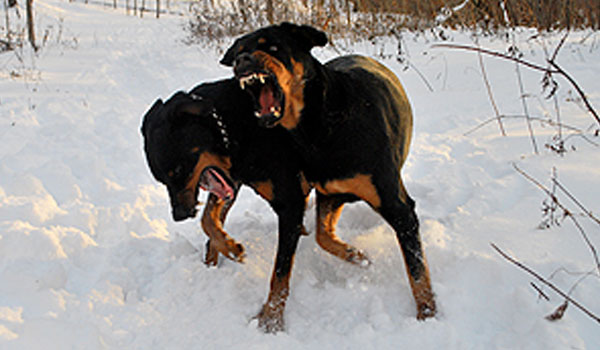
It's important to point out that I am talking about dogs on leash here. I am not talking about using a remote collar on a dog that starts to fight with another dog or even to use high level stimulation when a dog runs up to your dog and they are sniffing, squaring off or staring at one another. A correction at this point will trigger a dog fight. In addition, a correction during a fight will often make the dog fight harder. They think the other dog is the source of the correction.
The moral of the story is to train yourself if you're going to use a remote collar. I have an excellent training DVD on this.
Those who are critical of using painful corrections need to remember
that the vast majority of dogs that are dog fighters or handler aggressive
are destined to be etherized. There are not many options for dogs like
this, but with proper training by a trained handler, many of these dogs
can get a new lease on life.
Although this article is about corrections, I do need to make the point that
in formal obedience, we often follow a correction with praise---but with pack
behavior corrections, the dog is never praised after the correction.
When a dog demonstrates inappropriate pack behavior, he is showing
his disrespect to you as a higher ranking member of the pack.
In the wild, if a lower ranking member of a pack
disrespects and challenges the pack leader, there are going
to be serious consequences - many times, a fight. After the fight, the leader
does not turn around and fawn over the lower pack member. So
don’t
correct a dog for growling, nipping, or fighting and then
turn around and praise the dog.
Timeouts
I had never heard of timeouts until a few years ago. My initial impression was that "timeouts" in crates were not corrections. In fact, I poo-pooed them and made no bones about it. Well, once again I was wrong.
A timeout can be an effective correction for certain issues, but completely inappropriate for others.
When raising puppies that get a little wild and obnoxious, a timeout in the crate until it settles down and becomes quiet can be an effective training tool.
Using timeouts when training soft dogs in drive exercises (like agility) can also be an effective training tool. If a dog is not focused on the task or the work, putting him away in the crate will often be enough to convince him that playing with the owner is more fun than lying in a crate. Usually, covering the crate with a blanket (assuming it's not hot out) enhances the effect.
Using crate timeouts for things like handler aggression, people aggression or dog aggression are not recommended; in fact they are ineffective. These kinds of issues require more serious methods of correction.
I get a lot of emails from misdirected pet owners who tell me about their
dogs growling at them or growling at their kids. These people tell me
how they simply put the dog in its crate and consider this punishment
enough. They all go on to detail the escalating problems they have with these dogs.
Unfortunately, these people are only setting themselves up for more serious
problem. Dogs like this continue to embolden themselves by growling or nipping
and then getting away with it. These dogs need serious corrections, not a dog
crate.
Inappropriate Corrections
While there are many forms of appropriate corrections,
there are also some things that new pet owners should be aware
of.
One of the most common myths is that you should rub your dog's nose
in a mess he leaves on the floor. This is an old wives tale that
has been around for longer than I can remember. Once a dog trainer
understands dog training, they learn that this is a crazy thing
to do. The only thing it accomplishes is to destroy their relationship
with their dog.
Hitting, Beating or Spanking
There is no place in dog training for hitting or spanking
a dog with your hand, a rolled up newspaper, or a fly swatter, etc. Hitting a dog is going to make a dog hand shy, and with some
handler-aggressive dogs, hitting can even trigger an attack.
A comment I need to make in this section is that there
can be times when a dog is doing something inappropriate and
not paying attention to the handler where a tap on the back to redirect
the dog back to the handler is appropriate. This tap is not used
as a correction, it's used to redirect attention - it's kind of
like saying "Hey, knock it off and look at me."
After writing this article I had a webboard member
post the following in a thread on having multiple dogs in one home: "This is very simple for them, behave,
or get beaten." Needless to say, there is no reason to ever beat
a dog. There are always more effective ways to deal with problems.
Inappropriate Information from your Vet
It is sad but true when I say that vets don't know much about dog
training. In my 45 plus years
of studying the art
of dog training, I have only met 3 or 4 vets who knew how to train a dog.
Unfortunately, most new pet owners go
to their vet when they acquire a new dog. They assume vets know about
dog training so they ask questions. Most of the time this
is mistake because they get bad information.

Vets are health care providers, not DOG TRAINERS. I have started a web page that lists emails
from people who have gotten bad advice from their vets.
The End
I wrote this article because I have never seen the theory of corrections
discussed in any book or article.
I hope that this information will help new dog
trainers become better trainers---not because they can force their dogs
to comply, but because
they will now understand how many different kinds of corrections
there are that can be used in dog training. With luck, they will recognize
inappropriate
corrections when they see them.
In closing, if you ever see any portion of this article
copied on another web site, please contact me. My work is copyrighted
and registered, and
I aggressively go after those who choose to take my work without
permission. In EVERY case we will file law suites against those
who do this.
September 18, 2009
Dear Ed:
Thank you very much for your article on Dominant and Aggressive Dogs as Family Pets along with information on Correction Levels.
I have a very handsome 85 lb.-11 month old-White German Shepherd named Thor. Thor is a hard dog, I have spent significant money on training, that in retrospect, was truly for a soft dog and had little effect on Thor. Additionally, in frustration, sometimes I have gone too far in the other direction in trying to over correct, which in turn over stimulated Thor and didn't give him a choice to understand what was expected of him.
Your article clearly and concisely laid out the hierarchy of appropriate corrections for dogs based on their personalities. After using my voice in a normal tone and then escalating to a pronged collar (Leerburg's) leash correction (lifting pop). My very intelligent dog "gets it."
I am no longer yelling or trying to correct him with a death grip.
Further, you description of "Time Outs" and the kind that are appropriate, is also very effective. Thor has learned he cannot enjoy sitting outside Starbuck's with mom if he acts like a beast to other dogs. If he acts up, or tries to be aggressive to other dogs, he gets a leash correction and goes immediately back to the car. If he is a prince and lays at my feet, he earns the privilege of my company and the fun of people coming to see us. He is such a ham; he much prefers being admired to sitting in the car.
It is a treasure to apply your years of experience to the great improvement in our family's enjoyment of our intelligent dog. Your soul is truly in your work AND for all the hands-on work you have done with dogs, YOU ARE ALSO A VERY GOOD WRITER!
Thank You For Your Great Article and Great Collar:
Carol

ASK CINDY YOUR DOG TRAINING QUESTION